Firefighting
Firefighting Drone Types in 2026: Which Aircraft Fits Which Fire?
Firefighting drone types in 2026 by mission: thermal scouts, tethered, wide-area, pod-drop and hose-fed aircraft, with payload, endurance, crew and limits.
- Author
- VEXAFLY Aviation Technology Co., Ltd.
- Scope
- Firefighting
- Published
- Length
- 5 min read · 5 sources
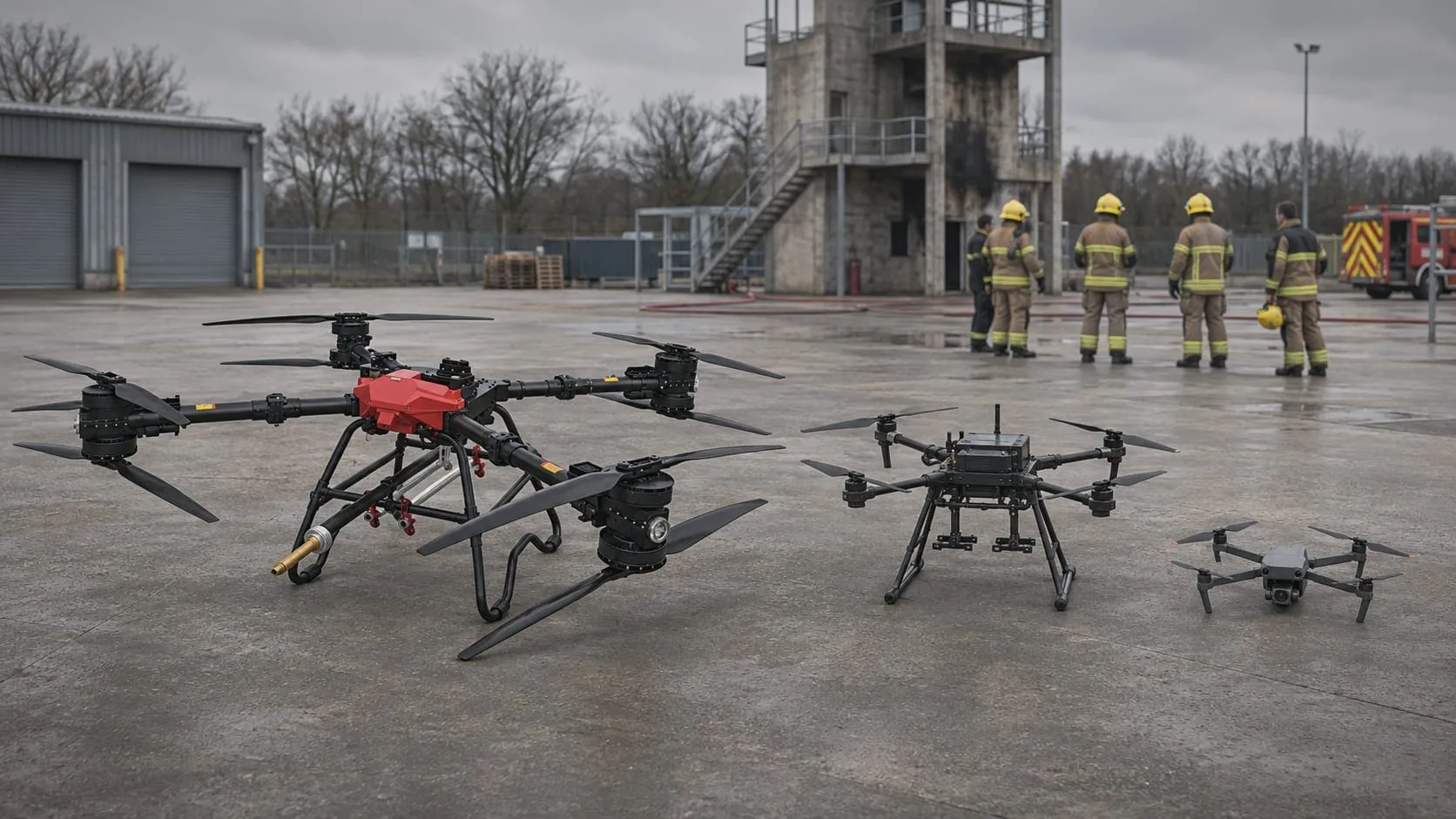
Short answer: in 2026 the most useful way to sort firefighting drone types is by what the aircraft does at the fire: scout, hold a view for hours, map a wide area, drop agent or deliver water through a hose. Small thermal scouts (1–7 kg) fly at almost every call. Agent-carrying aircraft in the 100–350 kg class are a later purchase, once crews and procedures exist.
Which type fits which mission?
| Mission | Aircraft type | Typical payload | Endurance (maker figures) | Typical crew | Where it stops |
|---|---|---|---|---|---|
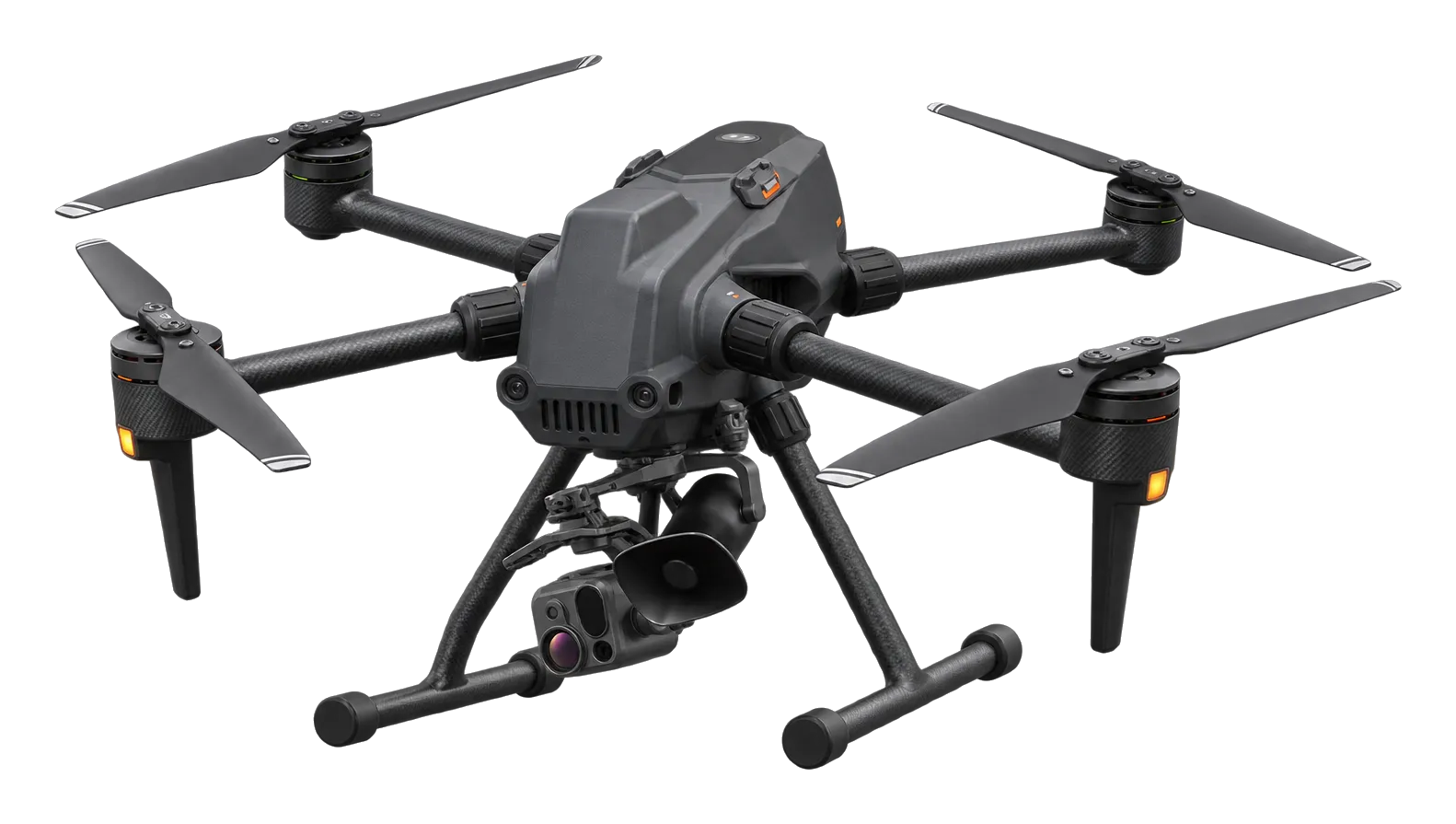
| Size-up, hotspot check | Small thermal multirotor, such as the IS-4X | 2.5 kg camera | up to 60 min | Pilot + observer | Wind above level 6, line of sight |
| Scheduled first look at one site | Docked multirotor, IS-4 in a DS-1 dock | 3 kg camera | up to 63 min per sortie | Remote pilot, nobody on site | Covers only the sites it is docked at |
| Hours of overwatch | Power-tethered observation drone (Fotokite Sigma) | 1.3 kg aircraft | 24+ h, 45 m ceiling | One operator | One spot, low height |
| Wide-area mapping | Fixed-wing VTOL (JOUAV CW-15) | 3 kg | up to 180 min | Pilot + observer | Cruise flight, no close hover at a window |
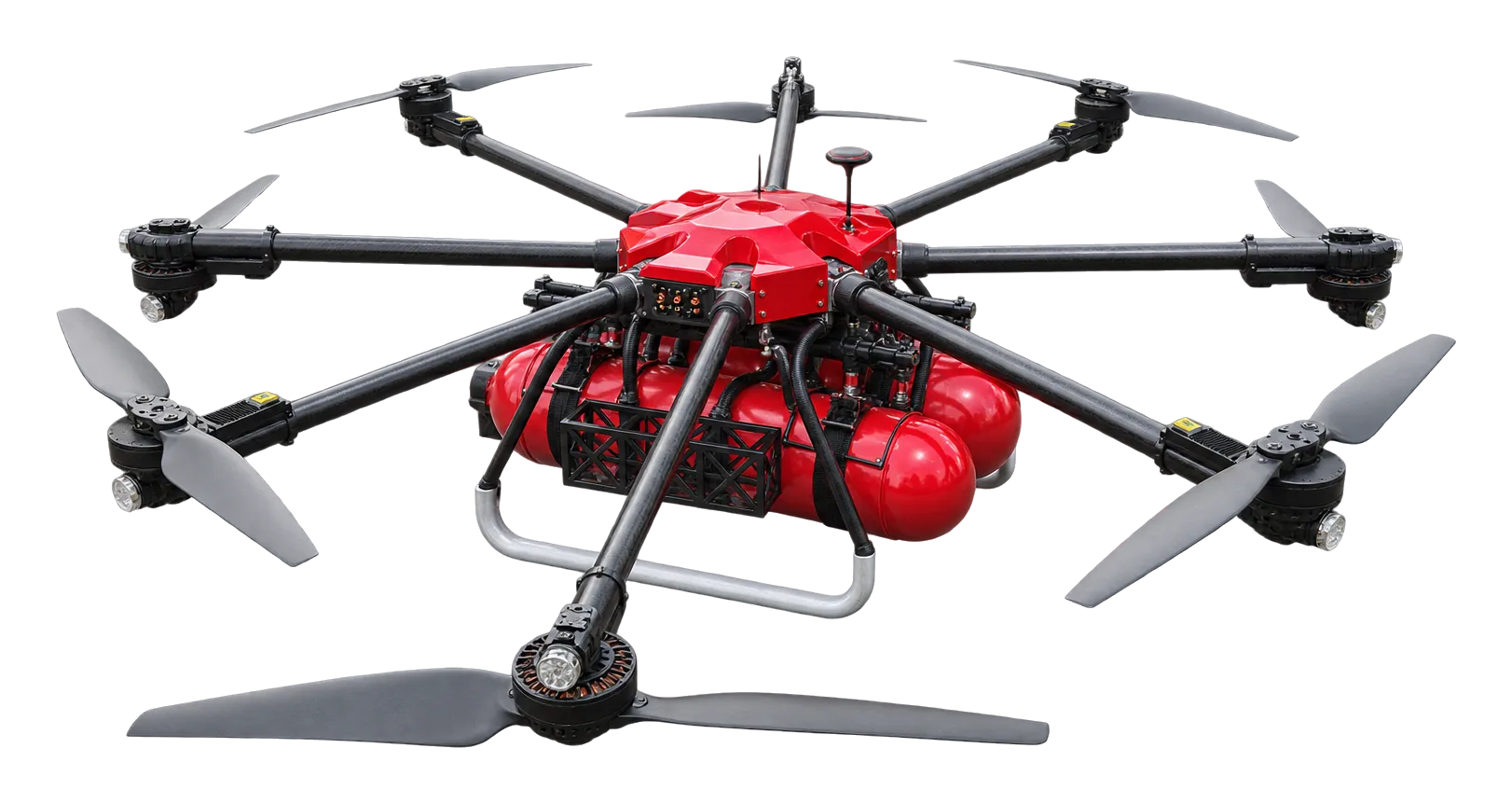
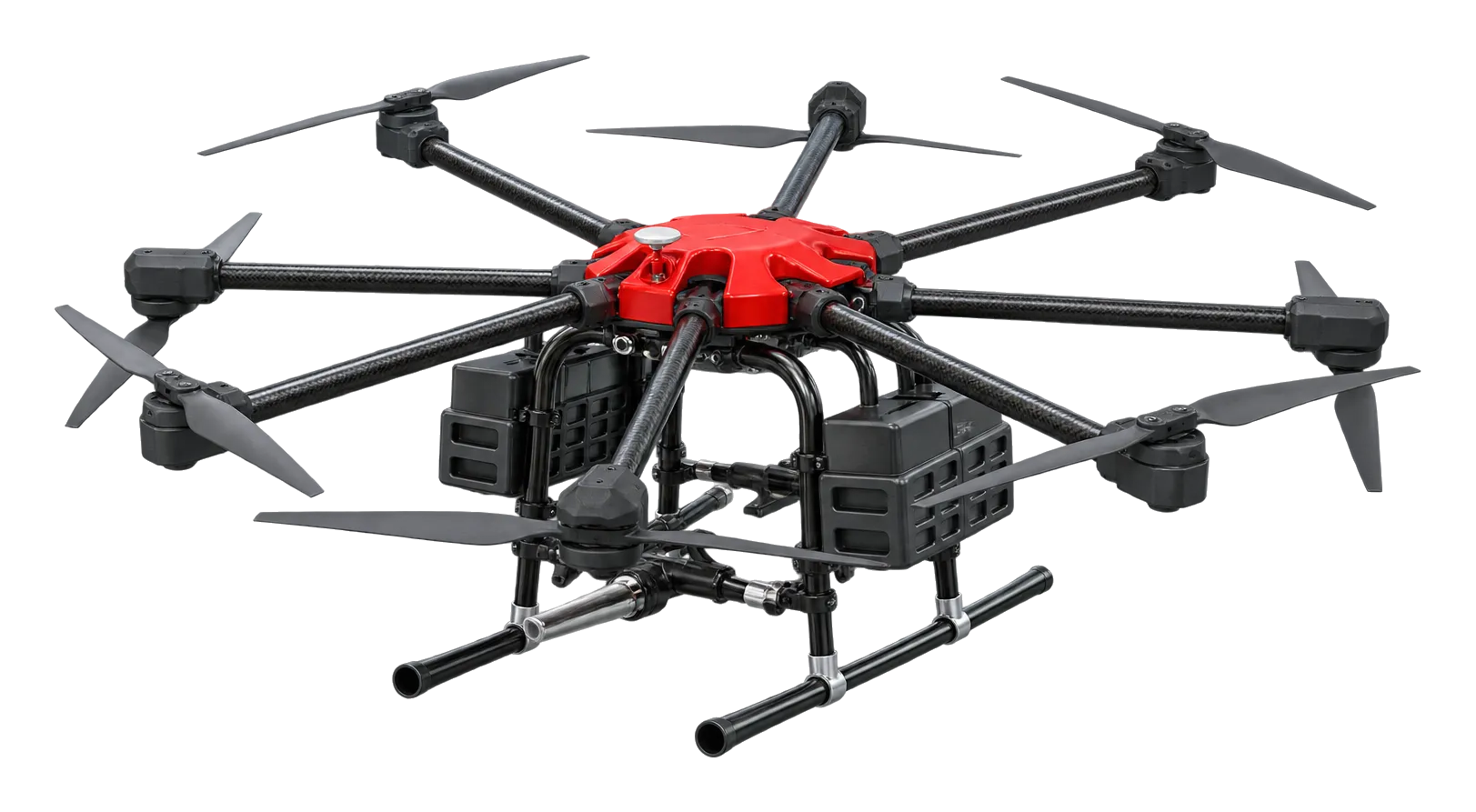
| Drop agent | 100–200 kg multirotor with pods or balls (RX-100, RX-120, RX-200) | 4 × 23 kg pods | 63 min (RX-120), 45 min (RX-200) | Pilot, spotter, payload handler | Indoor fires, wind drift |
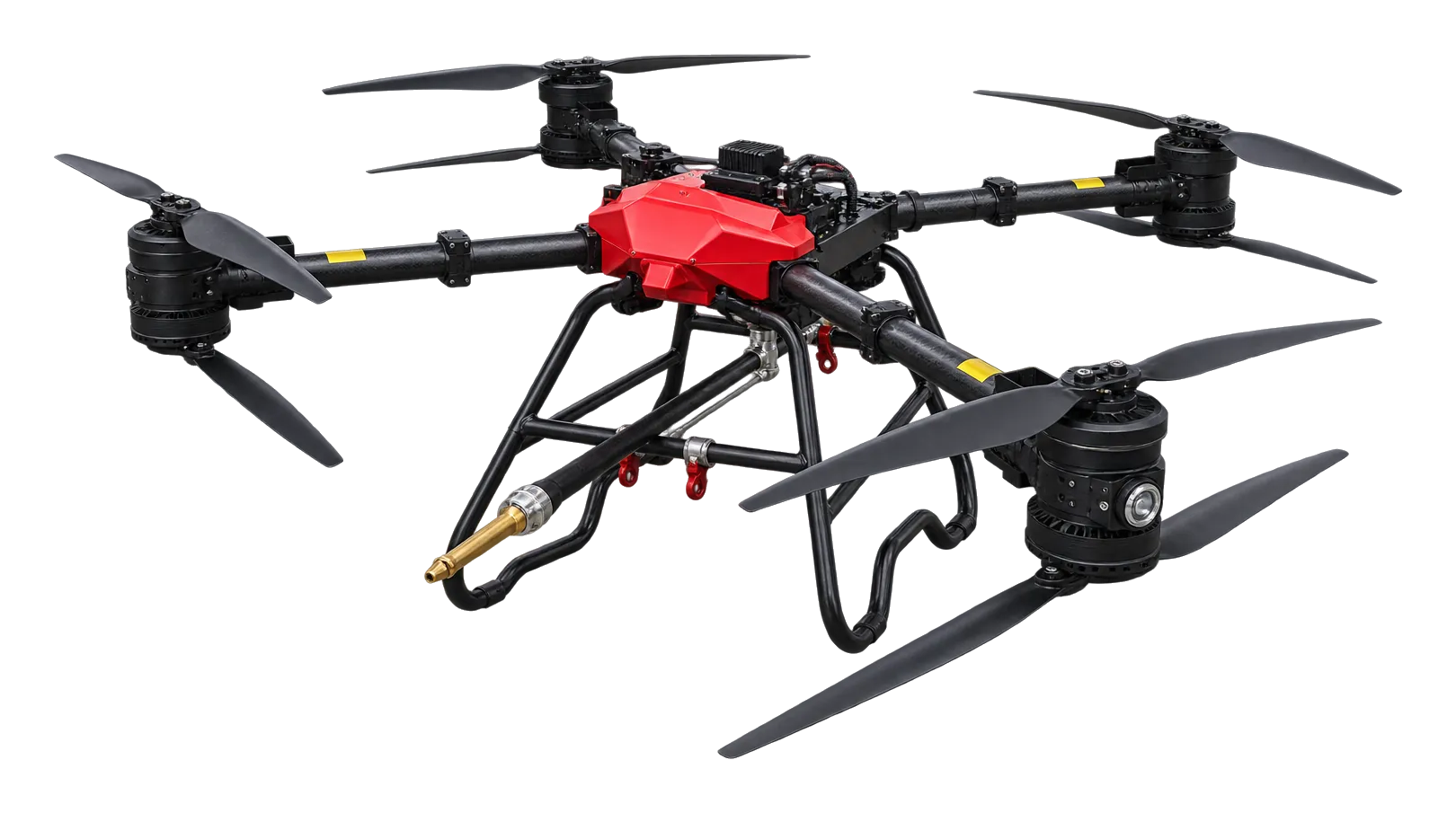
| Water through a hose | Same heavy aircraft + ground pump | Hose Ø 40 or 50 mm | as above | Pilot, pump operator, spotter | Pump pressure, hose weight |
| Vehicle-based system | Truck carrying drones (XCMG AP35G2: two 50 kg drones + one recon drone) | 50 kg class | per maker | Vehicle crew | Needs a road to the scene |
Crew sizes are typical, not rules.
What do scouting and thermal drones do well?
New South Wales parks service describes its fire drones as mostly 1–2 kg, flown by trained firefighters in teams of two. At night, when helicopters cannot fly safely, they run thermal line scans and stitch hundreds or thousands of photos into one map that shows dangerous hotspots. The US Forest Service uses small aircraft to find hotspots inside and outside a perimeter and notes that drones fly in smoke or fog, day or night. See the thermal drone guide.
What do drop drones carry: pods, balls or capsules?
The RX range carries four pods of up to 23 kg each, filled with a water-based agent or ABC dry powder, with a radio proximity fuze that bursts the pod 0–6 m above the target from a 90–150 m drop (brochure values). The RX-100 adds a dispenser for six small balls launched from 5–50 m. Other makers use different delivery: EHang’s 216F carries six dry-powder projectiles and a window breaker, and Fly4Future’s DOFEC launcher fires capsules, up to seven per flight on its large version. Compare methods in the extinguisher drone guide.
How do hose-fed and tethered drones differ?
A power tether keeps a light aircraft up for as long as the cable has current: the Fotokite Sigma lists 24+ hours at 45 m. A hose-fed drone is different: a heavy aircraft carries the nozzle end of a hose while a ground pump does the work. The RX-100 hose mount is Ø 50 mm at 1,900 L/min or more with a 150 m towing height; the RX-120 and RX-200 use a Ø 40 mm hose that sprayed 15 m at 15 bar in the brochure test. See tethered firefighting drones for the arithmetic.
Where does each type stop working?
| Site condition | What the source says | Affects |
|---|---|---|
| Heavy rain | IS-4 is IP45 and not for heavy rain; IS-4X and the RX aircraft are IP67 | IS-4 |
| Cold and heat | RX aircraft work from −20 °C to 60 °C (brochure) | Pod and hose aircraft |
| Altitude and heat | The Forest Service lists small loads at altitude and in heat as a drawback | Heavy aircraft |
| Wind | IS-4 level 7, IS-4X level 6; ask for the heavy aircraft’s limit with load | All |
| Distance | IS-4X range 5 km; RX-120 up to 44.6 km | Scouts, heavy |
Example: how many sorties for a grass-fire edge?
Example only, assumed figures. A 1,200 m² strip of grass fire sits out of crew reach. An RX-120 pod covers at least 50 m² (brochure minimum), so one sortie of four pods covers at least 200 m². That is 1,200 ÷ 200 = 6 sorties. If each sortie with a reload takes 12 minutes, the job takes about 72 minutes, so a scout drone must follow the fire edge between drops.
Which type should a fire service buy first?
Start with a thermal scout, add a dock if you protect fixed sites, then a heavy aircraft once pilots log regular hours. US fire services have extra homework before ordering any foreign-built aircraft: its FCC Covered List status, the Section 232 duty and, at 55 lb or more, FAA approval. Your customs broker and the FAA can confirm each point. Our guides on importing industrial drones from China and FCC certification explain each step.
- Best for night perimeter mapping: a 1–2 kg thermal scout, as used by NSW parks crews.
- Best for remote spot fires: RX-100, a 52 kg airframe with an operating height up to 1,000 m.
- Best for long-range drops: RX-120, up to 63 min and 44.6 km in the brochure.
- Best for heavy hose work: RX-200, 150 kg rated, 200 kg maximum load.
- Best for persistent overwatch: a power-tethered observation drone, 24+ h at 45 m.
Next step
Send us the scenes you cover: building heights, terrain, agents and pump pressure. We reply with the matching aircraft from the fire-response range. For high-rise work specifically, read our high-rise firefighting guide first.
Q & A
Common questions
01How are drones used in firefighting?
Mostly to look: thermal size-up, hotspot checks after the fire, night perimeter mapping and search. Heavier aircraft drop extinguishing agent or lift a hose nozzle to a facade. Each task needs a different aircraft and crew.
02Can a drone actually put out a fire?
On a small or contained fire, yes. A pod covers about 50 m² in the RX-120 brochure and a hose nozzle sprays about 15 m. A large structure or wildfire front is still fought by crews, trucks and crewed aircraft; drones add reach and information.
03What is a tethered firefighting drone?
Two different things share the name: a drone on a power cable that stays up for hours to watch, and a drone that carries a hose nozzle with water pumped from the ground. They solve different problems.
04Which type should a fire service buy first?
A thermal scout. It is cheap to train, useful at every call and teaches the crew the procedures a heavy aircraft needs later.
05How many people does each type need?
Small drone teams are often two people, a pilot and an observer. Pod and hose aircraft need a pilot, a spotter and a payload or pump operator. Your procedures set the final numbers.
References
- 1Drones help make fighting fires safer, cheaper, better throughout Rocky Mountain Region — USDA Forest Service
- 2Eyes in the sky: Firefighting by drone — NSW National Parks and Wildlife Service
- 3EHang 216F firefighting model — EHang
- 4Fotokite Sigma actively tethered drone — Fotokite
- 5CW-15 multi-purpose and long endurance VTOL drone — JOUAV
VEXAFLY Aviation Technology Co., Ltd.. VEXAFLY Aviation Technology Co., Ltd. — industrial drone maker in Nanjing. Our application engineers write and check these pages and configure inspection, cleaning, lift and fire-response systems for project buyers. About VEXAFLY