Firefighting
Tethered Firefighting Drones in 2026: Power Cable, Water Hose or Both?
Tethered firefighting drones in 2026: power-tether observation, hose-fed suppression and battery aircraft on a ground hose, with hose weight and pump pressure.
- Author
- VEXAFLY Aviation Technology Co., Ltd.
- Scope
- Firefighting
- Published
- Length
- 5 min read · 5 sources
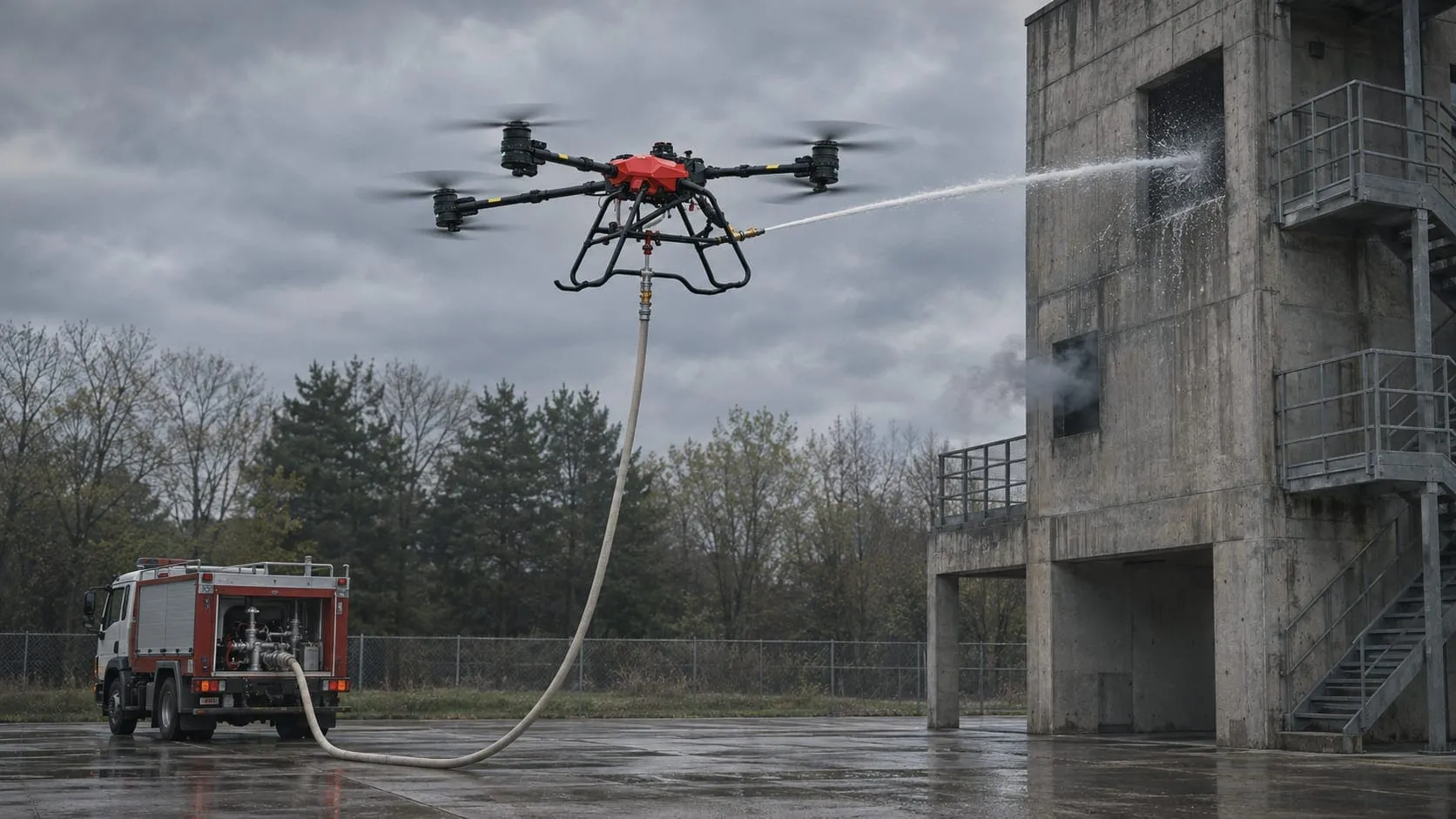
Short answer: in 2026 a tethered firefighting drone is one of three things: a light aircraft on a power cable for hours of overwatch, a heavy aircraft on a power cable and a water hose, or a battery aircraft that carries a hose fed by a ground pump. The limits are hose weight, pump pressure and wind, not only the aircraft.
Which “tethered” do you mean?
| Type | Example | Height / endurance | Water | What the ground must provide |
|---|---|---|---|---|
| Power tether, observation | Fotokite Sigma | 45 m max, 24+ h, 1.3 kg aircraft | None | Vehicle or mains power |
| Power tether + hose | Foxtech T-FC100X on a heavy-lift aircraft; GRUMMAN tethered vehicle system | 100 m tether, 6+ h; vehicle system listed above 150 m | From the fire truck | A 37.5–40 kW generator or grid supply (Foxtech); the vehicle (GRUMMAN) |
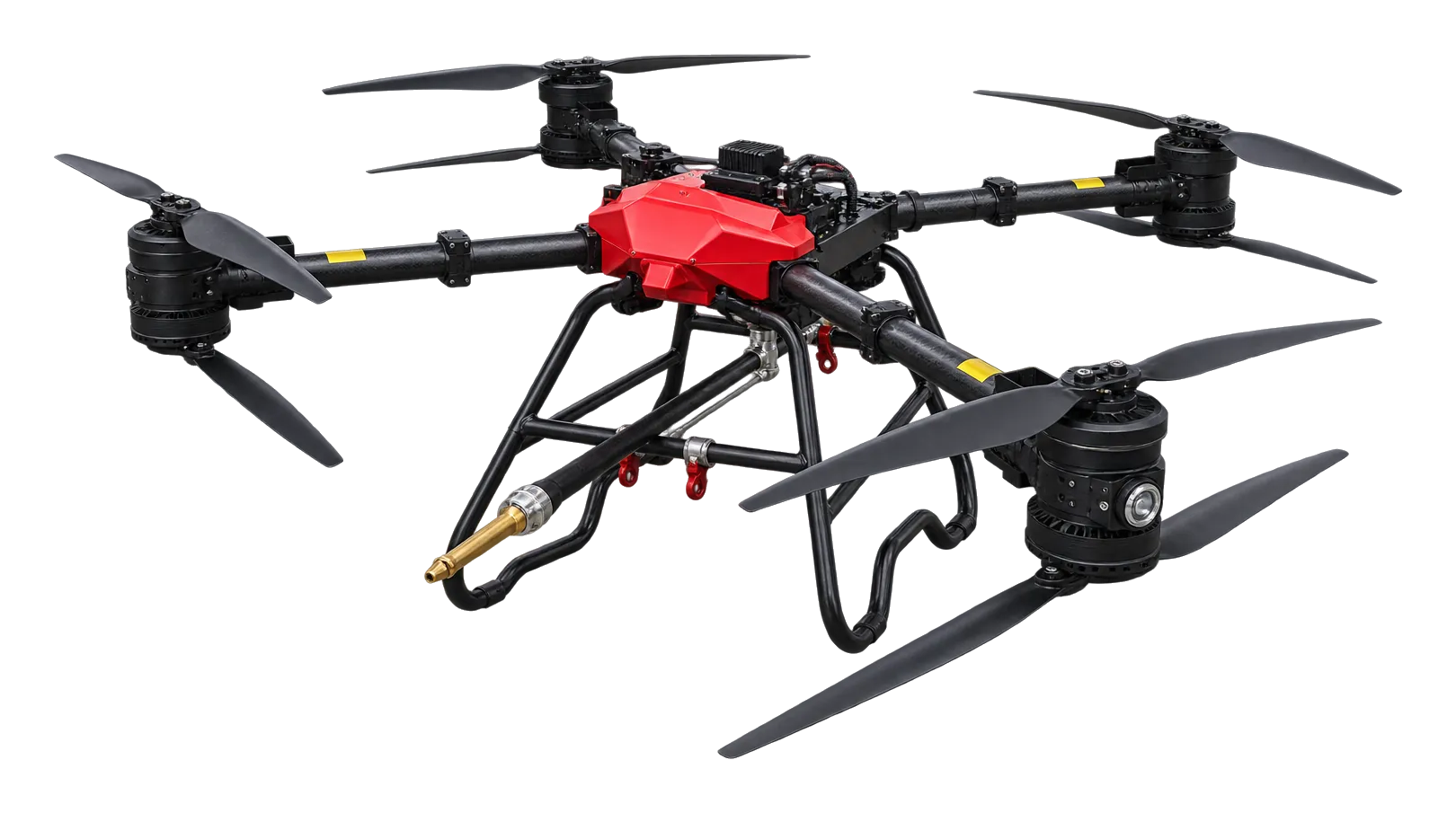
| Battery aircraft + ground hose | RX-200, RX-100 | RX-200 up to 45 min; RX-100 hose mount 150 m towing height | Pump and hose, Ø 40 mm or 50 mm | Pump, hydrant or tank, hose route |
Elistair, a tether maker, draws the same line: tethered drones monitor one area; free-flying drones travel and act.
How long can a tethered drone stay up?
A power tether takes the battery out of the equation. Fotokite lists 24+ hours on vehicle power, and the Foxtech kit lists 6+ hours with a 10-minute deployment and an 85 kg payload limit. A battery aircraft with a ground hose is different: the RX-200 flies up to 45 minutes in the brochure, but water supply never runs out while the pump runs.
How much does a full hose weigh under the drone?
Water in a hose weighs π × r² × 1,000 kg per metre. The hose’s own weight, from its data sheet, comes on top.
| Hose | Water per metre | 10 m hanging | 30 m hanging | 50 m hanging |
|---|---|---|---|---|
| Ø 40 mm (RX-120, RX-200 hose) | 1.26 kg | 12.6 kg | 37.7 kg | 62.8 kg |
| Ø 50 mm (RX-100 mount) | 1.96 kg | 19.6 kg | 58.9 kg | 98.2 kg |
Example only, assumed figures. A Ø 40 mm hose hangs 30 m below the aircraft before it rests on a balcony: 30 × 1.26 = 37.7 kg of water. With the Ø 50 mm hose, 30 × 1.96 = 58.9 kg. The RX-200 is rated at 150 kg, so it has margin; the RX-120’s 120 kg maximum load is tighter; the RX-100’s 100 kg payload leaves little room beyond 50 m of free-hanging 50 mm hose (98.2 kg). The nozzle’s reaction force and the hose’s own weight also load the aircraft; ask for these figures with the hose fitted.
How much pump pressure do you need at height?
Every metre of lift costs about ρ × g × h ≈ 0.098 bar per metre.
| Nozzle height | Pressure lost to lift | Pump pressure to keep 15 bar at the nozzle |
|---|---|---|
| 20 m | 2.0 bar | 17.0 bar plus friction |
| 40 m | 3.9 bar | 18.9 bar plus friction |
| 60 m | 5.9 bar | 20.9 bar plus friction |
| 100 m | 9.8 bar | 24.8 bar plus friction |
The RX-120 and RX-200 brochure tests sprayed about 15 m at 15 bar, with up to 100 m of pipe tested. Friction loss depends on hose length, diameter and flow; take it from the hose maker’s tables.
Where do hose-fed drones stop working?
At the first of these: wind that drags the hose sideways, a hose route that snags on balconies or trees, a pump that cannot hold pressure at height, and an aircraft load margin used up by water. Test at your tallest building before you promise a height.
Hose or pods: which for which scene?
| Scene | Better choice | Why |
|---|---|---|
| Facade or upper floor, hydrant near | Hose | Continuous water, about 15 m throw |
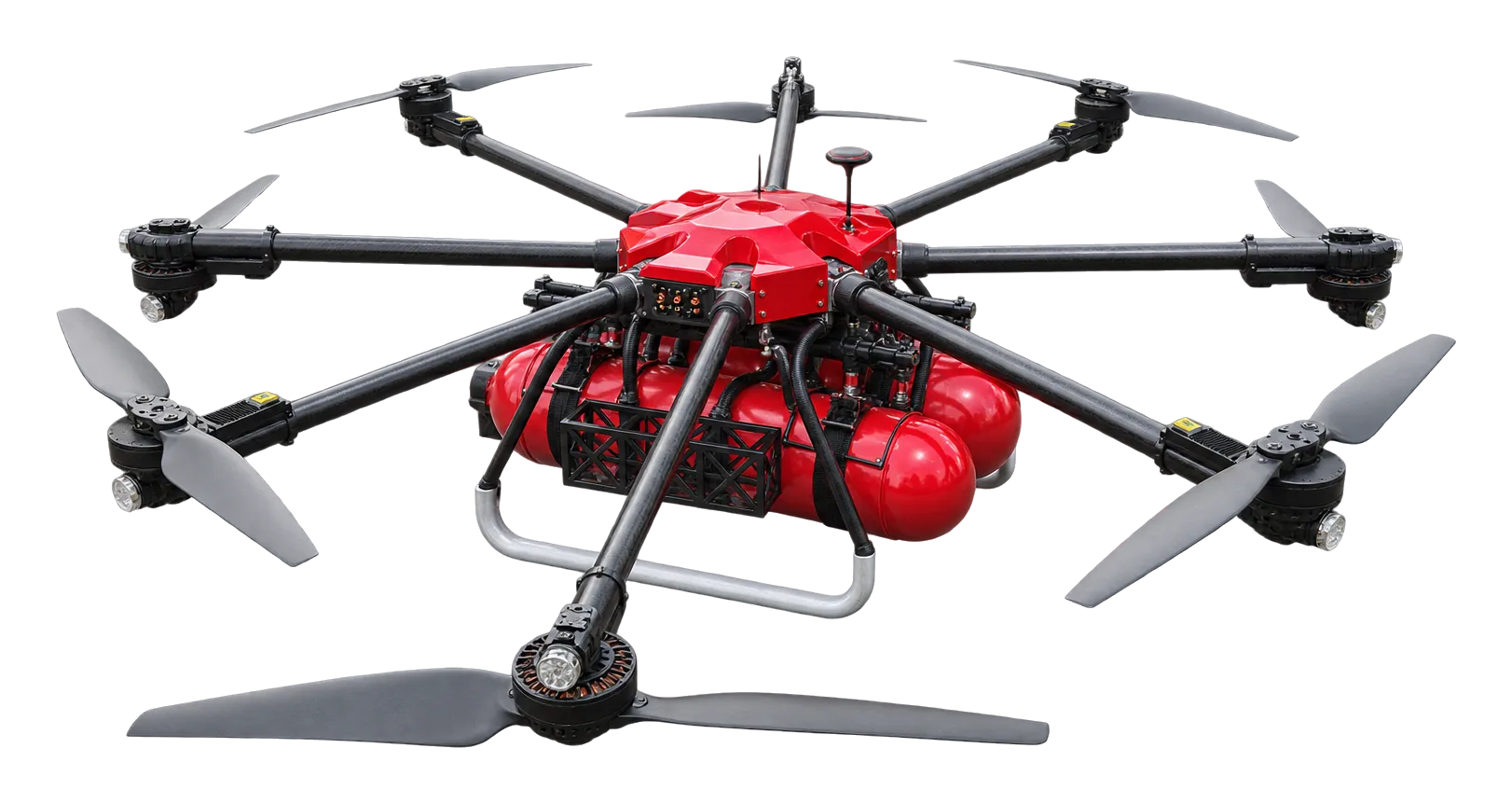
| Roof fire, no road access | Pods | Dropped from 90–150 m, no hose to lay |
| Storage tank cooling with a foam truck | Hose (RX-100 mount works with a compressed-air foam truck) | Truck supplies the flow |
| Remote spot fire | Pods | No supply line |
See fire extinguisher drones for pod specifications, and firefighting drones for high-rise buildings for the tower case. A comparison with ladders is in drone vs aerial ladder truck.
Do you need a licence or permission?
A tether does not change the aircraft’s category. In the US, public agencies flying under 55 lb choose Part 107 or a public-aircraft route with a Certificate of Waiver or Authorization (COA); our RX aircraft are far heavier, so check large-aircraft approval with the FAA. The Fotokite maker states that its aircraft is exempt from Part 107 and COA in the US; that is the maker’s statement, not ours. Elsewhere, ask your aviation authority. In the US, also check the FCC Covered List status and the Section 232 duty before ordering a foreign-built drone, and confirm with your customs broker.
- Best for hours of overwatch: a power-tethered observation drone, 24+ h at 45 m.
- Best for facade water at height with a battery aircraft: RX-200, 150 kg rated.
- Best for highest hose flow: RX-100 mount, 1,900 L/min or more, Ø 50 mm.
- Best where there is no water supply: pods, not a hose.
What to send us
Send the tallest nozzle height you need, your pump pressure at the truck, hose diameter and length, and the nearest hydrant or tank. We reply with the aircraft, hose kit and a margin check. Start from the RX-200 page, or use the contact form.
Q & A
Common questions
01How long can a tethered drone fly?
With a power tether, as long as the generator or vehicle supplies current: 24+ hours for a light observation drone and 6+ hours for a heavy-lift tether system in published maker figures. A battery drone with a ground hose, such as the RX-200, flies up to 45 minutes.
02What are the disadvantages of a tethered drone?
It cannot travel: the cable or hose limits its range and height, wind pulls on the line and the ground unit must be set up first. A power tether on a heavy aircraft also needs a generator of 37.5–40 kW in one published kit.
03Do you need a licence for a tethered drone?
Usually yes, because a tether does not change the aircraft's weight class or the airspace. In the US, agencies under 55 lb use Part 107 or a public-aircraft route; heavier aircraft need other approval. Elsewhere follow your aviation authority.
04Who makes drones that spray water from a ground hose?
Several firms: heavy-lift conversions with a hose module, vehicle-based tethered systems and our RX range. Compare hose diameter, flow, the nozzle's tested spray distance and the pump pressure each figure assumes.
05How high can a hose-fed drone lift a hose?
The RX-100 mount lists a 150 m towing height. Practical limits come from pump pressure, the hose's weight and wind; test at your own height with your own hose.
References
- 1T-FC100X Tethered Firefighting Drone Power & Water System for DJI FlyCart 100 — Foxtech
- 2Actively Tethered Drones for Emergency Response — Fotokite
- 3Firefighting drone: putting technology into action — Elistair
- 4Shanghai GRUMMAN Showcases Full Suite of Firefighting Innovations at China International Fire Expo — PR Newswire
- 5Operate a Drone, Start a Drone Program — Federal Aviation Administration
VEXAFLY Aviation Technology Co., Ltd.. VEXAFLY Aviation Technology Co., Ltd. — industrial drone maker in Nanjing. Our application engineers write and check these pages and configure inspection, cleaning, lift and fire-response systems for project buyers. About VEXAFLY