Firefighting
Fire Extinguisher Drones in 2026: Pods, Balls, Capsules and Hose Compared
Fire extinguisher drones in 2026 by delivery method: burst pods, powder balls, capsules, projectiles and tank spray, with agents, coverage and safety zones.
- Author
- VEXAFLY Aviation Technology Co., Ltd.
- Scope
- Firefighting
- Published
- Length
- 4 min read · 5 sources
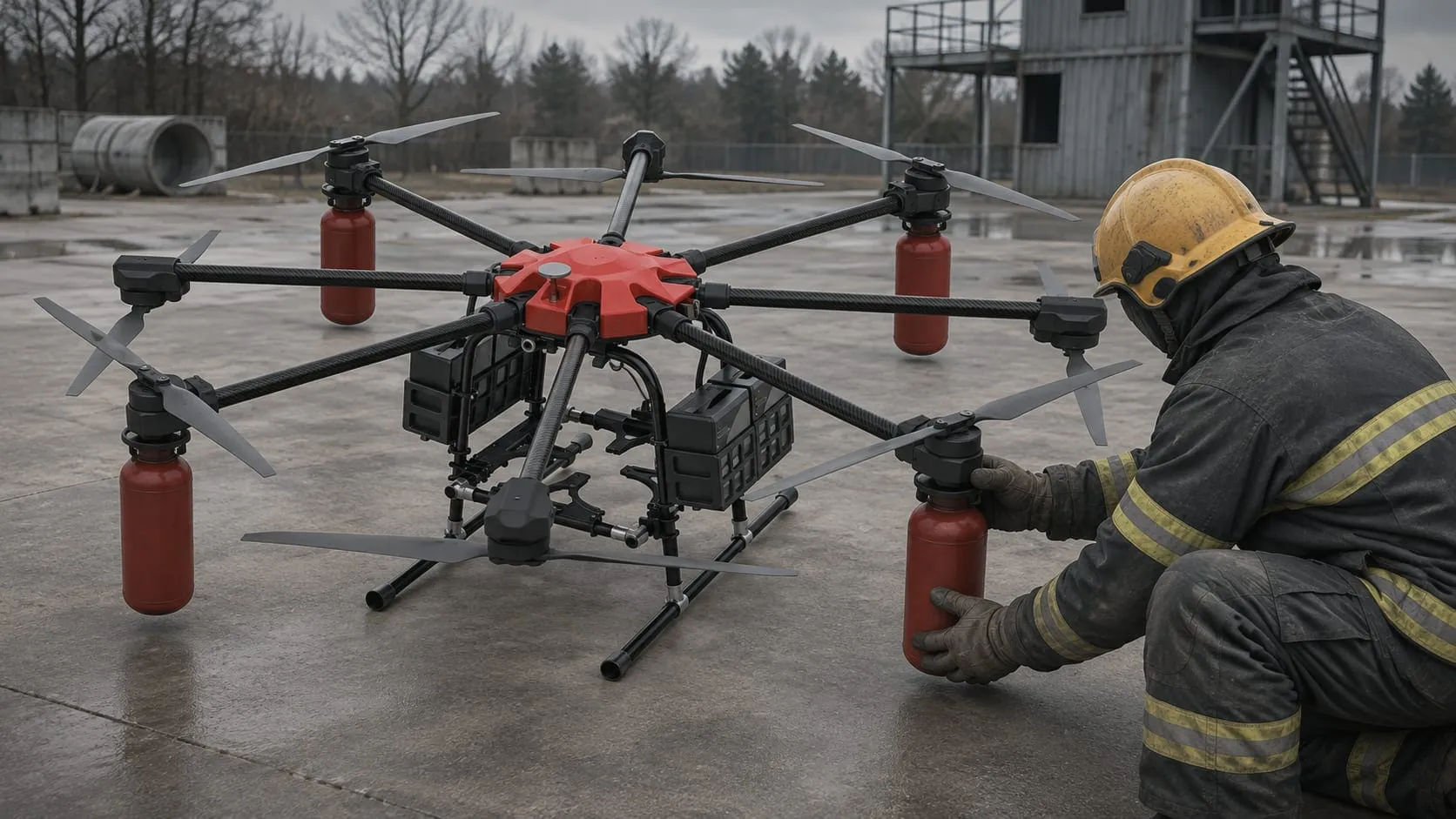
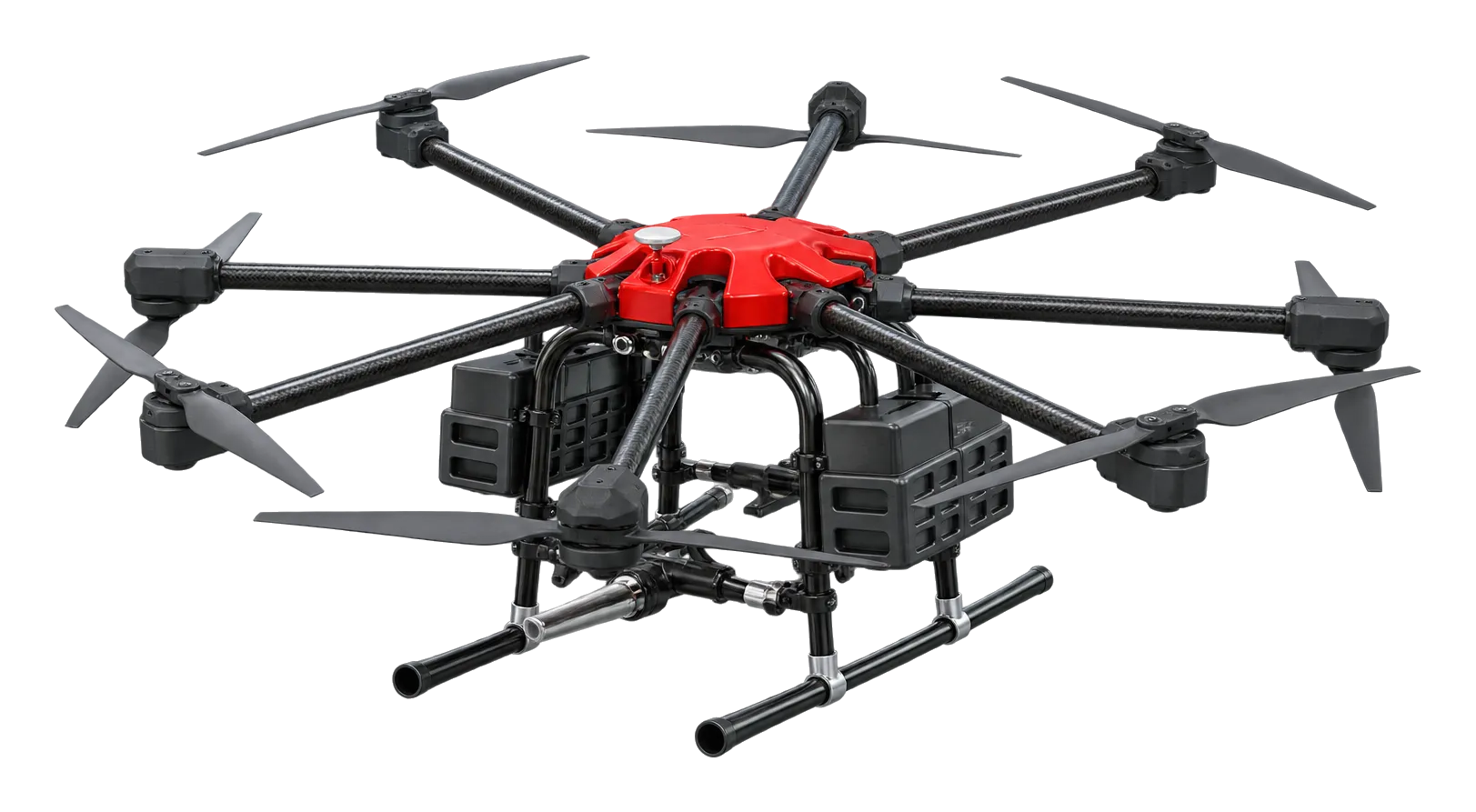
Short answer: a fire extinguisher drone delivers agent by burst pod, small ball, launched capsule, projectile or tank spray. In the RX range, four pods of up to 23 kg each burst above the fire and cover at least 50 m² per pod with a safety radius of at least 20 m. They work on roofs, terrain and small fires seen from outside, not on fires inside rooms.
Which delivery method fits which fire?
| Method | Example and agent | Release | Coverage | Best scene | Limit |
|---|---|---|---|---|---|
| Burst pods, heavy | RX-120 and RX-200: 4 pods, water-based or ABC powder, at least 20 kg net each | Radio proximity fuze, burst 0–6 m above target, drop 90–150 m | At least 50 m² per pod, safety radius at least 20 m | Roofs, terrain | Wind drift, no room fires |
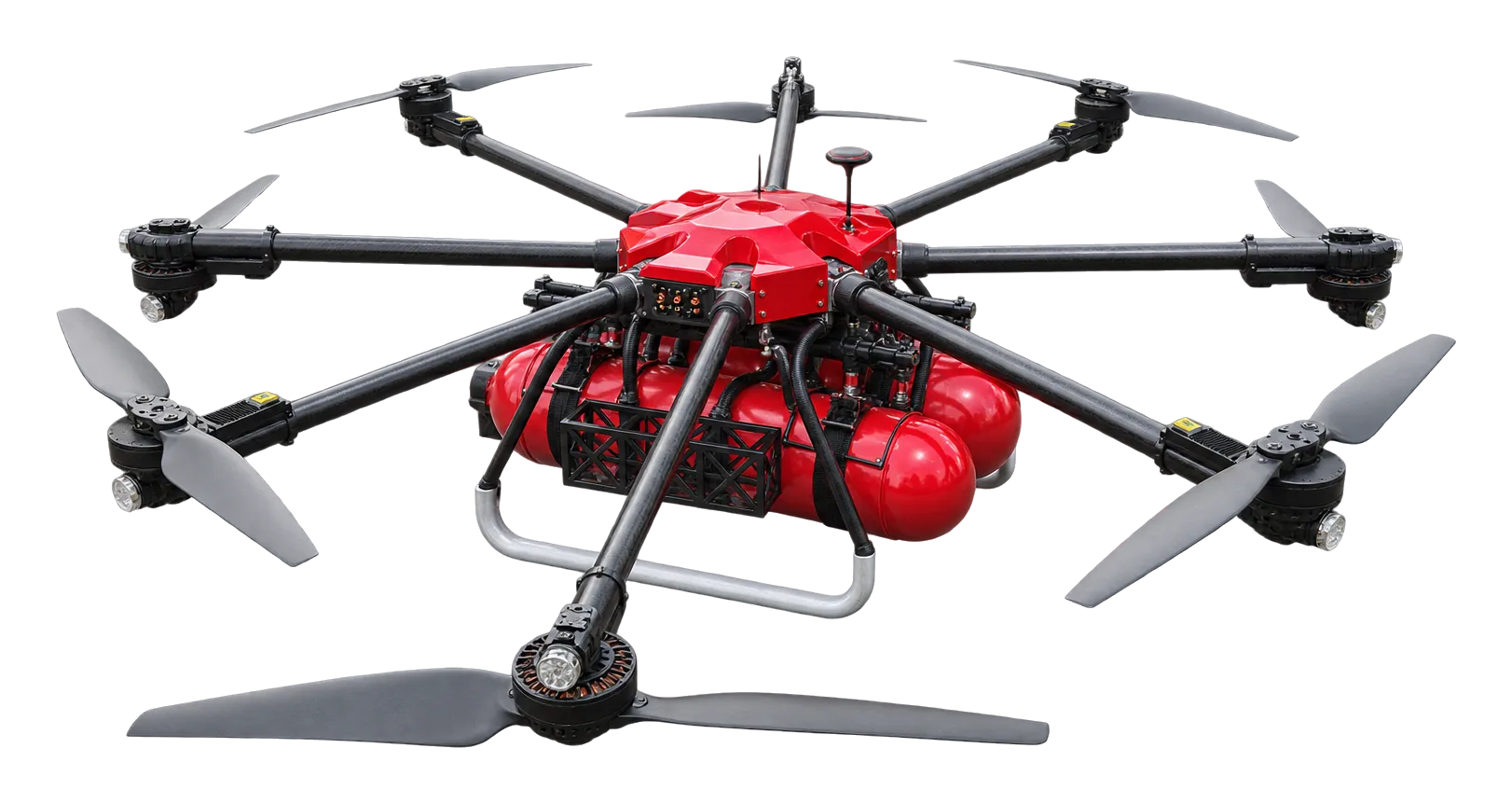
| Burst pod, lighter | RX-100: 25 L water-based pod | Vertical drop, 2 × 2 m accuracy | 200–300 m², at least 15 m spray radius | Spot fires, grass | One agent type |
| Dry-powder balls | RX-100 dispenser: 6 balls | Single or double shot, launched from 5–50 m | Small | Electrical cabinets, windows seen from outside | Small fires only |
| Projectiles + window breaker | EHang 216F: 6 ABC powder projectiles, laser aiming | Fired at the target | Per maker | High-rise windows | Serves buildings within 3 km of its station |
| Capsule launcher | Fly4Future DOFEC: one capsule on the small drone, seven on the large one | Launcher | Per maker | Fires reachable from outside | One capsule at a time |
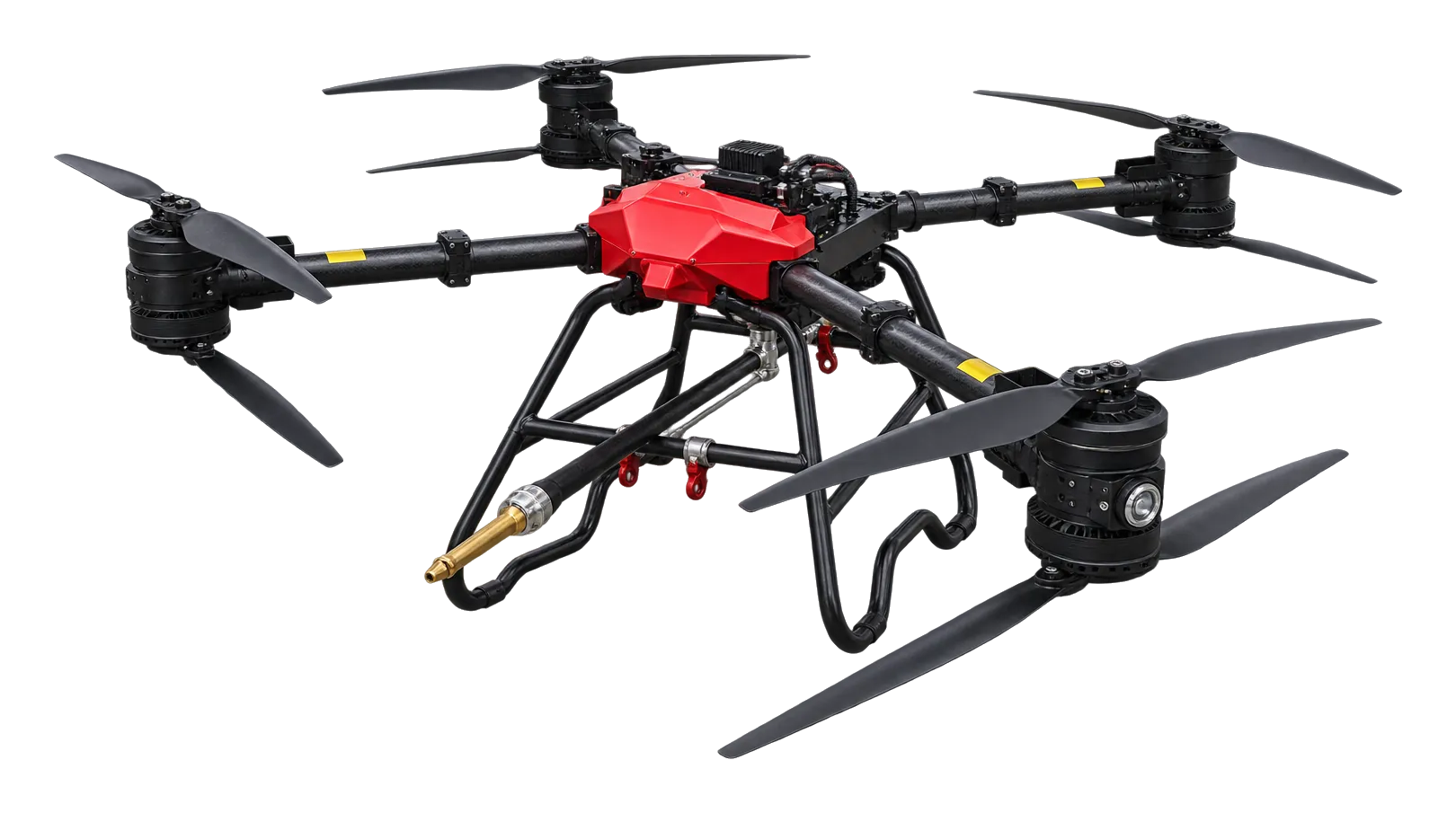
| Tank spray | Dryad Silvaguard: 100 L liquid suppressant; Walkera WK-1800: powder module 5 kg net, 1.2 MPa, 4.33 m spray tube | Spray | Small | Small wildfires; short-reach spraying | Small loads |
How does a burst pod work?
The aircraft flies over the fire, drops the pod and the proximity fuze fires it a few metres above the target so the agent spreads instead of hitting the ground in one spot. In the RX-120 and RX-200 brochures, the drop height is 90–150 m, the fuze range is 0–6 m, and the RX-200 pods carry dual-safety fuzes. The RX-100 pod holds 25 L, spreads at least 15 m and is released vertically with a 2 × 2 m accuracy.
Water-based agent, ABC powder or foam?
| Agent | Where it is offered | Typical use | Check |
|---|---|---|---|
| Water-based extinguishing agent | RX-100, RX-120, RX-200 pods | Vegetation, roofs, ordinary combustibles | Run-off, freezing |
| ABC dry powder | RX-120, RX-200 pods; EHang projectiles; Walkera module | Small fires where water is a poor choice | Residue, drift in wind |
| Foam | EHang 216F: 100 L through a high-pressure nozzle | Larger area at height | Supply and nozzle limits |
Your fire authority decides which agents are allowed and how a drop is approved.
What can balls, capsules and projectiles do?
Small ball and capsule systems suit fires that can be reached from outside a building, such as an electrical cabinet, a balcony or a window. They carry little agent, so a scout must tell you whether the fire is really out. Heavy pods carry more agent but cannot choose a window.
Example: how big is the safety zone?
Example only, assumed figures. A 180 m² flat roof is on fire. Each RX-120 pod covers at least 50 m², so 180 ÷ 50 = 3.6, which rounds up to 4 pods: one full sortie with at least 4 × 20 = 80 kg of agent. Around each burst the safety radius is at least 20 m, a cleared circle of π × 20² ≈ 1,257 m² per drop point. Crews must be outside that circle before the drop.
Where do extinguisher drones stop working?
Indoor fires, fires under a roof or dense canopy, strong wind that carries the agent off target, smoke that hides the drop point from the camera, and agents the fire authority has not approved. Pods also cannot judge whether the fire is out; a thermal scout does that.
What are the rules at an incident?
In the US the FAA issues temporary flight restrictions for wildfires and other disasters, and public agencies can use its emergency approval process. Elsewhere, ask your aviation authority. Buying for a US station? Before you order a foreign-built drone, check its FCC Covered List status, the Section 232 duty and, for aircraft of 55 lb or more, FAA approval, and confirm each with your customs broker and the FAA.
- Best for roofs and terrain: RX-120 or RX-200 pods, at least 50 m² each.
- Best for small electrical or window fires: RX-100 ball dispenser, 6 balls from 5–50 m.
- Best for wide water cover per pod: RX-100 25 L pod, 200–300 m².
- Best for the heaviest single sortie: RX-200, 200 kg maximum load.
What to send us
List the fires you want to reach: roofs, terrain, vessels, fuel yards. Add agents your authority allows and your distance from the scene. We propose a pod, ball or hose configuration. See the fire-response range, firefighting drone types, industrial firefighting drones and firefighting drone price.
Q & A
Common questions
01Do firefighting drones that drop extinguisher agent exist?
Yes. Fire services and makers have tested pods, balls, capsules and projectiles on drones. Our RX range carries four 23 kg pods or a ball dispenser, with figures from the maker's brochure.
02How does an extinguishing pod work?
A pod holding about 20 kg of agent is dropped from 90–150 m. A radio proximity fuze bursts it 0–6 m above the target and spreads agent over at least 50 m² in the RX-120 brochure.
03Water-based agent or dry powder?
Both are offered in the RX pods. Water-based agent suits vegetation and ordinary combustibles; ABC dry powder suits fires where water is a poor choice. Your fire authority decides which is allowed.
04Can a drone break a window and put out a room fire?
One maker's unmanned aircraft pairs a window breaker with dry-powder projectiles for high-rise windows. Pods and balls from our range are not designed for that; they work on roofs, terrain and fires seen from outside.
05How far must crews stand from a pod drop?
At least 20 m from the burst point in the RX-120 and RX-200 brochures. Keep people, vehicles and other aircraft outside that circle.
06Why is it illegal to fly a drone over a fire?
Your drone can force crewed firefighting aircraft to stay on the ground. In the US, a temporary flight restriction normally covers wildfires, and other countries have similar rules. Only fly with the incident commander's approval.
07What does a fire extinguisher drone cost?
The pods come with a 100–200 kg aircraft, so you pay for the aircraft: reference FOB China US$63,400–83,600 for the RX-120 and RX-200 and US$79,400–83,600 for the RX-100. Freight, training and duties are extra; our price guide lists the lines.
References
- 1DOFEC – the Fire Fighting Drone — Fly4Future
- 2Autonomous Fire Suppression (Silvaguard) — Dryad Networks
- 3EHang 216F firefighting model — EHang
- 4WK-1800 firefighting drone (Chinese) — Walkera
- 5Temporary Flight Restrictions (TFRs) — Federal Aviation Administration
VEXAFLY Aviation Technology Co., Ltd.. VEXAFLY Aviation Technology Co., Ltd. — industrial drone maker in Nanjing. Our application engineers write and check these pages and configure inspection, cleaning, lift and fire-response systems for project buyers. About VEXAFLY