Cleaning
Tethered vs Tank Cleaning Drones in 2026: Power, Water and Job Fit
Tethered cleaning drone or on-board tank? In 2026, compare battery plus tank, battery plus hose and tether plus hose by job: facade, roof, solar, insulators.
- Author
- VEXAFLY Aviation Technology Co., Ltd.
- Scope
- Cleaning
- Published
- Length
- 4 min read · 5 sources
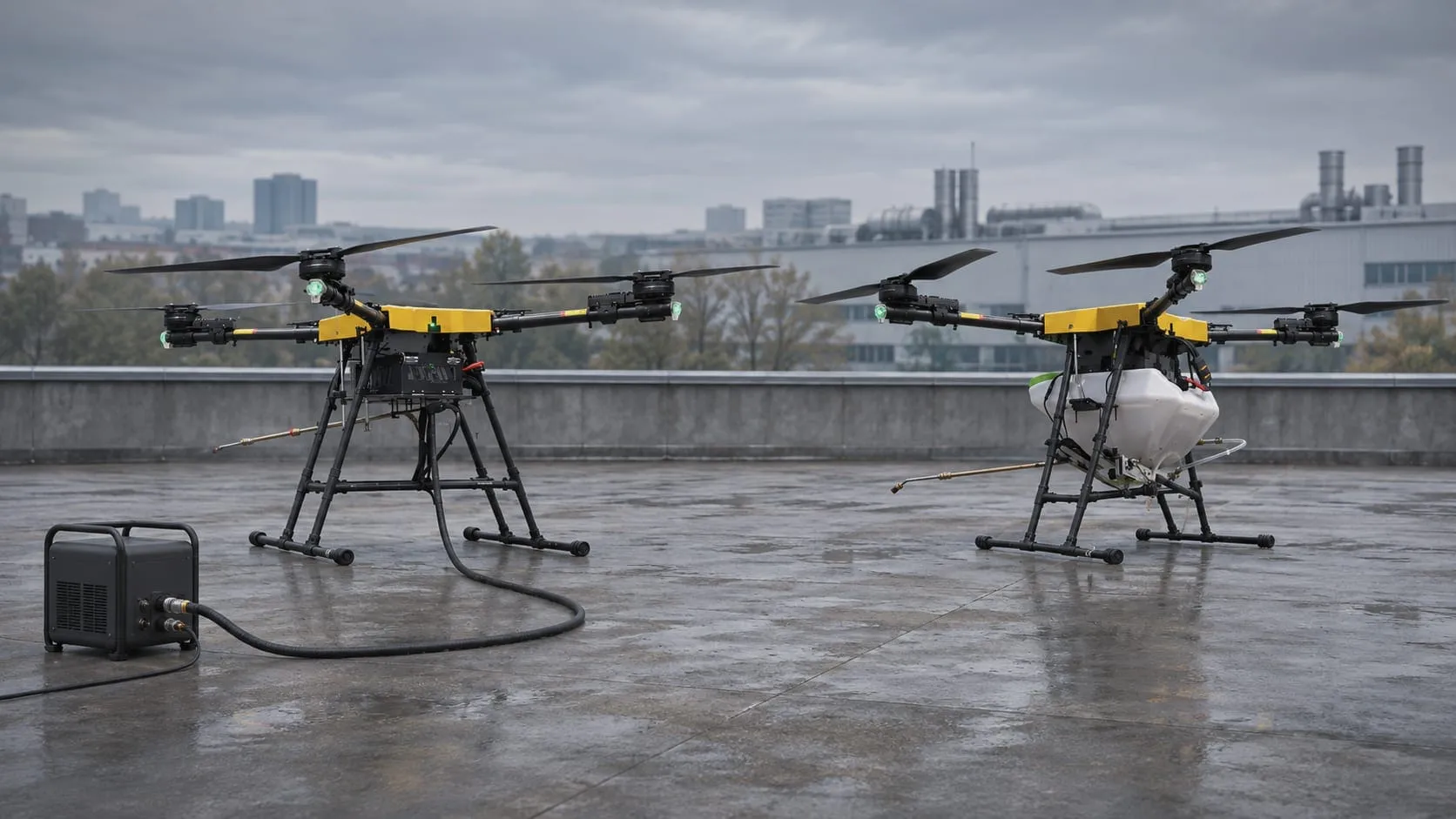
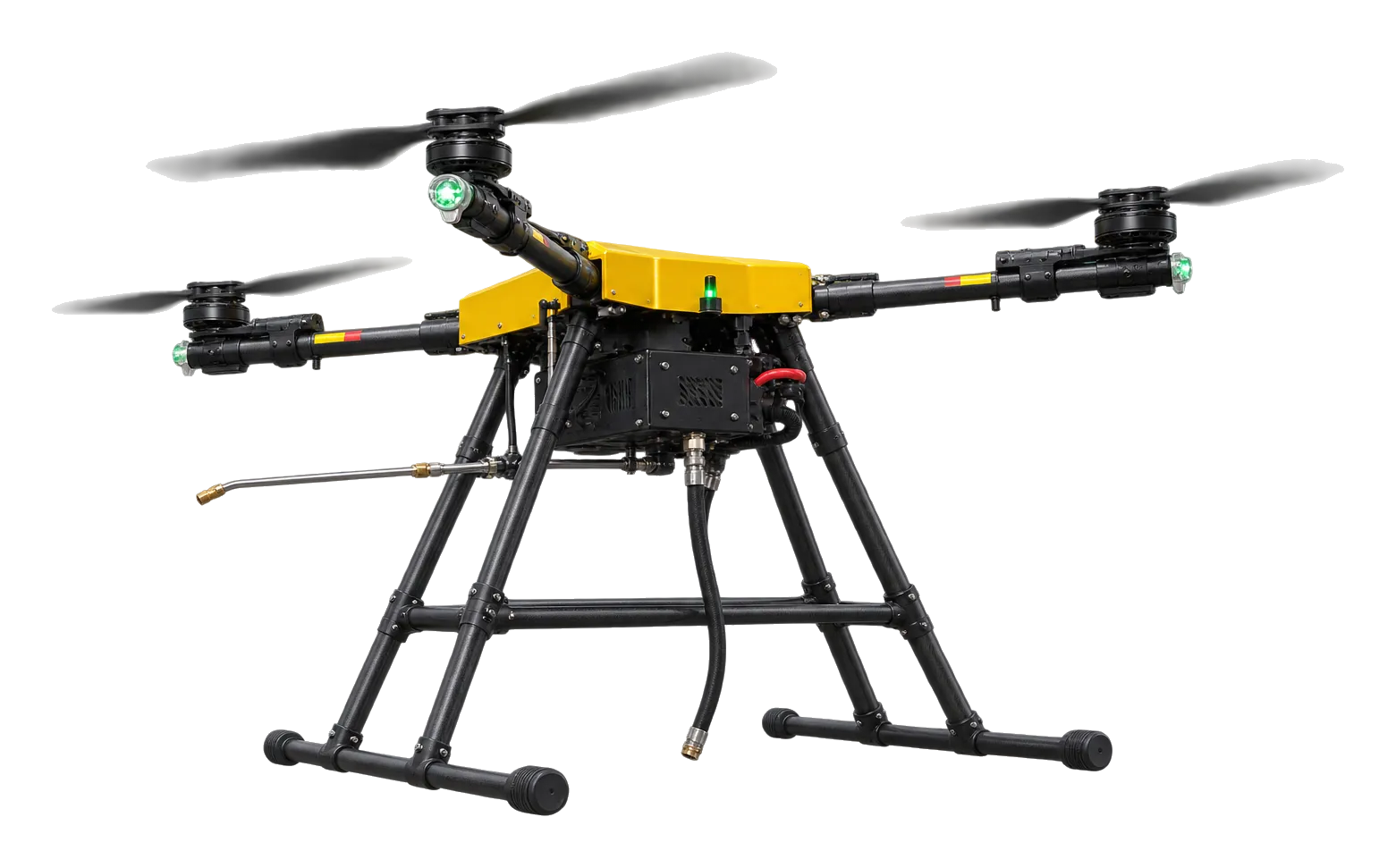
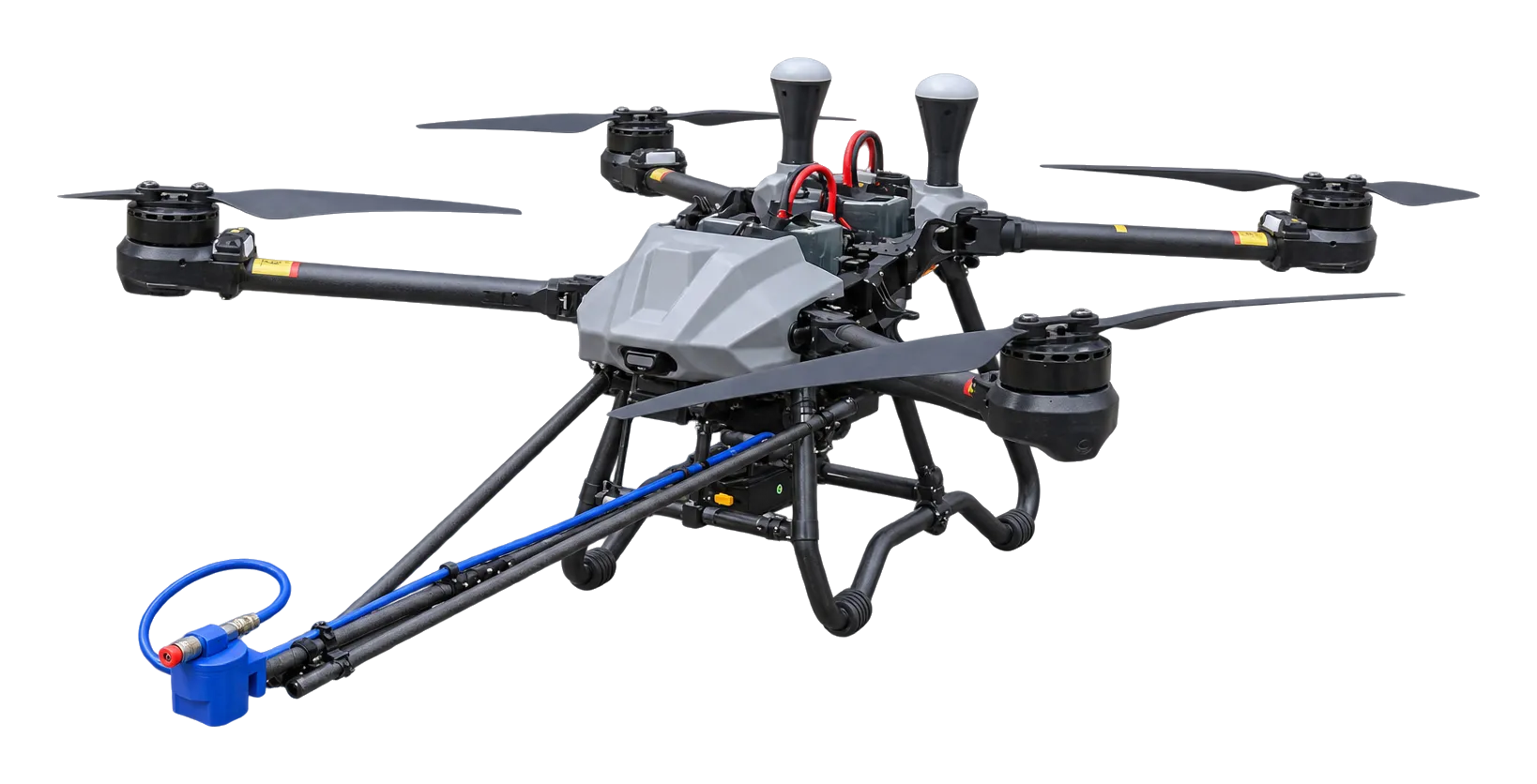
Short answer: in 2026 a tethered cleaning drone is not the same as a tank drone, because “tethered” can mean power, water or both. Choose a tank aircraft such as the CW-30T for many small roofs and panels, a battery aircraft with a hose (CW-30P) for mid-rise glass, and a tether plus hose (CW-65 or CW-30P) for one long facade or a utility solar block where time in the air is the limit.
What does “tethered” mean on a cleaning drone?
| Set-up | Power | Water | Flight-time limit | Other limit | Our model |
|---|---|---|---|---|---|
| Battery plus tank | Battery | 30 L on board | 8–15 min | Refill after each flight | CW-30T |
| Battery plus hose | Battery | Hose from a ground pump | CW-30P: 8–15 min standard, 20–30 min extended; CW-65: 7–28 min standard, 20–40 min customised | Hose length and pump | CW-30P, CW-65 |
| Tether plus hose | Cable from the ground | Hose from a ground pump | None | Cable and hose weight, wind, tangling | CW-30P or CW-65 on a tether |
The CW-65 data also lists a 62 L tank. Water weight counts against its 111 kg take-off weight, so the fill level is set on the quotation.
Which set-up for which job?
| Job | Battery plus tank | Battery plus hose | Tether plus hose | Pick |
|---|---|---|---|---|
| Mid-rise facade | Many refills | Good with a pump spot | Best for long runs | Battery plus hose; tether for a full day on one elevation |
| Roof and gutters | Good, no hose to move | Works | Overkill | Tank, many roofs a day |
| Rooftop solar | Good | Works | Overkill | Tank (CW-30T) |
| Utility solar block | Constant refills | Good | Continuous spray | Tether plus hose |
| Substation insulators | Possible | Possible | Good | Hose-fed, with the owner’s procedures |
How long can each stay in the air?
A battery aircraft is limited by its packs, which Tattu puts at 15–30 minutes per flight for cleaning drones. A tether removes the limit, so crew, water and daylight decide the day. The brochure flight times above are reference values; the quotation fixes them.
How far and how high can a tether go?
Tattu notes that cable weight, length, wind resistance and entanglement risk limit both height and horizontal range, and that a tether needs reliable ground power. DroneBundle adds that a charged hose pulls on the aircraft as it climbs or moves sideways, so a hose handler is needed. The altitude ratings stay at about 50 m for the CW-30 and 100 m for the CW-65.
How much area does one tank cover?
Example A: tank coverage. Assumptions: a 30 L tank emptied each flight, and water use of 0.5, 1.0 or 1.6 L per m². The last figure is derived from Lucid Bots’ Sherpa, which lists up to 12 GPM at up to 300 ft² a minute (45.4 L/min over 27.9 m²/min); that is a peak, so real use is higher.
| Water use | Area per 30 L fill |
|---|---|
| 0.5 L/m² | 60 m² |
| 1.0 L/m² | 30 m² |
| 1.6 L/m² | 19 m² |
So a tank suits small areas and spot work. Remember 30 L of water is about 30 kg of the CW-30T’s 60 kg take-off weight.
How many batteries does continuous work need?
Example B: battery rotation. Assumptions: 12 usable flight minutes and 60 minutes to recharge a pack. Packs in rotation = 60 ÷ 12 + 1 = 6. A six-hour spraying day is 360 ÷ 12 = 30 flights, five per pack. Tattu’s rule for 20-minute flights and a 60-minute recharge, at least four packs, uses the same formula (60 ÷ 20 + 1). On a tether you need none.
What must the ground provide for a tether?
- Reliable power from a generator or the mains; the size is confirmed on the quotation.
- A cable route that will not snag.
- A hose handler, a pump position and water.
- Clear ground for take-off and landing.
Does a tether cost more?
Foxtech lists a tethered kit for a DJI Matrice 400 at US$3,399–13,200, in 50 m and 120 m versions, without the aircraft. For complete aircraft see the window cleaning drone price guide. In the US, a foreign-built aircraft must also clear the FCC Covered List, the Section 232 duty and, from 55 lb, FAA approval; your customs broker and the FAA can confirm, and our import guide explains the steps.
Which set-up is best for what?
- Best for one long facade: CW-65 on a tether, no flight-time limit.
- Best for many small roofs a day: CW-30T, 30 L, no hose to move.
- Best for mid-rise glass with a pump spot: CW-30P on batteries with a hose, 6–10 m throw.
- Best for utility solar blocks: a tethered, hose-fed set-up for continuous spray.
Next step
Tell us the job mix: how many roofs, how long a facade, and the power at the site. We reply with the set-up and the ground gear. Read the pump and hose guide, the water consumption guide and the cleaning drones range; insulator work is in the insulator guide and roofs in the roof guide.
Q & A
Common questions
01What is a tethered cleaning drone?
It is a drone connected to the ground by a hose, a power cable or both. With a power tether the aircraft has no battery limit on flight time; with a hose, water is pumped up from the ground instead of carried.
02Tethered power or tethered water: what is the difference?
Power decides how long the aircraft can stay up. Water decides how much it can spray before a refill. A CW-30P can run on batteries with a hose, or on a tether with a hose.
03What are the disadvantages of a tethered drone?
Cable and hose weight, limited reach, wind drag and the risk of tangling. It also needs reliable ground power from a generator or mains, and a person to manage the lines.
04How much does a tethered system cost?
A public kit for a DJI Matrice 400 runs US$3,399–13,200 without the aircraft. Complete CW-30 and CW-65 aircraft are priced in the cost guide; ask whether the tether unit is in your quotation.
05When is an on-board tank better?
When there is no hose route or the jobs are small and scattered, such as many roofs or small solar arrays in one day. The 30 L CW-30T needs only a refill point.
06Can a drone clean gutters?
Yes, from above, with the lance at 90° down. A tank aircraft suits single roofs; for the roof method, see the roof cleaning guide.
References
- 1Battery-Powered vs Tethered Cleaning Drones: Which Power System Fits the Mission? — Tattu
- 2AeroClean P3 (T50) Tethered Drone Cleaning System — Foxtech
- 3AeroClean T120 Duo Tethered Aerial Cleaning & Power Supply System — Foxtech Robot
- 4Sherpa Cleaning Drone — Lucid Bots
- 5Drone Window Cleaning: Rules, Costs and How It Works — DroneBundle
VEXAFLY Aviation Technology Co., Ltd.. VEXAFLY Aviation Technology Co., Ltd. — industrial drone maker in Nanjing. Our application engineers write and check these pages and configure inspection, cleaning, lift and fire-response systems for project buyers. About VEXAFLY