Cleaning
Insulator Cleaning Drone in 2026: Method by Asset, Water Quality and Live-Line Rules
Insulator cleaning drone in 2026: method by asset and contamination, water resistivity, live or de-energised washing and the water a campaign needs.
- Author
- VEXAFLY Aviation Technology Co., Ltd.
- Scope
- Cleaning
- Published
- Length
- 4 min read · 5 sources
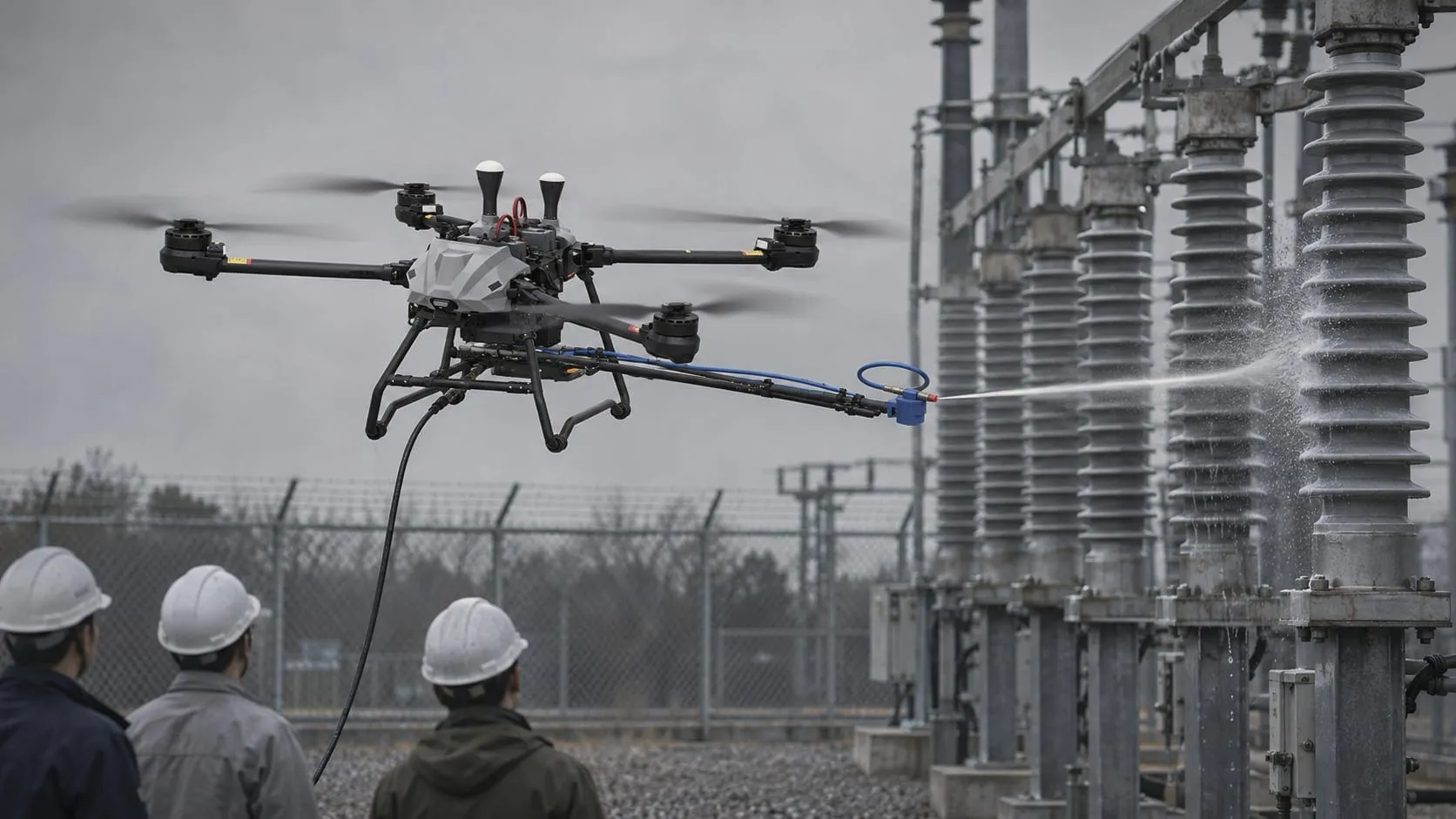
Short answer: in 2026, choosing an insulator cleaning drone starts with three questions: is the asset a substation or a line, what is on the insulators, and is the circuit live or de-energised? Live washing follows your utility’s procedure and its minimum approach distances, and we make no live-line claim for our aircraft. For de-energised substation work use the hose-fed CW-65; for remote towers use the CW-30T tank version.
Which insulators, which contamination, which method?
| Asset | Contamination | Circuit | Drone setup | Note |
|---|---|---|---|---|
| Substation post and bushing insulators | Coastal salt, desert dust | De-energised | CW-65 on a tether, 1.06 m lance at 45°, 90° or 180° | Plan the hose route around equipment; follow the owner’s permit system |
| Substation, energised | Any | Live | The utility’s live-washing procedure and equipment | We make no live-line claim; the owner sets method and clearances |
| Remote line tower strings | Dust, bird droppings | De-energised | CW-30T, 30 L on board, 3–5 m throw | Water must reach the tower base for refills |
| Long line section, heavy salt | Salt, industrial fallout | Often live | A contractor with an approved live-washing method | Utility rules set the method; keep a record per tower |
| Cured cement or paint | Construction deposits | De-energised | Not a drone job | The drone sprays and does not scrub; clean by hand first |
Why are insulators washed at all?
Salt, dust and industrial pollution become conductive when wet. Leakage current rises, and the result can be flashover and a trip. IEEE 957-2024, “Guide for Monitoring, Managing, and Cleaning of Contaminated Insulators”, gives procedures for insulators of all types. The text is paywalled, so we quote none of its figures: use it to decide wash intervals from monitored contamination, not from the calendar.
What water can you use?
| Figure | What it means | Where it comes from |
|---|---|---|
| Below 0.05 µS/cm conductivity | Equal to 20 MΩ·cm resistivity (1 ÷ 0.05 × 10⁻⁶); the demineralised-water level one service company uses for live washing | Helion |
| “500 ohm/in3” as written | California’s minimum resistivity for water used on insulators that support energised conductors | Cal/OSHA Title 8 §2941.2 |
The two figures use different units and different rules, so do not compare them. California also requires each load to be tested immediately before use, and bonding of the pumper and equipment to the structure when conductive hoses are used. Whatever your utility sets, test every load.
Live-line or de-energised: who decides?
The utility does, in its written procedure. OSHA 1910.269 gives minimum approach distances for qualified workers in Table R-6; OSHA notes that the newer NESC values are slightly larger and that it has proposed changes. We give no distances here: use your utility’s table for the voltage. One service company offers live washing up to 500 kV and, in substations, an insulated version with a dielectric hose after a prior study; those are its method and equipment, not ours.
Substation or line: which drone?
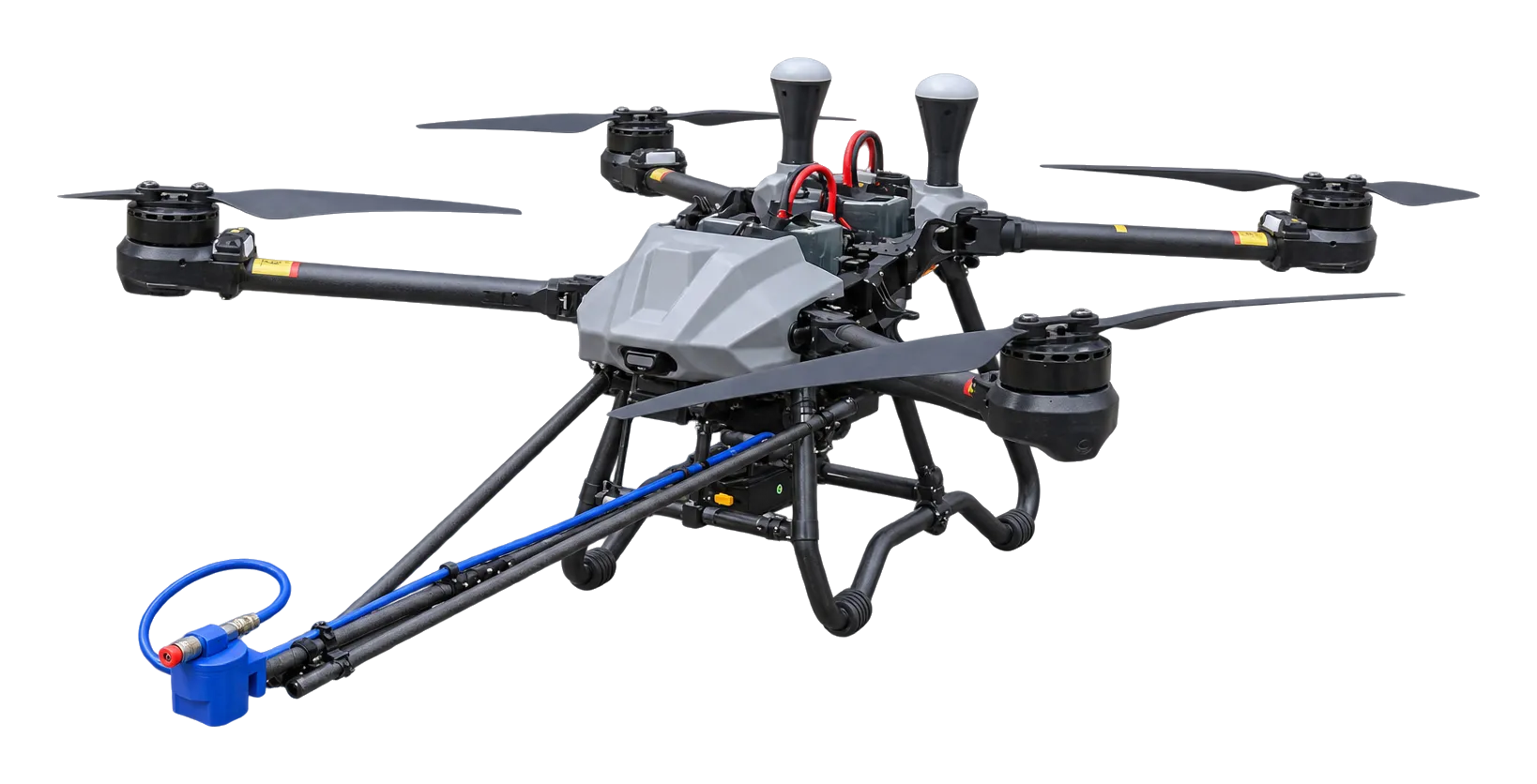
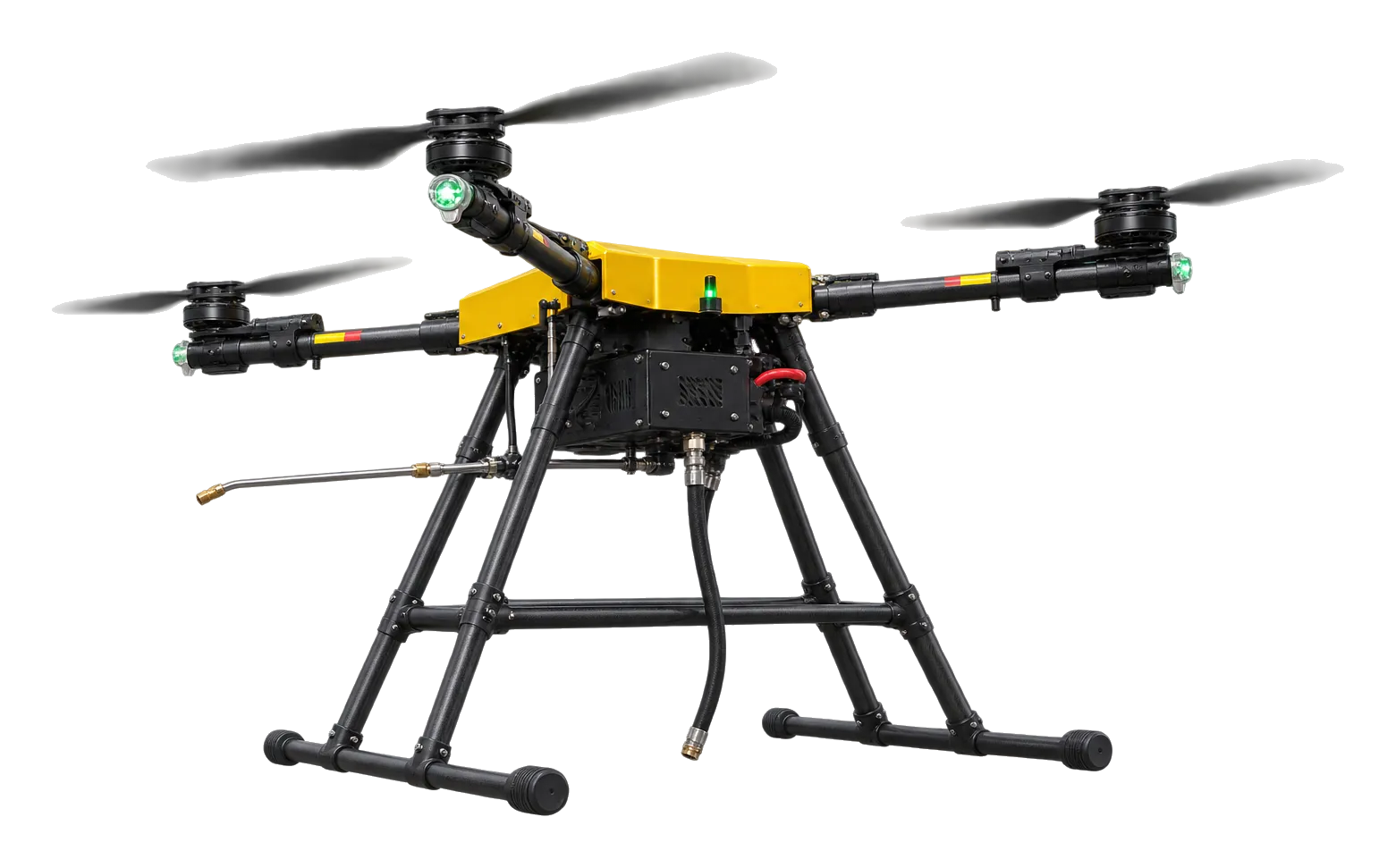
Substations are tight yards where a long tether and a steerable lance matter: the CW-65 flies on a tether with no flight-time limit, and its 1.06 m lance turns to 45°, 90° or 180°. On a line, the access road is the limit. The CW-30T carries 30 L and sprays 3–5 m, so one crew can work a tower without a ground hose, with flight time of 8–15 minutes per battery.
How much water does a campaign need?
Example (assumptions, not a quotation): a campaign uses a 1,000 L demineralised-water bowser. The CW-65 tank is 62 L, but water counts against the 111 kg maximum take-off weight, so the fill per sortie is set on the quotation; use the tank volume only for planning.
| Item | Arithmetic | Result |
|---|---|---|
| Tank volumes per bowser | 1,000 ÷ 62 | 16.1, about 16 |
| Water-quality checks | One per fill | About 16 per bowser |
| Water per string (assumption: measure it on the first string) | 8 L | Set on site |
| Strings per tank volume | 62 ÷ 8 | 7.75, so 7 |
| Strings per bowser | 1,000 ÷ 8 | 125 |
How does it compare with a helicopter or water truck?
One service company puts the market cost per insulator at €85–120 by helicopter and €60–80 by water truck. Those are its figures for its own market, not independent data, and we quote no drone figure here because it depends on access, counts and water supply. A drone can reach towers a truck cannot; whether it beats a helicopter on cost depends on your counts and access, and the utility still decides which method is allowed.
What should you send us for a quote?
- Asset type and voltage, and whether the work will be live or de-energised.
- Insulator material (glass, porcelain, composite), counts per tower or bay, and the contamination type.
- The utility’s wash procedure and water-quality requirement.
- Road access, water source and where the bowser can stand.
Which setup fits which site?
- Best for substations: CW-65, 1.06 m lance turning to 180°, tether for long sessions.
- Best for remote line towers: CW-30T, 30 L, 3–5 m throw, no ground hose.
- Best for heavy salt on long line sections: a contractor with a live-washing procedure, because the utility’s rules set the method.
Next step
Send the asset list and the procedure to the contact form, and read how we plan around substation inspection before a wash. More aircraft are in the cleaning range and the inspection range.
Q & A
Common questions
01Does the line have to be de-energised?
That is the utility’s decision, not the drone maker’s. Live washing is done only under a written procedure with minimum approach distances for the voltage involved. If your procedure requires an insulated lance or dielectric hose, tell us before quoting; our product files make no such claim.
02What water quality do you need?
Use low-conductivity water and test it. One European service company uses demineralised water below 0.05 µS/cm for live washing; California’s rule requires each load to be tested immediately before use. Your utility’s procedure sets the figure for your network.
03How many insulators can a drone wash in a day?
One service company reports about 250 insulators a day with a 100 L aircraft, a crew of two and an auxiliary water tank. That is a vendor figure for its own method; your count depends on access, string size and water supply.
04Substation or line: which drone?
Substations suit the hose-fed CW-65: tether power, a 1.06 m lance that turns to 180° and a 3–6 m spray range. Remote line towers suit the CW-30T, which carries 30 L and needs no ground hose.
05Is drone cleaning effective on insulators?
A drone applies and rinses; it does not scrub. Salt and dust rinse off well. Cured cement, paint or heavy deposits may need hand cleaning first.
References
- 1IEEE 957-2024 Guide for Monitoring, Managing, and Cleaning of Contaminated Insulators — IEEE Standards Association
- 2Title 8 §2941.2 Washing Insulators Supporting Energized Conductors or Equipment — California Department of Industrial Relations
- 31910.269 Electric power generation, transmission, and distribution — OSHA
- 4Minimum Approach Distances (eTool) — OSHA
- 5Live-line insulator washing by drone up to 500 kV — Helion
VEXAFLY Aviation Technology Co., Ltd.. VEXAFLY Aviation Technology Co., Ltd. — industrial drone maker in Nanjing. Our application engineers write and check these pages and configure inspection, cleaning, lift and fire-response systems for project buyers. About VEXAFLY