Cleaning
How Much Water Does a Cleaning Drone Use? Litres per m², per MW and per Day
How much water a cleaning drone uses in 2026: litres per m² of glass, per MW of panels and per day, plus the flow × time rule and pure-water limits.
- Author
- VEXAFLY Aviation Technology Co., Ltd.
- Scope
- Cleaning
- Published
- Length
- 4 min read · 6 sources
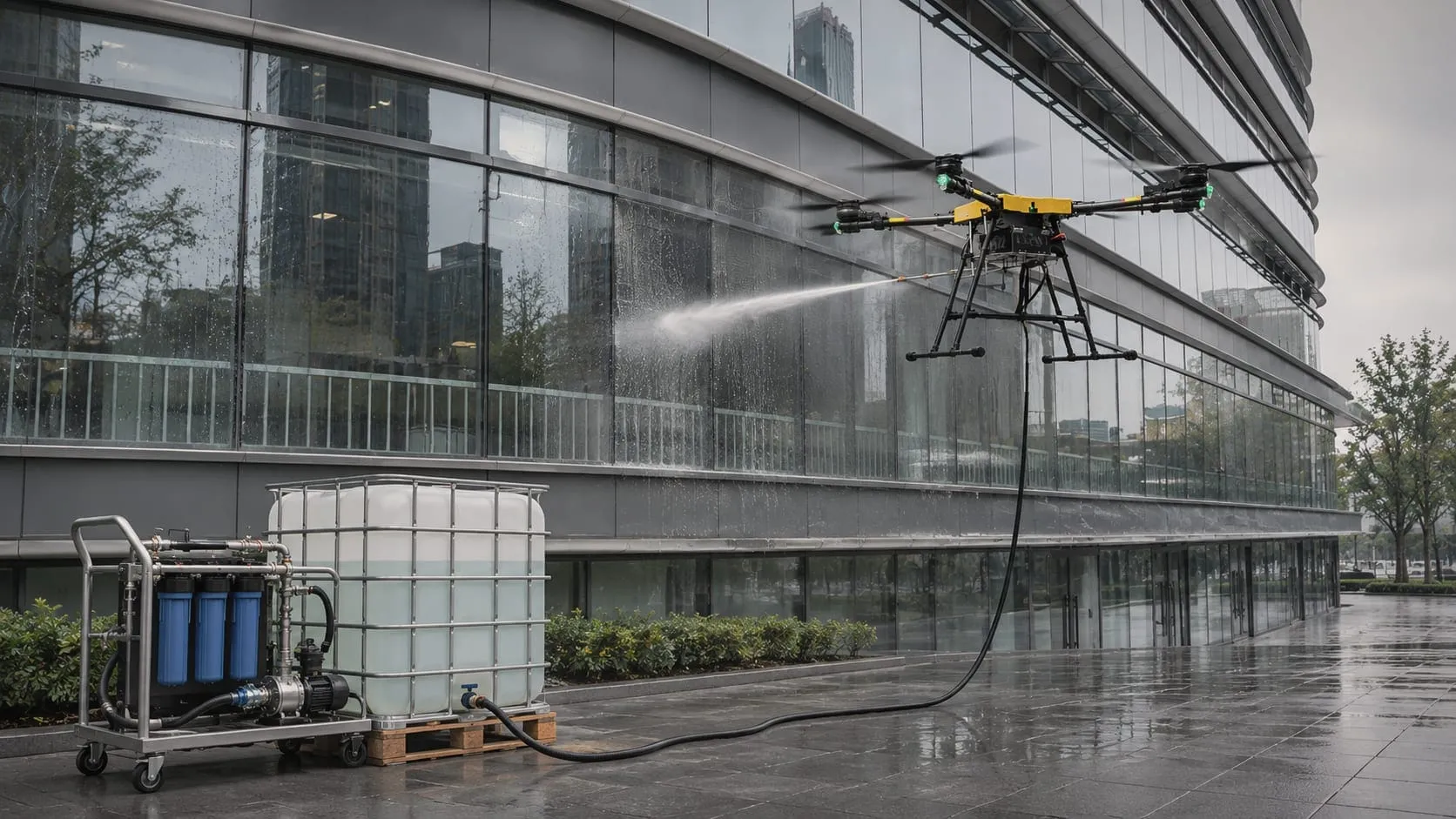
Short answer: in 2026 a hose-fed cleaning drone uses roughly 1.6 litres of water per m² of facade at peak coverage, derived from one maker’s figures, and about 3,600 L per MW of solar at an assumed six hours of spraying. For a day, the rule is flow × nozzle-open time: a drone drawing 8 GPM (30.3 L/min) used about 9,700 L in an eight-hour day in one supplier’s example. Plan the supply from the job, not from the tank size.
How much water does each job use?
| Job | Flow basis | Derived use | Source |
|---|---|---|---|
| Facade soft wash, peak | Up to 12 GPM (45.4 L/min) at up to 300 ft²/min (27.9 m²/min) | About 1.6 L/m² | Lucid Bots |
| Full facade day | 8 GPM (30.3 L/min); 2,560 gal in 8 h | About 9,700 L a day | J. Racenstein |
| Solar, S2 kit | 10 L/min, about 1 MW a day (maker claim) | 3,600 L per MW at 6 h (assumed) | Foxtech |
| Solar, S4 kit | 20 L/min, up to 2 MW a day (maker claim) | 3,600 L per MW at 6 h (assumed) | Foxtech |
| Other flows | ABZ C10: 11.6 L/min; Sherpa high pressure: up to 10 GPM | Set by the job | ABZ, Lucid Bots |
The CW-30P pump allows up to 32 L/min as a maximum; the working flow is set by the job.
What is the formula?
Litres = flow (L/min) × minutes with the nozzle open. The nozzle is not open all day. In the Racenstein example, 2,560 gal at 8 GPM is 320 minutes of spraying in a 480-minute day, about two thirds. Lucid Bots notes that its coverage rate leaves out set-up, dwell, moves and battery changes.
How much water per m² of facade?
Use 1.6 L/m² as the planning peak, then measure on a test panel. A light rinse can use less, and a soft wash with dwell time more.
How much water per MW of solar?
At 600 W a panel, 1 MW is about 1,667 panels.
| Spraying time per MW | Water per MW | Per 600 W panel |
|---|---|---|
| 4 h at 10 L/min | 2,400 L | 1.4 L |
| 6 h | 3,600 L | 2.2 L |
| 8 h | 4,800 L | 2.9 L |
The spraying hours are our assumption; the flows are from the maker’s claims.
How far does one tank go?
A 30 L tank covers 30 ÷ 1.6 = 19 m² at the peak figure, or 25 m² at 1.2 L/m². Tank litres are not payload kilograms: 30 L of water is about 30 kg, half of the CW-30T’s 60 kg take-off weight. The CW-65 data lists a 62 L tank, and the fill level is set on the quotation. Ground tanks of 50–200 gal (189–757 L) are typical for Lucid Bots’ operators.
Example: a day on a 3,000 m² facade
Example: CW-30P. Assumptions: 1.2 L/m² on average, between a light rinse and the 1.6 peak; a working flow of 20 L/min; the nozzle open two thirds of the time.
- Water: 3,000 × 1.2 = 3,600 L.
- Nozzle-open time: 3,600 ÷ 20 = 180 min.
- Spraying time on site: 180 ÷ (2 ÷ 3) = 270 min, about 4.5 h.
- Supply: about 4,000 L, or a mains feed. The pump’s 32 L/min maximum is not the limit here.
What water quality do glass and panels need?
For glass, operators rinse with pure water; Racenstein’s trailer logs TDS and changes membranes above 10 ppm. For solar, First Solar prefers reverse-osmosis water, asks for TDS below 1,500 mg/L and hardness below 75 mg/L, or a squeegee finish, and limits nozzle pressure to 35 bar. Check the module maker’s cleaning guideline.
Where does the runoff go?
US municipal storm sewers run under EPA NPDES permits, and Tablelands Regional Council in Queensland says pressure-cleaning wastewater must not enter gutters or stormwater. Plan bunds and vacuum recovery, and check your local rules.
Which water plan is best for what?
- Best for glass with a spot-free finish: a pure-water rinse, with no detergent residue to wash off.
- Best for remote solar sites: a tank trailer sized by litres per MW, 2,400–4,800 L at maker-claim flows.
- Best for spot jobs: the CW-30T, 30 L a fill.
- Best for full-day facade work: mains or an RO trailer with a buffer, about 9,700 L a day at 8 GPM.
Next step
Tell us the facade area or the plant size and the water you have. We size the supply and the pump. Read the pump and hose guide and the cleaning frequency guide next, then the CW-30P and CW-65 pages and our solar panel cleaning guide.
Q & A
Common questions
01How much water does a cleaning drone use per hour?
It depends on flow and how long the nozzle is open. At 30 L/min with the nozzle open all hour, about 1,800 L; in practice the nozzle is open perhaps two thirds of the time, so about 1,200 L.
02How many litres per m² of facade?
About 1.6 L/m² at peak coverage, derived from one maker’s published flow and coverage figures. A light rinse can use less, so measure on a test panel before sizing the supply.
03How much water per MW of solar?
About 3,600 L per MW at maker-claimed flows and an assumed six hours of spraying per MW. At four hours it is 2,400 L, and at eight hours 4,800 L.
04How many gallons does a cleaning drone tank hold?
The CW-30T carries 30 L, about 8 US gallons. The CW-65 data lists a 62 L tank; its water counts against the 111 kg take-off weight, and the fill level is set on the quotation.
05Do I need pure water?
For spot-free glass, yes: operators rinse with pure water. For solar, First Solar prefers reverse-osmosis water and asks for TDS below 1,500 mg/L.
06Where does the wash water go?
Rules vary. In the US, storm sewers run under EPA permits; in Queensland, pressure-cleaning wastewater may not enter gutters or stormwater. Use bunds and vacuum recovery where required.
References
- 1Drone Building Cleaning: Pure Water Systems for 8 GPM — J. Racenstein
- 2Sherpa Cleaning Drone — Lucid Bots
- 3AeroClean S2/S4 Solar Panel Cleaning Kit for DJI T-Series — Foxtech
- 4FS-Series PV Module Cleaning Guidelines (PD-5-804) — First Solar
- 5NPDES Stormwater Program — US EPA
- 6Water Pressure Cleaning — Tablelands Regional Council (Qld)
VEXAFLY Aviation Technology Co., Ltd.. VEXAFLY Aviation Technology Co., Ltd. — industrial drone maker in Nanjing. Our application engineers write and check these pages and configure inspection, cleaning, lift and fire-response systems for project buyers. About VEXAFLY