Cleaning
Cleaning Drone Water Supply in 2026: Pump, Hose and Pressure Budget Explained
Cleaning drone water supply in 2026: where the water comes from, what height and hose bore cost in pressure, which pump to pick, with an 80 m worked example.
- Author
- VEXAFLY Aviation Technology Co., Ltd.
- Scope
- Cleaning
- Published
- Length
- 4 min read · 7 sources
Short answer: in 2026 a hose-fed cleaning drone gets its cleaning drone water supply from a ground pump that must overcome three things: the lift (about 0.098 bar per metre), the friction in the hose and the pressure wanted at the lance. For an 80 m job with 100 m of half-inch hose at 15 L/min that is about 32 bar, or 0.8 kW of hydraulic power, well inside a 5.5 kW pump. Hose bore, not pump size, is usually the weak link. The hose figures below are estimates.
Where should the water come from?
| Source | Flow available | Permit | Good for | Watch out |
|---|---|---|---|---|
| Mains tap | Measure it at the tap | Owner’s consent | Street-front offices | Low flow, backflow |
| Metered hydrant | High | Yes: Portland up to 7 days; Broomfield permit valid 90 days | Large jobs | Needs valve, spanner, meter and backflow device |
| Tank trailer | Set by tank size | None | Sites with no mains | Refill trips |
| RO / DI trailer | One maker’s trailer: RO makes 5 GPM (19 L/min) | None | Spot-free glass and solar | Needs a buffer tank; check TDS |
How does water reach the drone?
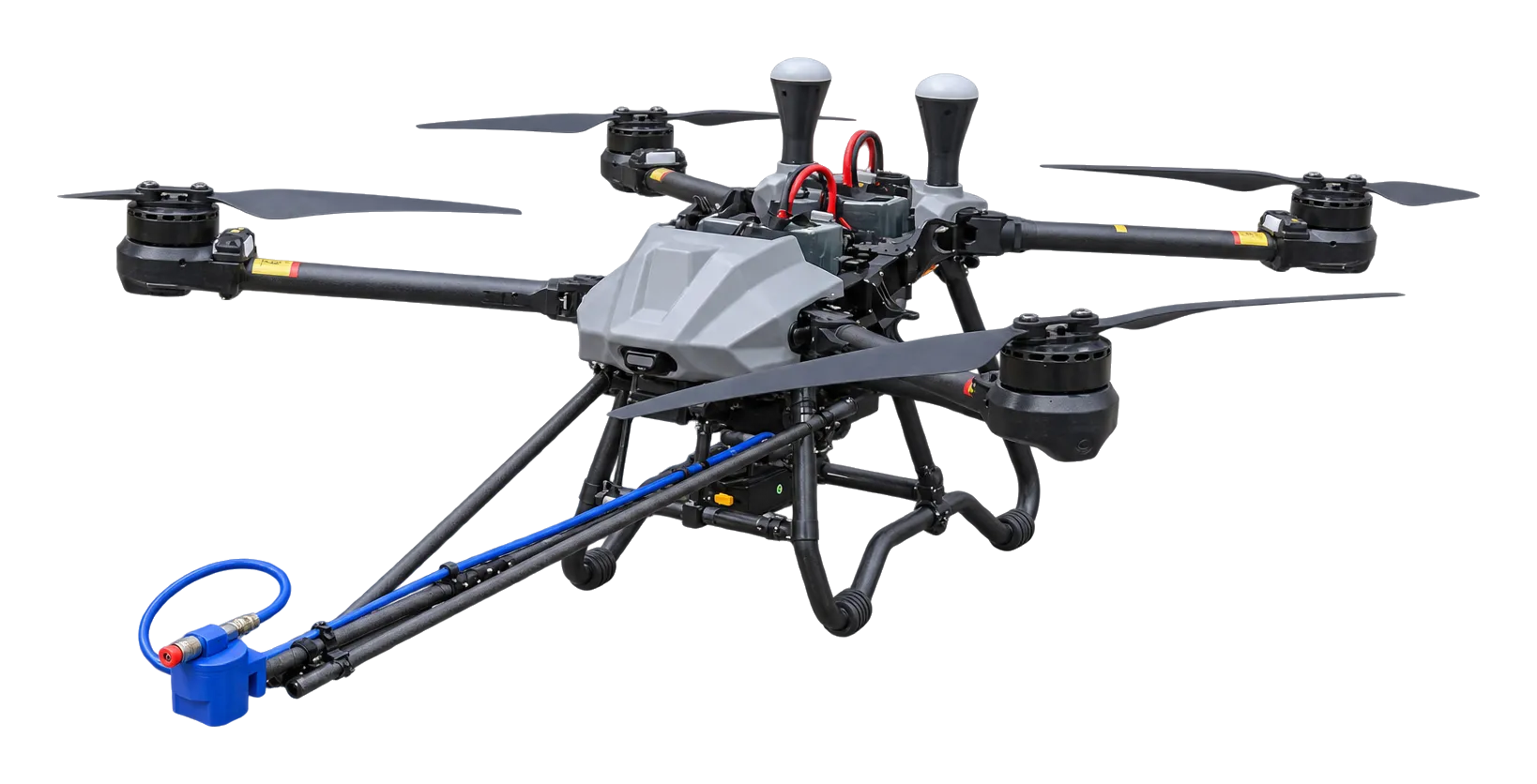
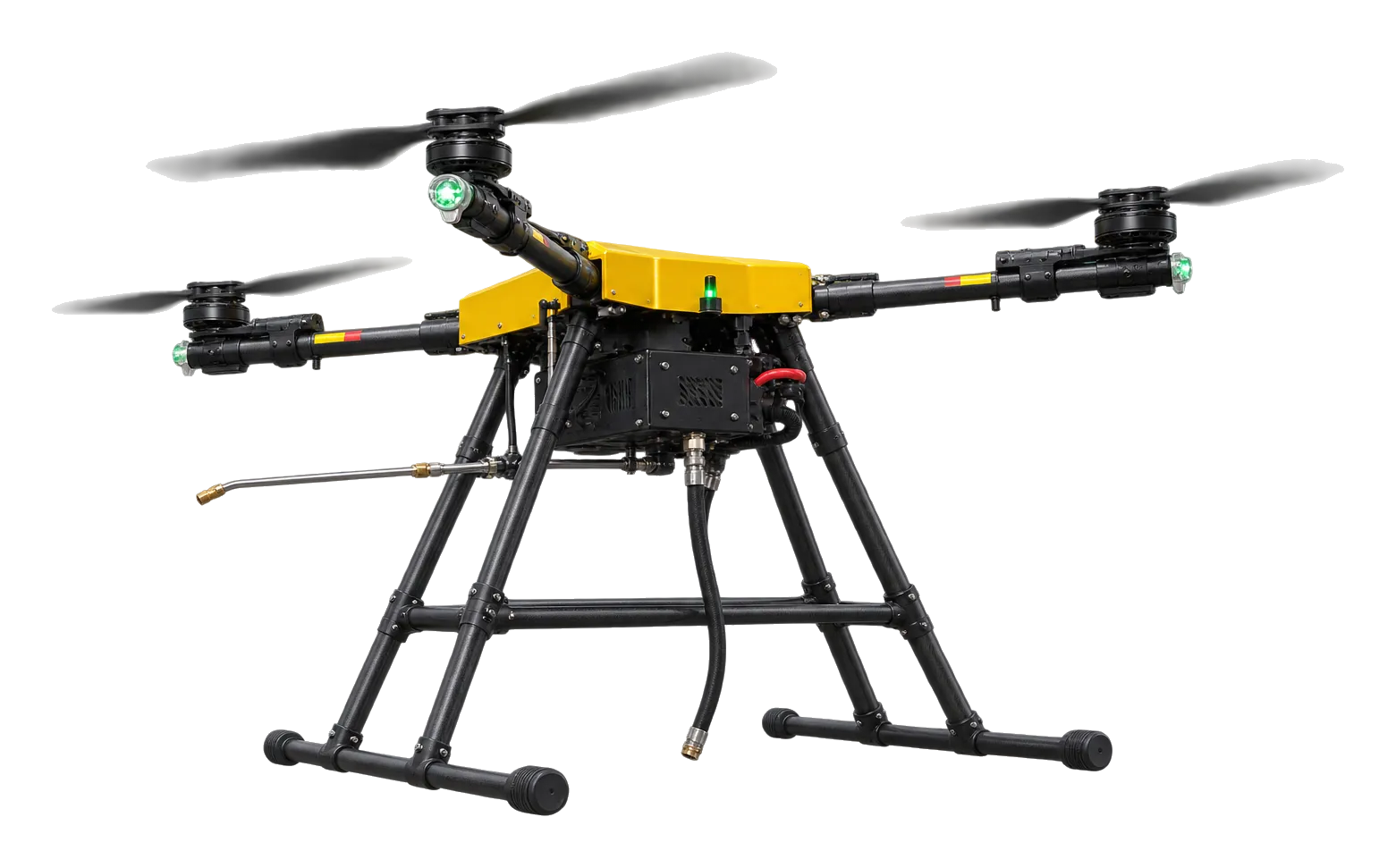
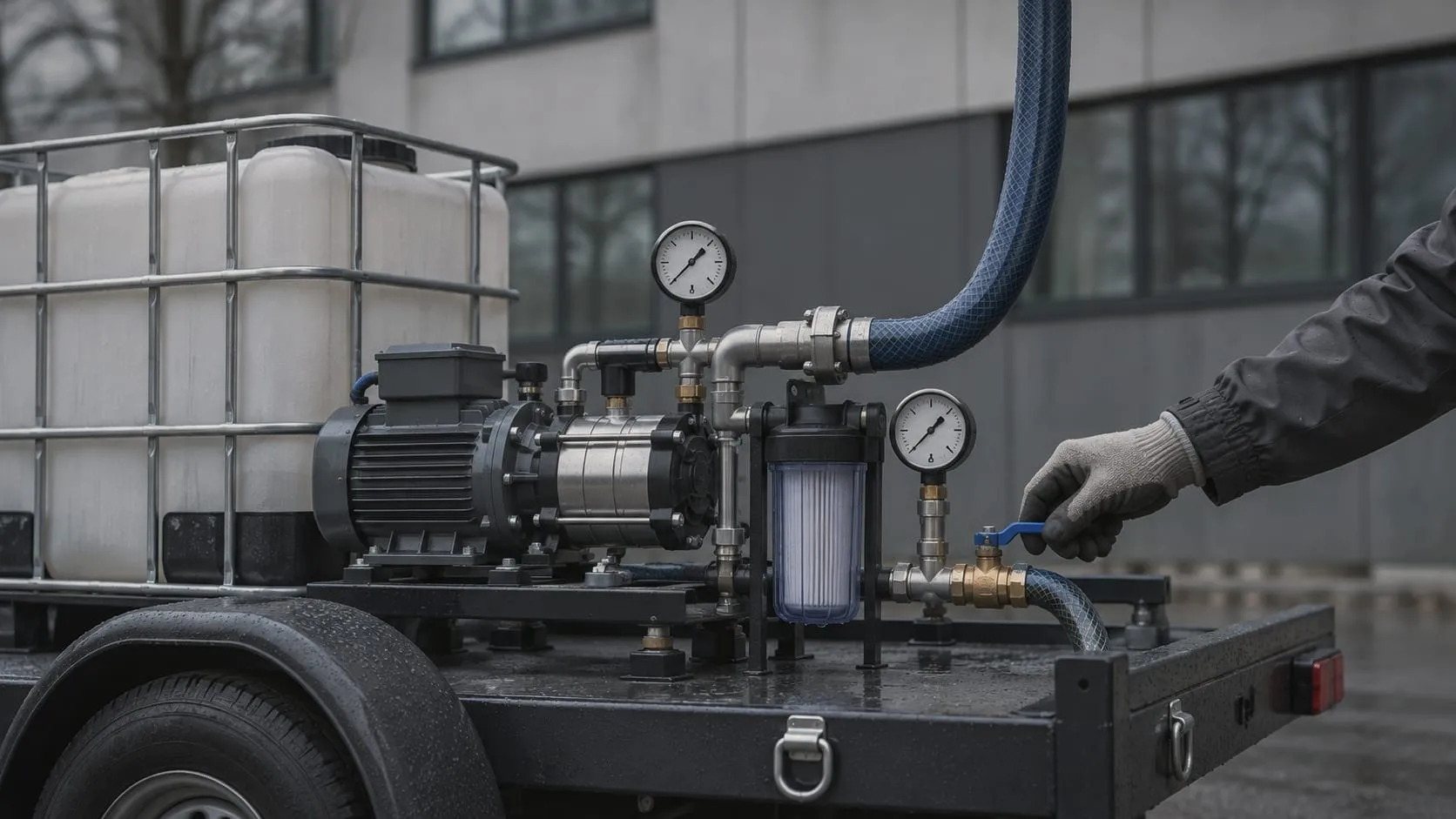
The chain is source, filter or RO / DI unit, buffer tank, ground pump, hose, lance. The CW-30P pump is 5.5 kW, 220 V, 50 kg, with a 28 MPa and a 32 L/min maximum. The CW-65 ground unit is 5.5 or 13 kW, 220 V. Both need water and power at ground level. A comparable system, Drone Volt’s Hercules 20, uses a 100 m lightweight hose for up to 250 bar and 28 L/min.
How much pressure do you lose with height?
Water weighs 9.81 kPa per metre of lift, which is 0.098 bar.
| Height | 30 m | 50 m | 80 m | 100 m |
|---|---|---|---|---|
| Static head | 2.9 bar | 4.9 bar | 7.85 bar | 9.8 bar |
How much do you lose in the hose?
Friction over 100 m of smooth hose by the Hazen-Williams formula, with C = 140 assumed:
| Flow | ⅜ in (9.5 mm) | ½ in (12.7 mm) | ⅝ in (15.9 mm) |
|---|---|---|---|
| 15 L/min | 16.6 bar | 4.1 bar | 1.4 bar |
| 32 L/min | 67 bar | 16.7 bar | 5.6 bar |
The formula assumes slower water than these small bores carry, so treat the figures as rough and use the hose maker’s pressure-drop chart.
Which pump: 5.5 kW or 13 kW?
Hydraulic power is pressure × flow. At 100 % efficiency 5.5 kW gives at most about 10.3 MPa at 32 L/min, or about 11.8 L/min at 28 MPa; at 85 % efficiency about 8.8 MPa or 10 L/min. So the 28 MPa and 32 L/min figures are separate maxima. A 13 kW unit allows about 24 MPa at 32 L/min. Choose it for tall jobs or thin hose.
Example: the CW-65 at 80 m
Assumptions: 100 m of hose, 15 L/min, and 20 bar wanted at the lance for glass. Hose friction comes from the table.
| Item | ½ in hose | ⅜ in hose |
|---|---|---|
| Static head at 80 m | 7.85 bar | 7.85 bar |
| Hose friction | 4.1 bar | 16.6 bar |
| Pressure at the lance | 20 bar | 20 bar |
| Pump pressure needed | about 32 bar (3.2 MPa) | about 44 bar (4.4 MPa) |
| Hydraulic power | 0.8 kW | 1.1 kW |
The thinner hose adds 12.5 bar. Both are estimates, and both sit well inside the pump’s power.
How big should the buffer tank be?
J. Racenstein’s drone trailer shows the logic. The drone draws 8 GPM (30.3 L/min); the RO unit makes 5 GPM (18.9 L/min). The buffer therefore loses 11.4 L/min while the nozzle is open: 45 minutes of unbroken spraying empties about 510 L (135 gal). The buffer refills during battery swaps and moves, so size it to the longest unbroken spray. That trailer carries a 400 gal (1,514 L) buffer and a 100 gal inlet tank, and its supplier changes the membranes when TDS rises above 10 ppm.
What water quality does the finish need?
Pure water leaves glass spot-free. For solar glass, First Solar’s guideline asks for TDS below 1,500 mg/L, prefers reverse osmosis and limits nozzle pressure to 35 bar; check the module maker’s cleaning guideline.
Which supply is best for what?
- Best for street-front offices with a tap: CW-30P with a 5.5 kW pump on mains, no trailer.
- Best for 80–100 m work: CW-65 with the 13 kW unit, more headroom for lift and friction.
- Best for sites without mains: a tank trailer and buffer sized to the battery-swap pauses.
- Best for glass and solar finish: an RO / DI feed with TDS checked through the day.
Next step
Send the height, the water source and its flow, and the power at the site. We size the pump and hose and confirm the bore and length on the quotation. See also tethered or tank, water consumption, the CW-65, the CW-30P and our service page.
Q & A
Common questions
01How does a cleaning drone get its water?
On a hose-fed drone a ground pump pushes water up a hose to the lance. The aircraft lifts only the hose and lance, not the water. A tank drone carries its own water instead.
02How big a pump do I need?
Add the lift, the hose friction and the lance pressure, then multiply by the flow to get hydraulic power. The 80 m example below needs about 0.8 kW, so the 5.5 kW unit has ample headroom.
03How much pressure is lost up the hose?
Static head is about 0.098 bar per metre. Friction depends on bore, length and flow: about 4.1 bar over 100 m of half-inch hose at 15 L/min, as an estimate. Check the hose maker’s chart.
04Can I use a fire hydrant?
Often, with a permit, a meter and a backflow device. Portland says approval can take up to seven days. Ask the local water utility before you plan the job.
05Tank trailer or mains?
Mains is simplest if the tap flows enough. A tank trailer suits sites without mains, and an RO trailer with a buffer tank suits spot-free glass and solar finishes.
06What hose size should I use?
The hose bore and standard length are confirmed on the quotation for your height and flow. Narrow hose saves weight but loses much more pressure, as the friction table shows.
References
- 1Hydrostatic Pressure vs. Depth — Engineering ToolBox
- 2Hazen-Williams Water Flow Formula — Engineering ToolBox
- 3Pump Power Calculator — Engineering ToolBox
- 4Drone Building Cleaning: Pure Water Systems for 8 GPM — J. Racenstein
- 5Hercules 20 High-Pressure Spraying System — Drone Volt
- 6Temporary hydrant permit information — City of Portland Water Bureau
- 7Construction / Hydrant / Temporary Water — City and County of Broomfield
VEXAFLY Aviation Technology Co., Ltd.. VEXAFLY Aviation Technology Co., Ltd. — industrial drone maker in Nanjing. Our application engineers write and check these pages and configure inspection, cleaning, lift and fire-response systems for project buyers. About VEXAFLY