Cleaning
Solar Panel Cleaning Drone Price in 2026: Rooftop, Commercial and Utility Plants
Solar panel cleaning drone price in 2026 by plant type: kits, tank and hose-fed aircraft, site extras, module warranty limits and own-versus-contract maths.
- Author
- VEXAFLY Aviation Technology Co., Ltd.
- Scope
- Cleaning
- Published
- Length
- 4 min read · 6 sources
Short answer: in 2026 the solar panel cleaning drone price depends on the plant, not only on the aircraft. A rooftop with no hose route is cleaned with a tank aircraft, a commercial roof or carport with a hose-fed one, and a utility plant with a tethered aircraft and a water trailer. Our reference FOB prices run from US$4,500 to US$16,000 for the aircraft; water, pump and pure-water equipment on site come on top.
Price by plant type
| Plant | Typical set-up | Equipment price | The site must provide |
|---|---|---|---|
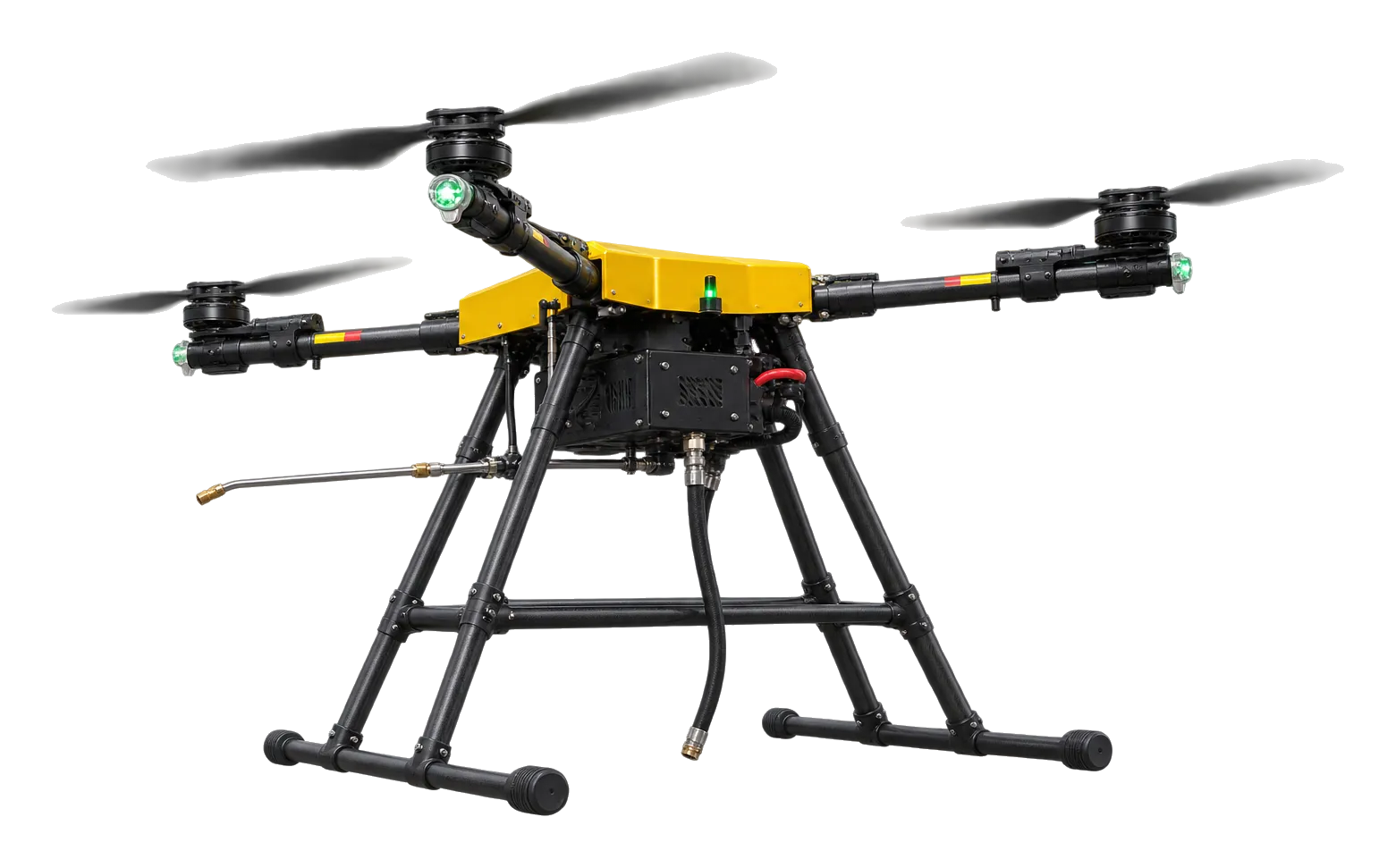
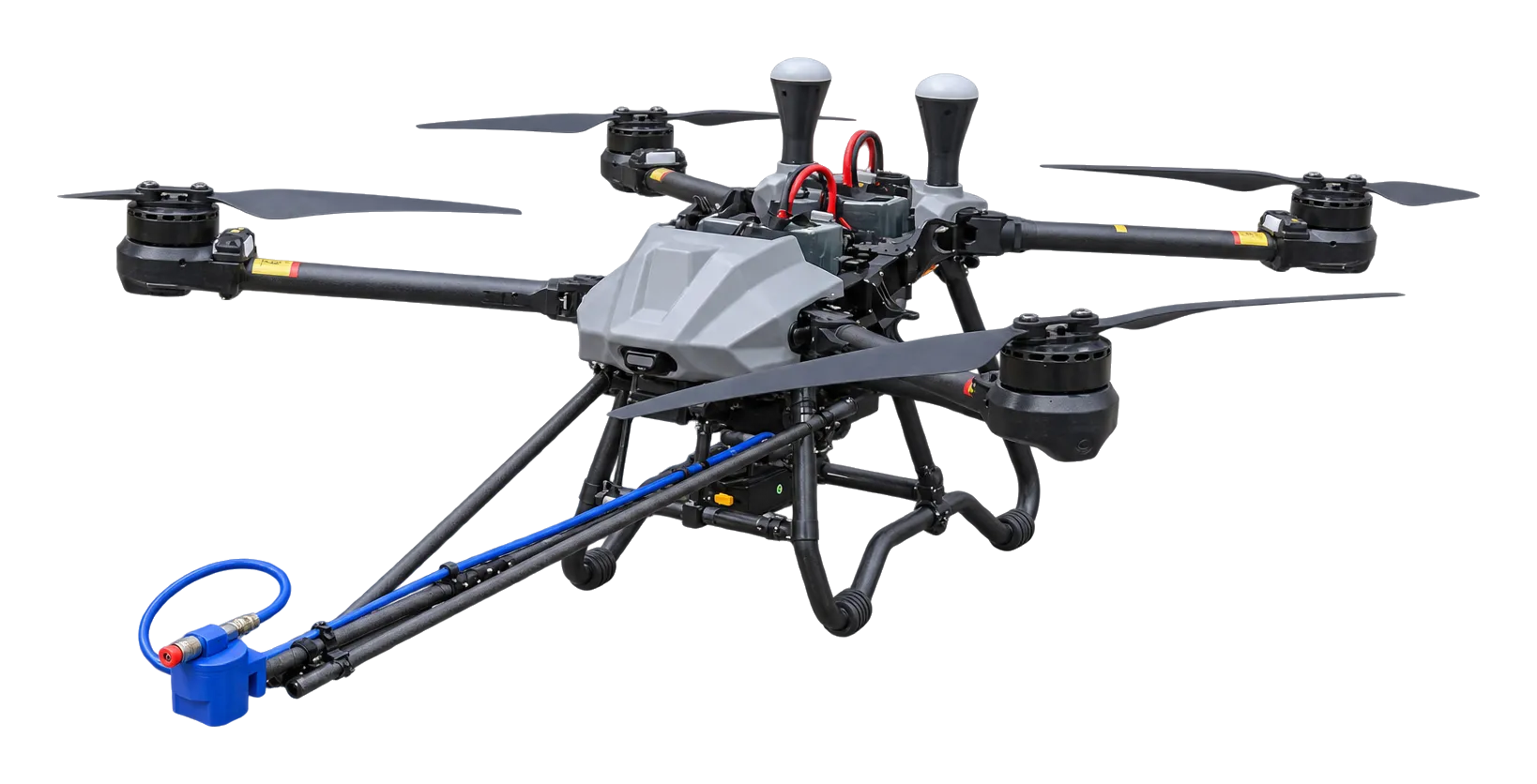
| Rooftop, no hose route | CW-30T with a 30 L tank and 3–5 m throw; or a bolt-on kit for a DJI Agras T-series drone | CW-30 range US$4,500–10,600 FOB; kit US$2,500–3,500 (kit only) | Refill water; a safe take-off spot |
| Commercial roofs and carports | CW-30P with a 5.5 kW ground pump, hose and lance at 45° | US$4,500–10,600 FOB (CW-30 range) | Tap or tank, 220 V power, a pump position |
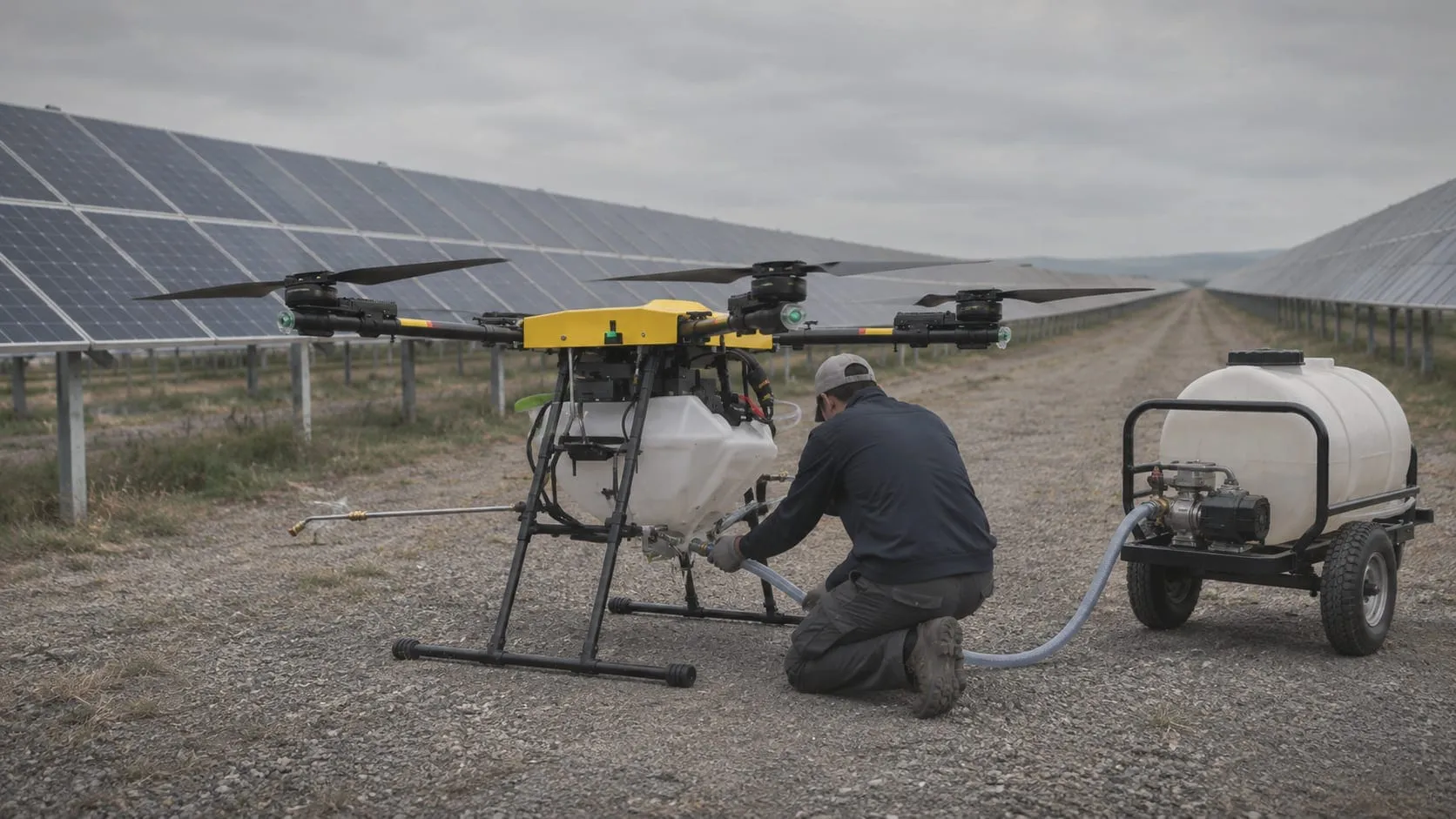
| Utility ground-mount | CW-65 with a 5.5 or 13 kW ground unit on a tether | US$11,300–16,000 FOB | Water trailer, RO / DI unit, generator or grid, a hose handler |
The CW-30 range covers both the CW-30P and CW-30T. Prices are reference values and the final price is on the quotation; the minimum order is 1 unit.
What is in the price, and what does the site add?
The aircraft price covers the aircraft and lance. Confirm these as separate lines or site items: the ground pump and hose (bore and length are on the quotation), tether power, a water trailer or tank sized to the plant, reverse-osmosis or deionised water, a generator where there is no mains, a hose handler, and training, spares, freight and import costs.
Will drone cleaning affect my module warranty?
Possibly, so check before you buy. The First Solar guideline PD-5-804 says water must not exceed 35 bar (500 psi) at the nozzle. It asks for fresh water with TDS below 1,500 mg/L, with reverse osmosis giving the best result, and recommends cleaning from dusk to dawn. It also says automated or motorised cleaning tools need First Solar’s review and approval for warranty coverage.
The CW-30P booster pump reaches 28 MPa (280 bar) at its maximum, eight times that limit, so the operating pressure is set at the module maker’s figure, not the pump’s. Other makers publish different limits: check the module maker’s cleaning guideline and ask in writing whether a drone method is accepted.
Kit for a spray drone, or a dedicated cleaning drone?
Foxtech sells bolt-on kits for DJI Agras T-series drones at US$2,500–3,500, without the aircraft. It claims the S2 kit (20 MPa pump, 10 L/min) cleans about 1 MW a day and the S4 (two pumps, 20 L/min) up to 2 MW a day. These are maker claims.
A kit is cheaper if you already fly a heavy spray drone. A dedicated CW-30P keeps the water on the ground, so it lifts only the hose and lance. Ask what a kit needs from the spray drone, and whether its maker approves it.
Is it cheaper to own or to hire a contractor?
One US operator publishes a commercial rate of US$200 per appointment plus US$2.00 per panel.
Example: 5 MW ground-mount plant, 600 W modules. Assumptions: 5,000,000 W ÷ 600 W = 8,333 panels. A contract wash at the published US rate costs 8,333 × US$2.00 + US$200 = US$16,866, or US$3,373 per MW; four washes a year cost US$67,464. For owning, the all-in set-up cost S (aircraft, ground unit, trailer, RO, training) and own cost per wash c (crew, water, consumables, wear) are assumptions. Break-even washes = S ÷ (16,866 − c).
| Set-up cost S (assumed) | c = US$4,000 per wash | c = US$6,000 per wash |
|---|---|---|
| US$30,000 | 3 washes | 3 washes |
| US$50,000 | 4 washes | 5 washes |
| US$80,000 | 7 washes | 8 washes |
At four washes a year, a US$50,000 set-up is recovered in one to one and a quarter years. Import duty, permits and insurance belong in your own S; the example leaves them out.
How often must you clean for the drone to pay?
The IEA photovoltaic programme estimates that soiling costs 3–5 % of annual PV production worldwide. Whether that pays for a wash depends on your soiling rate and electricity price: see how often to clean solar panels and the water consumption guide for the trailer size.
What should US buyers check first?
A US buyer of a foreign-built aircraft has three gates: the exact model’s FCC Covered List status, the Section 232 duty, and an FAA Section 44807 exemption at 55 lb or more. Your customs broker and the FAA can confirm each; see importing industrial drones from China and FCC certification. One US operator says its FAA exemption for a heavier cleaning drone covers ground-mounted solar at secure sites only, with rooftops flown under Part 107 below 55 lb. That is the operator’s own statement.
Which set-up for which owner?
- Best for rooftop arrays without a hose route: CW-30T, 30 L tank, 3–5 m throw.
- Best for commercial roofs and carports: CW-30P, lance at 45°, to about 50 m.
- Best for utility plants: CW-65 on a tether, no flight-time limit, with a 5.5 or 13 kW ground unit.
- Best for farms that already run a DJI Agras: a bolt-on kit, US$2,500–3,500 (kit only).
Next step
Send the plant type, size in MW, module maker and water source. We reply with the set-up and a quotation that lists every line. Read the solar panel cleaning drone guide or compare robots and drones next.
Q & A
Common questions
01How much does a solar panel cleaning drone cost?
It depends on the plant. A bolt-on kit for a spray drone costs about US$2,500–3,500 without the aircraft. Our reference FOB prices are US$4,500–10,600 for the CW-30 class and US$11,300–16,000 for the CW-65. Pump, hose, tether, water trailer and freight come on top.
02Is there a drone that can clean solar panels?
Yes. The CW-30P lance tilts to 45° to follow the panel slope, the CW-30T carries 30 L for roofs with no hose route, and the CW-65 works on a tether at utility plants.
03Does drone cleaning void the module warranty?
It can if the method breaks the maker’s cleaning guideline. First Solar sets a 35 bar nozzle limit and needs to approve motorised or automated cleaning. Ask your module maker in writing first.
04How much should I charge for solar panel cleaning?
One US operator publishes US$200 per appointment plus US$2.00 per panel for commercial sites. Your market, water cost and plant size will move that figure.
05How much water and power does the site need?
The ground unit runs on 220 V; the CW-30P pump is 5.5 kW and the CW-65 unit is 5.5 or 13 kW. Water per MW depends on flow and spray time.
References
- 1FS-Series PV Module Cleaning Guidelines (PD-5-804) — First Solar
- 2Commercial Solar Panel Cleaning (prices and FAA exemption) — DronePower1
- 3AeroClean S2/S4 Solar Panel Cleaning Kit for DJI T-Series — Foxtech
- 4Soiling Losses – Impact on the Performance of Photovoltaic Power Plants — IEA PVPS
- 5Proclamation 11055: Adjusting Imports of Unmanned Aircraft Systems — US Government Publishing Office
- 6Drone Cleaning Cost Australia: Pricing Guide 2026 — iDrone Corp
VEXAFLY Aviation Technology Co., Ltd.. VEXAFLY Aviation Technology Co., Ltd. — industrial drone maker in Nanjing. Our application engineers write and check these pages and configure inspection, cleaning, lift and fire-response systems for project buyers. About VEXAFLY