Cleaning
Solar Panel Cleaning Robot vs Drone in 2026: A Decision Table by Plant Type
Solar panel cleaning robot vs drone in 2026: which method fits rooftops, carports, fixed-tilt rows and trackers, with water, module limits and an example.
- Author
- VEXAFLY Aviation Technology Co., Ltd.
- Scope
- Cleaning
- Published
- Length
- 5 min read · 5 sources
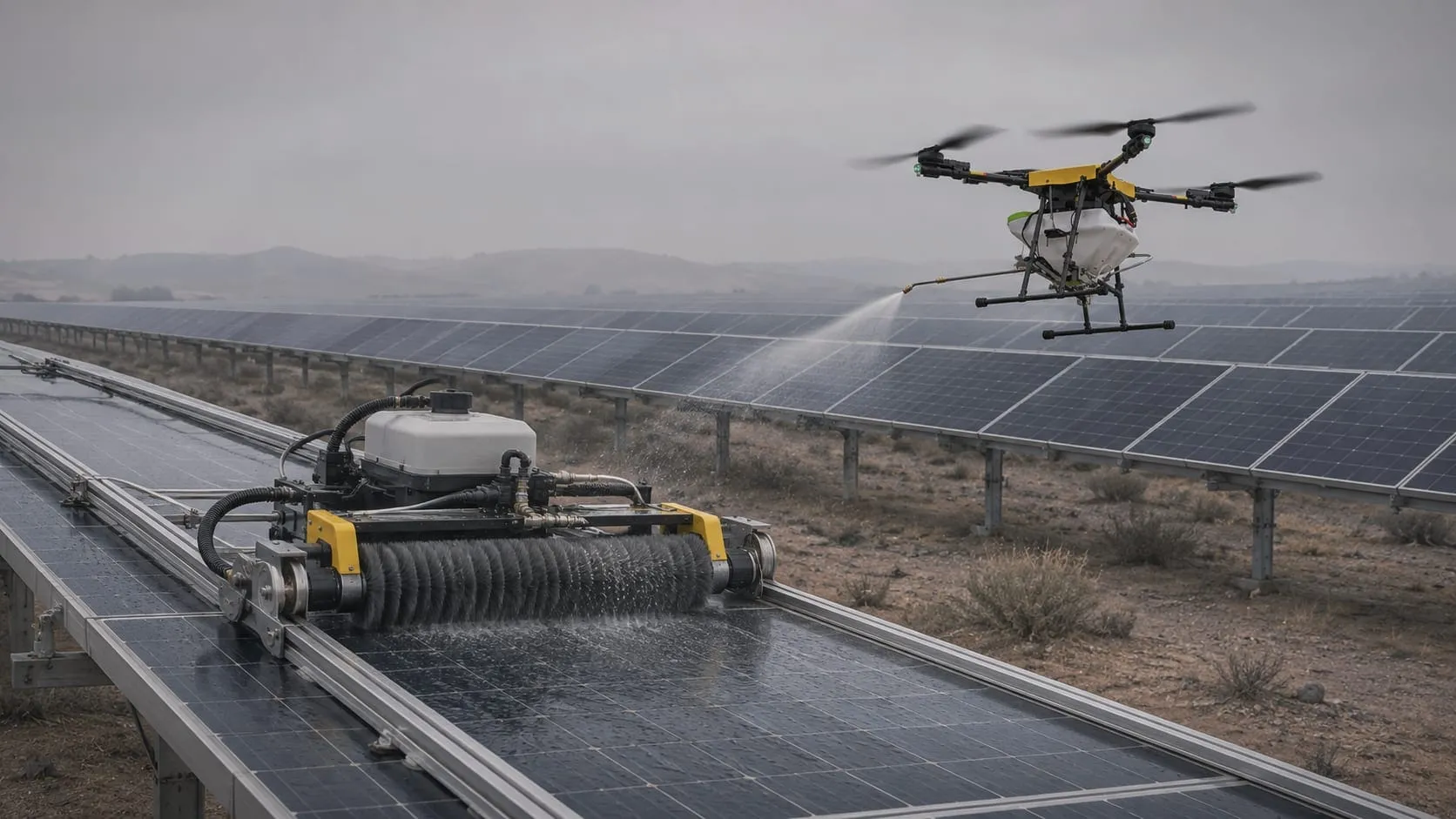
Short answer: in 2026 the solar panel cleaning robot vs drone question has no single winner, because the plant decides. Drones fit rooftops, carports and scattered small sites where there are no rails and nobody should walk on the modules. Robots, or a truck with a brush, fit long uniform ground rows. The module maker’s cleaning guideline limits every method, so read it before the first wash.
Which method fits which plant?
| Plant | Best fit | Why | Where it fails |
|---|---|---|---|
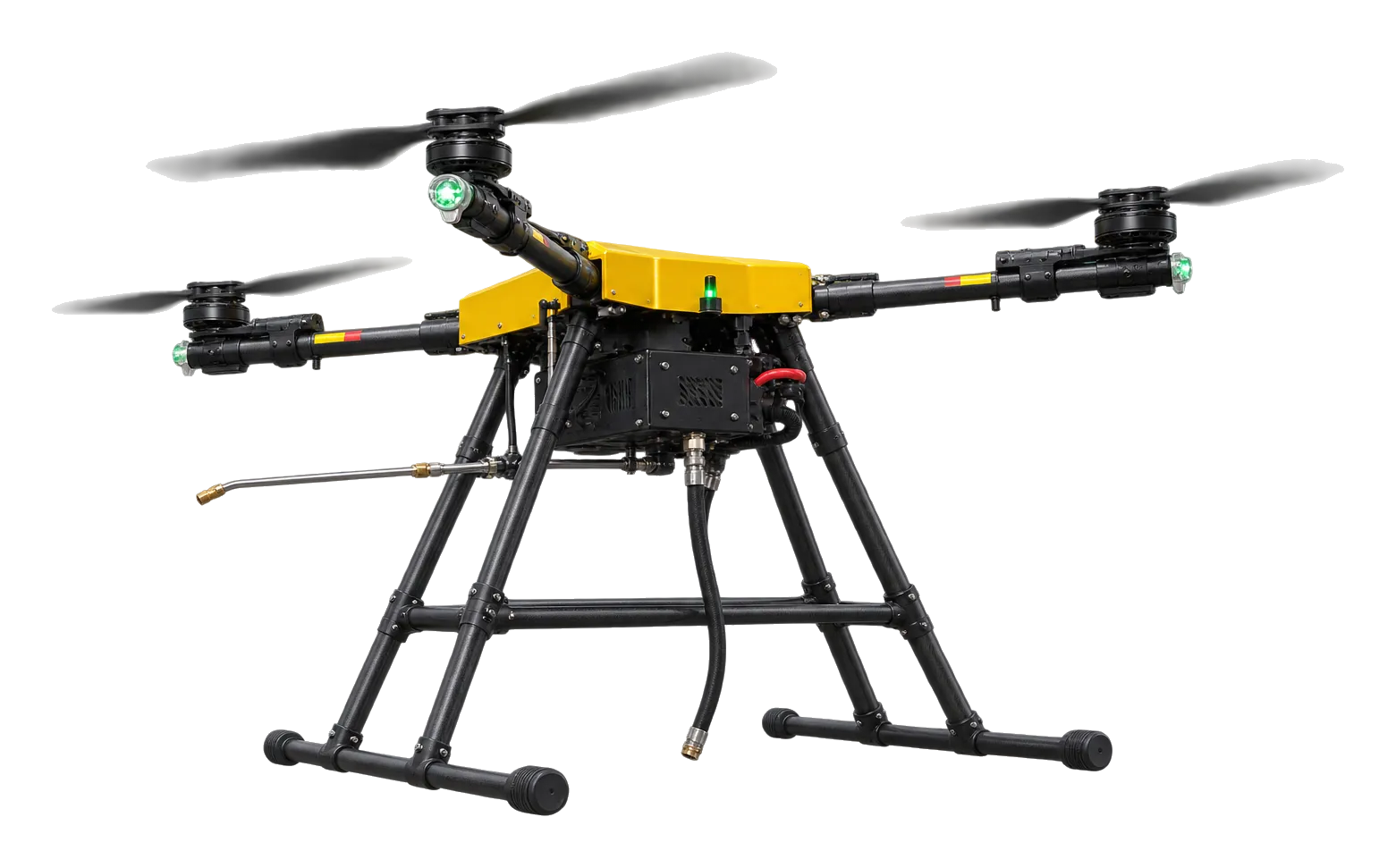
| Pitched or fragile home roof | Drone (CW-30T) | Nobody on the roof; 30 L tank, no hose over the garden | Caked dirt needs hand work |
| Large flat commercial roof | Drone with hose (CW-30P) | 32 L/min pump, tether, no rails to fit | Wind above the module limit |
| Carport over parked cars | Drone | No walkway above the cars | Needs a cordon below and a weight-class check |
| Fixed-tilt ground rows, uniform, dry region | Robot or truck with brush | Hardware repeats per row; contact cleaning; little or no water | Uneven ground and scattered blocks |
| Single-axis tracker field | Tracker-compatible robot or truck brush | Long regular rows | Check the tracker maker’s cleaning position |
| Scattered small sites | Drone (CW-30T) | One aircraft serves every site | Water must reach each site |
What do you buy, and what do you staff?
| Method | What you buy | Water | Labour | Module-maker point |
|---|---|---|---|---|
| Rail or autonomous robot | Hardware per row or block, plus charging | Many types use little or none; ask the maker | Low per wash once installed | Trina: damage from improper robot use is not covered; First Solar: approval needed |
| Drone | One aircraft, ground pump, hose | Spray and rinse; measure on a test row | Crew of two | No contact; nozzle pressure limit applies |
| Truck with brush | Vehicle and brush arm | Water plus contact | Driver and a helper | First Solar: motorised tools that rest on modules need approval |
| Manual crew | Almost nothing | Water, often a pure-water pole | Many hours per MW | Walking on modules and tilted rows |
How much energy does dirt cost?
The IEA’s 2025 fact sheet puts average soiling loss at 4–7 % of global solar energy, rising, with multi-billion-euro losses a year. MIT News cites an estimate of about 10 billion US gallons of water a year for cleaning panels worldwide, and dust that can cut output by up to 30 % in a month. How often to wash is in our solar panel cleaning frequency guide.
What do the module makers allow?
| Limit | Trina Vertex manual | First Solar guideline |
|---|---|---|
| Nozzle pressure | Maximum 4 MPa | At most 35 bar (3.5 MPa) |
| Wind and timing | No cleaning above Beaufort 4 (6–8 m/s), heavy rain or snow | Dusk to dawn, or with the inverter off |
| Water | pH 6–8, CaCO₃ below 600 mg/L, soft water | TDS below 1,500 mg/L, pH 6.5–8.5 |
| Robots and motorised tools | Soft plastic brushes; damage from improper use not covered | Tools that rest on modules must be approved by First Solar to keep the warranty |
The CW-30P pump is rated 28 MPa, which is 28 ÷ 4 = 7 times Trina’s cap. On modules use the CW-30T at 0.8–1.8 MPa, or set the nozzle pressure to the module maker’s limit. The wind limit also differs: Trina’s Beaufort 4 is stricter than the CW-30’s level 6 (11–14 m/s), so the module sets the day, not the aircraft.
Which uses less water?
Do not guess: measure a test row. A CW-30P pump at full flow delivers 32 L/min, which is 1,920 L an hour, but the nozzle is not open all the time. The plan below assumes 0.5 L/m². For the full water picture see our water consumption guide.
Why do drones win on rooftops and carports?
A South African chemicals supplier says a drone suits steep, fragile or high surfaces and carports. No rails, no walking on glass and no hardware on each row are the reasons. Our solar panel cleaning drone price guide lists the equipment cost.
When do robots or trucks win?
On open ground rows the same supplier calls a drone possible but rarely the best fit; a crew, tractor or robot is usually better. A drone also sprays rather than brushes, so cured cement or lichen needs hand cleaning first. A drone still helps on scattered blocks that rails do not reach.
How would a mixed portfolio split?
Example (assumptions, not a quotation): 550 W modules of 2.6 m² each and 0.5 L/m² of water per wash.
| Site | Modules | Glass area | Water per wash | Method and arithmetic |
|---|---|---|---|---|
| 1 MW rooftop | 1,000,000 ÷ 550 = 1,818 | 1,818 × 2.6 = about 4,730 m² | 2,365 L | Drone: 2,365 ÷ 32 = 74 min of CW-30P pump time |
| Eight 50 kW sites | 91 each | 237 m² each | 118 L each | CW-30T: 118 ÷ 30 = 3.9, so 4 tank loads a site, 32 in all |
| 20 MW fixed-tilt ground plant | 36,364 | 94,546 m² | 47,273 L | Drone pump time alone: 47,273 ÷ 32 = 1,477 min, 24.6 h a wash; use robots or trucks |
- Best for rooftops and carports: CW-30P or CW-30T, nobody on the roof, 45° lance.
- Best for long fixed-tilt rows in dry regions: robots or a truck with a brush, contact cleaning with little or no water.
- Best for scattered small sites: CW-30T, 30 L on board, no hose.
Next step
Send the plant list with module type, layout and water access. We reply with the aircraft and the pump set-up that stays inside your module maker’s limits.
Q & A
Common questions
01Can I use a drone to clean solar panels?
Yes. A drone sprays and rinses from above, with nobody on the array. It works best where access is the problem. It does not brush, so cured dirt, cement or lichen is softened or removed by hand first.
02What is the best method of cleaning solar panels?
The IEA’s soiling fact sheet says there is no one-size-fits-all fix and that cleaning schedules balance recovered energy against cost. Match the method to the layout: drones for roofs and carports, robots or trucks for long ground rows.
03What are the best robots for solar panel cleaning?
We do not make robots, so we do not rank them. Ask any robot maker for the module maker’s written approval, because Trina does not cover damage from a robot used improperly and First Solar must approve automated tools that rest on its modules.
04Is drone solar panel cleaning cheaper than cleaning robots?
It depends on whether you buy equipment or a service, and on array size. A drone is one purchase for many sites; a robot is hardware per row or block, which pays off on large uniform plants.
05Does drone cleaning void a module warranty?
It can if it breaks the maker’s cleaning guideline. Check pressure, water quality, wind and timing, and ask the module maker in writing before the first wash.
References
- 1Understanding, Measuring, and Mitigating Soiling Losses in PV Power Systems (fact sheet) — IEA PVPS
- 2Vertex Series User Manual — Trina Solar
- 3PV Module Cleaning Guidelines — First Solar
- 4How to clean solar panels without water — MIT News
- 5Drone cleaning where crews can’t reach safely — RenewChem
VEXAFLY Aviation Technology Co., Ltd.. VEXAFLY Aviation Technology Co., Ltd. — industrial drone maker in Nanjing. Our application engineers write and check these pages and configure inspection, cleaning, lift and fire-response systems for project buyers. About VEXAFLY