Market · Site conditions
Firefighting Drones in Greece (2026): Detection, Suppression and Who May Fly
Firefighting drones in Greece in 2026: detection versus suppression, who flies under which rules, and which RX-100, RX-120 or IS-4 fits estates and solar parks.
- Author
- VEXAFLY Aviation Technology Co., Ltd.
- Scope
- Market · Site conditions
- Published
- Length
- 4 min read · 5 sources
Short answer: in 2026 firefighting drones in Greece split into two jobs. Detection is already a state programme with more than 100 announced drone bases. Suppression, with pods or a hose, is a heavier class of aircraft, and who may fly it depends on whether the operator is a public fire service or a private team. Facts checked on 28 November 2026.
Site conditions at a glance
This page covers suppression payloads, who may operate and island logistics.
| Condition | Figure | What it means for equipment |
|---|---|---|
| 2023 Evros fire | Started 19 August 2023; over 94,000 ha burnt in this single blaze (EFFIS/JRC) (JRC) | Scale beyond any drone: use drones for spot work and mop-up |
| Surveillance network | More than 100 drone bases and three mobile command centres announced for the 2026 season (Dronewatch) | Detection is covered by the state |
| Fleet growth | 82 fire-surveillance drones in 2025, up from 45 two years earlier | Public demand is for cameras, not pods |
| Solar | About 1.9 GW added in 2025, around 11.5 GW in total | Private sites with fire exposure |
| Regional fire danger | 2025 was a record burnt-area year across Europe; the south-east had above-average fire danger June to September (Copernicus) | Season length for staffing and spares |
Wind drove the Evros fire. Wind ratings for the RX aircraft are not in our product files, so we set wind limits for your site in the quotation.
Detection or suppression: what each drone does
| Role | Aircraft | What it does | Typical operator |
|---|---|---|---|
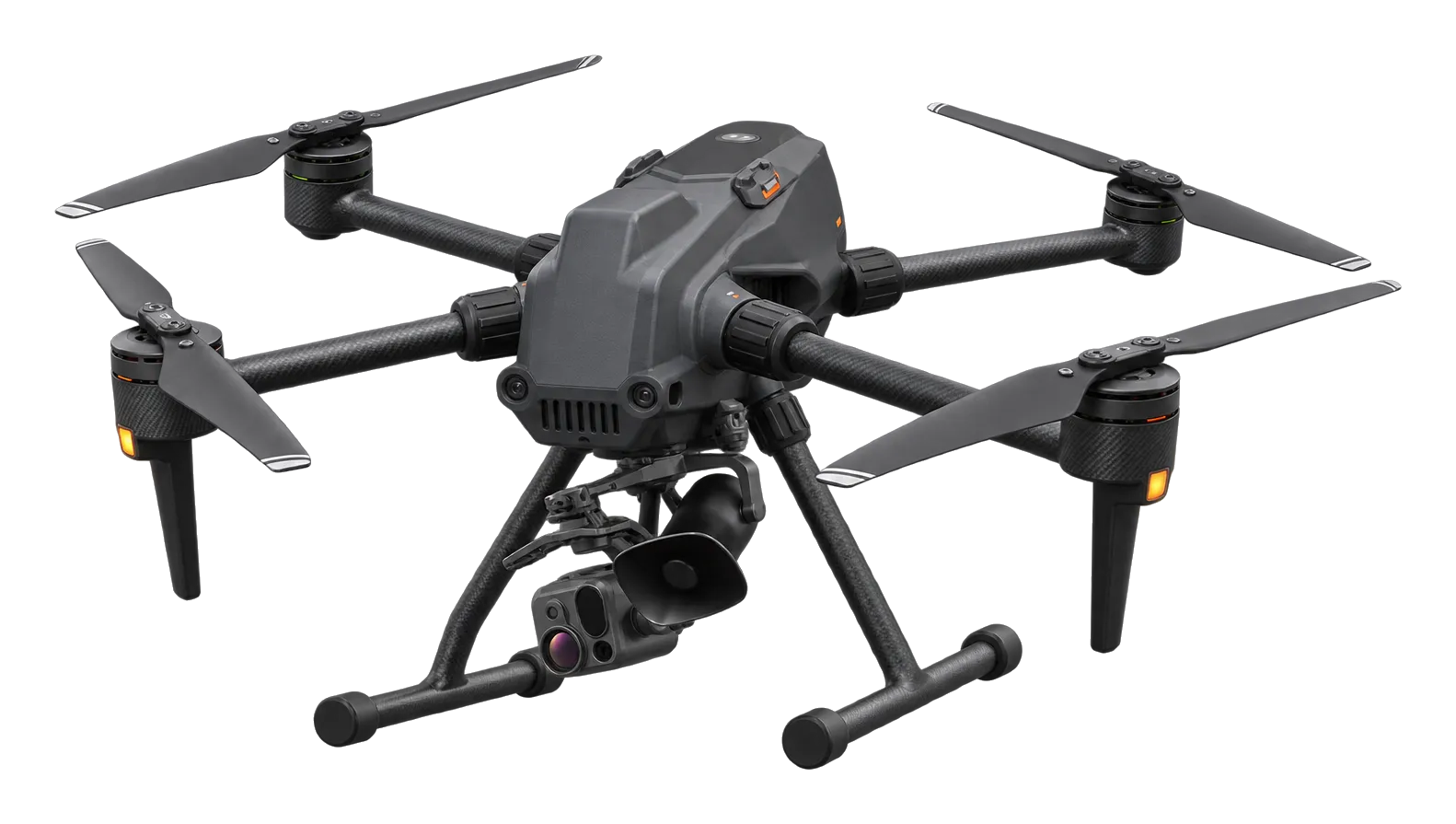
| Hotspot and perimeter watch | IS-4 thermal | Finds hot ground and embers after the front passes; 7 kg, IP45, not for rain | Estates, solar parks, forest owners |
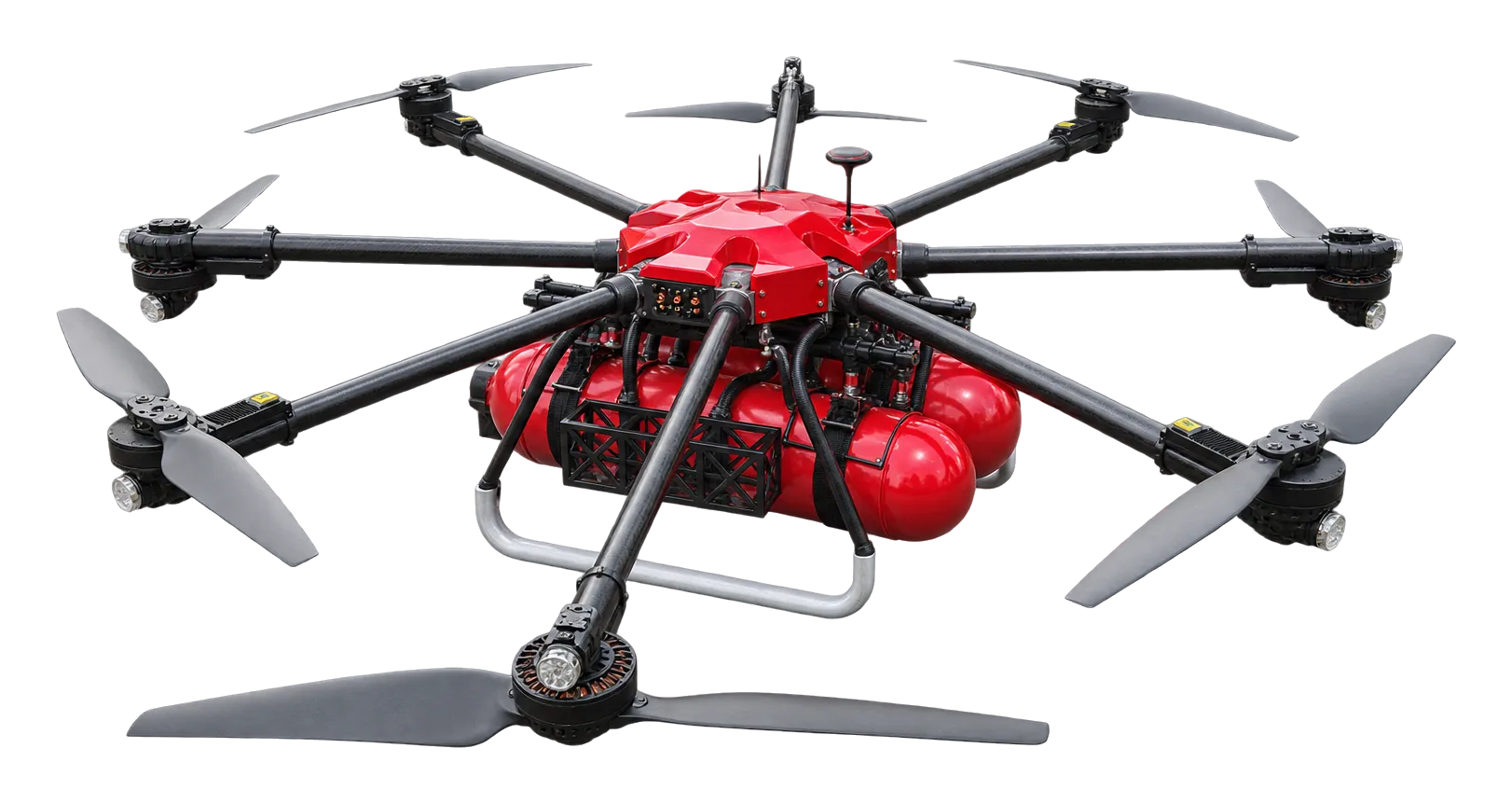
| Spot drops and mop-up | RX-100 | 100 kg payload, 190 kg MTOW, 25 L pods, ball dispenser or hose | Fire teams, estates |
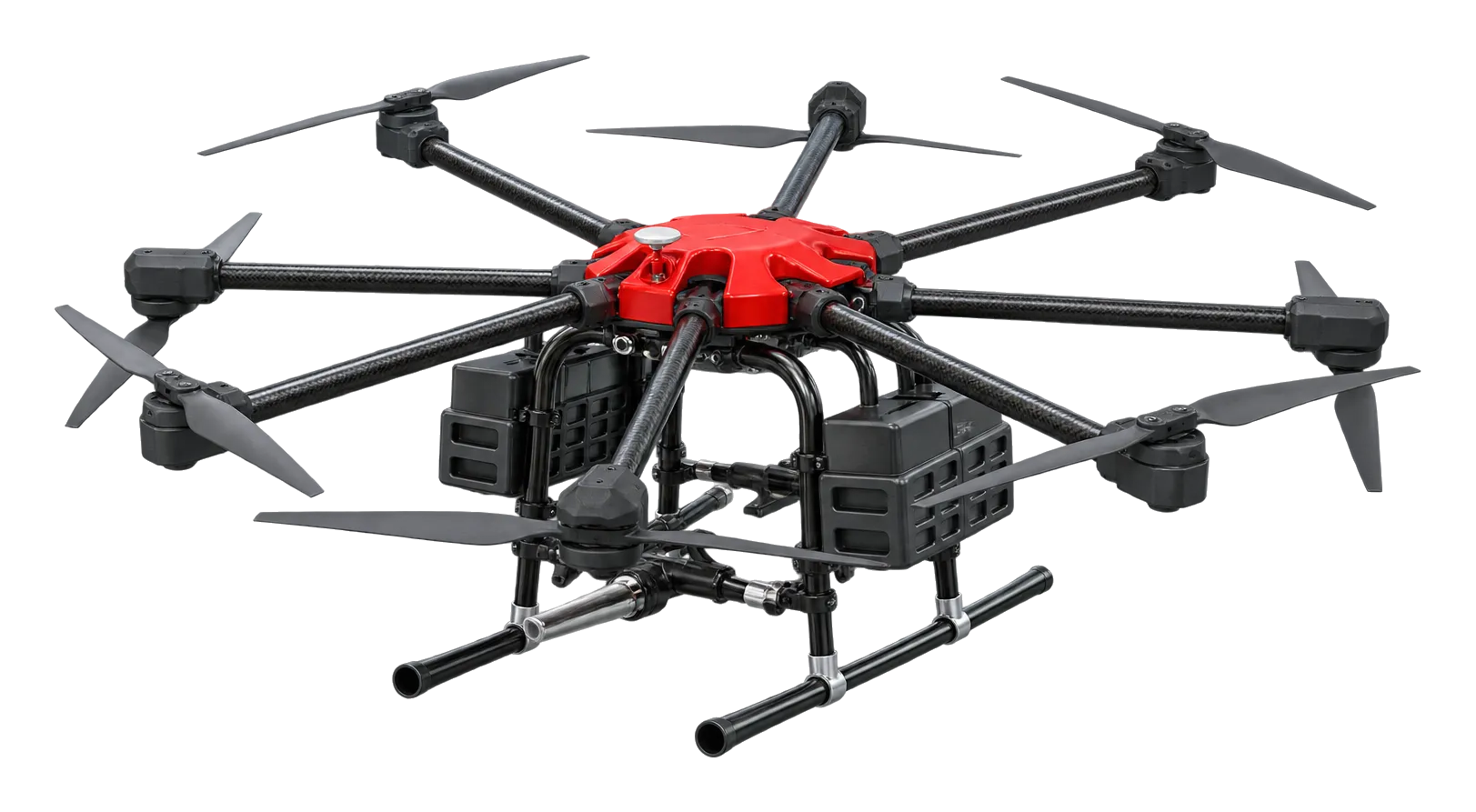
| Hose or four-pod work | RX-120 | 120 kg load, 257.8 kg MTOW, 4 × 23 kg pods or 40 mm hose, IP67, −20 °C to 60 °C | Industrial sites, forest edges |
Who operates under which rules?
EU Regulation 2018/1139, Article 2, says it does not apply to aircraft used for firefighting under the control of a Member State, in the public interest, by a body with public authority. So a state fire service follows national rules, and a private or industrial team follows the EASA specific category with an operational authorisation. We do not say either route is easier. The HCAA runs the drone portal and operator registration. Read how to buy firefighting drones before choosing.
Which RX set-up for which site?
| Site | Supply | Set-up | Why |
|---|---|---|---|
| Estate or resort with a tank | Water tank on site | RX-100 with pods | Light frame, pickup transport |
| Industrial site with hydrants | Hydrant or truck | RX-120 with 40 mm hose | Continuous water from the ground |
| Forest edge, no road | Water point nearby | RX-100 pods | 52 kg airframe, up to 1,000 m height |
| Remote ridge | Water point at launch | RX-120 pods | 44.6 km range in the brochure, load dependent |
Example (assumptions marked). The RX-120 with four 23 kg pods releases 4 × 23 = 92 kg per sortie. If a plan for a fire line needs 1,000 kg of agent (assumption), that is 1,000 ÷ 92 ≈ 10.9, so 11 sorties, before reloading time. We do not quote a pod count per sortie for the RX-100 because the product file does not give it.
Heat, wind and smoke: where it stops working
The RX-120 is IP67 and rated −20 °C to 60 °C. That covers the heat of a Greek summer, but not the heat of a fire plume, and not the wind that drives a front. Drones add the most when crews are on the ground near a water source and need a precise drop on a spot fire. They do not replace aircraft for a front.
Islands and remote sites
Many sites are reached by ferry, so plan spare parts, batteries and a pickup-sized transport case on the island rather than on the mainland. Our service page covers spares, and firefighting drone cost covers the budget.
Recommended configurations
Best for hotspot watch on estates and solar parks: IS-4 thermal, 63 min, 3 kg payload. Best for spot drops near a water point: RX-100 with pods, 100 kg payload. Best for industrial sites with a hose supply: RX-120, 40 mm hose or four pods.
Next step: tell us the site, the water point and who will operate, and we will say which aircraft fits and what to ask the HCAA; see the fire-response range.
Q & A
Common questions
01How are drones used against wildfires in Greece?
Mostly for detection and surveillance: Greek reports describe more than 100 drones for the Fire Service and Civil Protection across all 13 regions, with thermal and zoom cameras. Suppression with pods or hoses is a different, heavier class of aircraft.
02Can drones drop water or extinguishing pods on wildfires?
Yes, heavy drones can: the RX-120 carries four 23 kg pods. Their effect is local, on spot fires and hot ground near a water point. They do not stop a wind-driven fire front, and agents must be allowed on the site you plan to use.
03Who may fly firefighting drones in Greece?
It depends on who operates. Firefighting by a public body is outside the EU Basic Regulation and follows national rules; a private or industrial team follows the EASA specific category. Ask the HCAA which applies to your organisation.
04What payload does a firefighting drone carry?
The RX-100 has a 100 kg maximum payload and the RX-120 a 120 kg maximum load. Remember that load capacity is not the same as the weight of the agent: pods and hose kits count against it.
05Which drone suits island and mountain sites?
The RX-100 has a 52 kg airframe and works up to 1,000 m above ground, so it travels by pickup. For islands, plan spare parts and batteries on the island, because many sites are reached by ferry.
06Do private estates and solar parks need HCAA permission?
Aircraft above 25 kg need an operational authorisation in the specific category, and the operator must register. The HCAA is the authority to ask. Do not assume a private fire drone is exempt because a public one might be.
References
- 1Wildfires in the Mediterranean: EFFIS data reveal extent this summer — European Commission Joint Research Centre
- 2Greece expands drone surveillance network ahead of 2026 wildfire season — Dronewatch Europe
- 3More than 100 drones on standby for wildfire season across Greece — ProtoThema English
- 4Drones & Air Mobility — Hellenic Civil Aviation Authority
- 5Regulation (EU) 2018/1139, Article 2 (scope) — legislation.gov.uk (EU text as adopted)
VEXAFLY Aviation Technology Co., Ltd.. VEXAFLY Aviation Technology Co., Ltd. — industrial drone maker in Nanjing. Our application engineers write and check these pages and configure inspection, cleaning, lift and fire-response systems for project buyers. About VEXAFLY