Firefighting
How to Buy Firefighting Drones in 2026: A Procurement Guide for Fire Services
How to buy firefighting drones in 2026: needs assessment, specification, bid scoring, acceptance test, training and the US rules for foreign-made aircraft.
- Author
- VEXAFLY Aviation Technology Co., Ltd.
- Scope
- Firefighting
- Published
- Length
- 4 min read · 5 sources
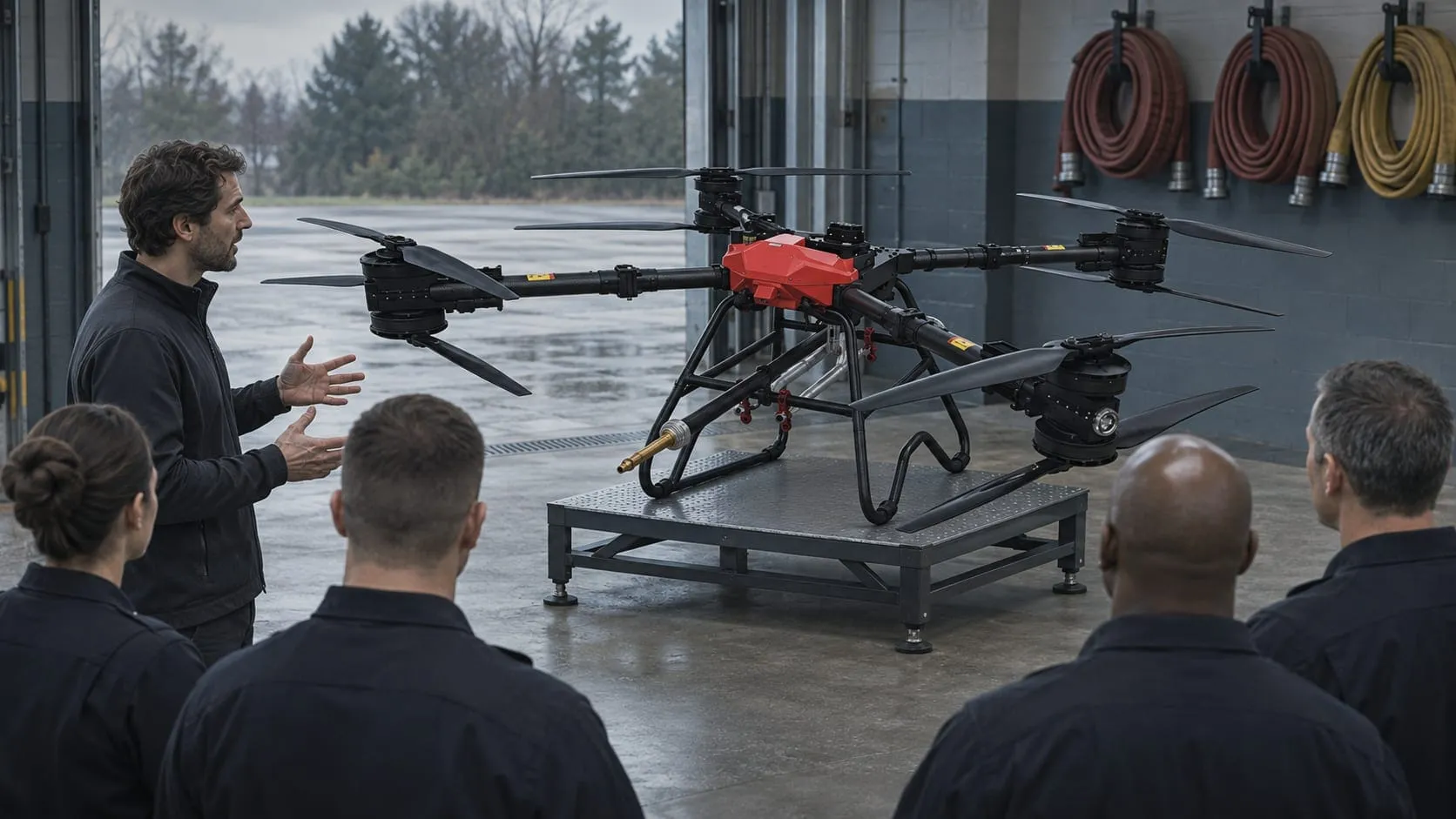
Short answer: in 2026 the way to buy firefighting drones is a seven-step process: assess your needs, write the specification, invite bids, score them, test the aircraft, sign with training and spares, and plan the funding. Writing the specification first matters most, because NFPA 2400 asks for one before acquisition.
What are the steps to buy a firefighting drone?
| Step | Who does it | Output | Evidence to ask the supplier for |
|---|---|---|---|
| 1 Needs assessment | Chief officer + drone lead | Scenes, heights, distances, agents | None yet |
| 2 Specification | Drone lead + procurement | Requirements table with verification method | Datasheet figures at your conditions |
| 3 Invitation to bid | Procurement | Same sheet to every supplier | Quotation with separate lines |
| 4 Bid scoring | Panel of 3–5 | Weighted score sheet | Test reports, manuals, references |
| 5 Demo and acceptance test | Pilots + supplier | Signed test record | Live flight at your site |
| 6 Contract | Procurement + legal | Training, spares, warranty, delivery | Support period in writing |
| 7 Funding and rules | Finance + aviation lead | Approved budget and permissions | Import and approval documents |
What should the needs assessment cover?
Write down the scenes you will actually attend: roof fires, upper floors of towers, grass and forest edges, industrial tanks, warehouses. For each, note the height, the distance from the nearest road, the agent you may use and who approves a drop. Count how often each scene occurs a year. A department with two tall buildings a year needs a different fleet from one with a forest on its doorstep.
What should the specification say?
NFPA 2400 says a purchase specification is completed before acquisition, based on the needs assessment, and considers operational requirements, a minimum configuration, quantitative data showing the aircraft’s capabilities and a sustainable life cycle, which means the supplier can provide parts, maintenance and updates.
| Requirement | Example wording | How to verify |
|---|---|---|
| Payload and range | Carry 4 pods or a hose at 40 m height | Test flight with the real load |
| Environment | Operate −20 °C to 60 °C; IP67 | Datasheet plus supplier test report |
| Agents | Water-based and ABC powder pods | Pod specifications, fuze type |
| Documents | Manuals, parts list, maintenance plan in English | Check before award |
| Life cycle | Parts available for a stated period | Written commitment |
Direct from the maker, a dealer or an integrator?
Direct purchase gives engineers access to the factory and often the best price. A dealer or integrator adds local training and spares. Teams without in-house pilots should consider a local partner; see our partner programme. Whichever you choose, the specification stays the same.
How do you score the bids?
Fix the weights before opening any offer.
Example only, assumed scores out of 10. Weights: mission fit 30, site-condition test 25, documents 20, training and spares 15, price 10.
| Criterion (weight) | Bid A | Bid B | Bid C |
|---|---|---|---|
| Mission fit (30) | 8 | 7 | 9 |
| Site test (25) | 8 | 6 | 7 |
| Documents (20) | 7 | 9 | 5 |
| Training and spares (15) | 6 | 8 | 5 |
| Price (10) | 6 | 9 | 10 |
| Weighted total | 2.40 + 2.00 + 1.40 + 0.90 + 0.60 = 7.30 | 2.10 + 1.50 + 1.80 + 1.20 + 0.90 = 7.50 | 2.70 + 1.75 + 1.00 + 0.75 + 1.00 = 7.20 |
The cheapest bid finishes last. Bid B wins on documents, training and spares.
How do you run a demo and acceptance test?
For scouts, NFPA 2400 uses ten NIST aerial test methods, five on manoeuvring and five on functionality, built around cheap targets such as white buckets. For heavy aircraft there is no equivalent: drop a pod on a marked area, run the hose at your actual pump pressure and time the set-up with your crew. Record results, sign them and attach them to the contract.
What do US buyers need to check?
NFPA 2400 covers small aircraft under 55 lb (25 kg); our RX aircraft are far heavier (the RX-120 has a maximum take-off weight of 257.8 kg), so the specification must also include large-aircraft approval with your aviation authority. In the US, foreign-made drone models that did not already hold an FCC equipment authorisation cannot get one since 22 December 2025, and federal grant money cannot buy drones on the federal prohibited list. Ask any foreign supplier, including us, for the FCC ID. Also check the Section 232 duty and, for aircraft of 55 lb or more, FAA approval, and confirm with your customs broker and the FAA. Read our FCC guide and the import guide.
- Best for buyers with fixed tender rules: write an NFPA 2400-style purchase specification first.
- Best for a first heavy drone: RX-120, 44.6 km range, four 23 kg pods or a hose.
- Best for heavy hose loads: RX-200, 150 kg rated.
- Best for teams without pilots: buy through a local partner with training.
Next step
Send your specification sheet, or the scenes if you have no sheet yet, through the contact form. We return a configuration, reference price and a training plan. For the technical checklist behind a tender, read industrial drone tender specifications, and see the fire-response range.
Q & A
Common questions
01Where can a municipal fire department buy firefighting drones?
From manufacturers, from dealers and integrators that bundle training, and through cooperative purchasing contracts where your government offers them. Which route fits depends on your tender rules and whether you need local support.
02What goes into a drone specification?
Missions and scenes, payload and flight time at your altitude and temperature, ingress rating, agents, documents, training days, spares and the support period. Add how each item will be verified.
03How do we test a drone before we accept it?
For scouts, run the NIST test methods that NFPA 2400 uses. For pod and hose aircraft, drop a pod on a marked area and run the nozzle at your pump pressure with the real hose. Write pass marks into the contract.
04Do we buy direct from the maker or through a dealer?
Direct can be cheaper and gives engineers a straight line to the factory. A local partner gives you language, training and quick spare parts. Large buyers sometimes sign with both.
05Can we use a FEMA grant?
FEMA's FY2025 AFG guidance names drones as ineligible equipment, and since 22 December 2025 no federal grant money may buy a drone on the federal prohibited list. Read the current notice or ask FEMA before you build a grant into the budget.
06What training comes with the aircraft?
Ask for days, location and a written syllabus. Our RX aircraft are delivered with operator training; drops need a trained pilot, a spotter and a procedure agreed with the incident commander.
References
- 1NFPA 2400 Standard Development — National Fire Protection Association
- 2NIST Performance Tests for Aerial Response Robots Become National Standard — NIST
- 3Fiscal Year 2025 Assistance to Firefighters Grant (AFG) Program NOFO — FEMA / U.S. Department of Homeland Security
- 4M-26-02: Ensuring Government Use of Secure Unmanned Aircraft Systems and Supporting United States Producers — Office of Management and Budget
- 5Operate a Drone, Start a Drone Program — Federal Aviation Administration
VEXAFLY Aviation Technology Co., Ltd.. VEXAFLY Aviation Technology Co., Ltd. — industrial drone maker in Nanjing. Our application engineers write and check these pages and configure inspection, cleaning, lift and fire-response systems for project buyers. About VEXAFLY