Buying
Drone Tender Specifications in 2026: Writing Measurable Specs for Inspection and Dock Bids
Drone tender specifications for inspection and dock bids in 2026: measurable lines, brand-neutral wording, acceptance tests, legal filters and a worked example.
- Author
- VEXAFLY Aviation Technology Co., Ltd.
- Scope
- Buying
- Published
- Length
- 5 min read · 7 sources
Short answer: drone tender specifications for an inspection or dock project should be measurable, brand-neutral and tied to an acceptance test. In 2026, write each performance line with a value, a condition and a method. A note on the keyword: in the US, “drone tender” often means a trailer or skid that carries water and mix tanks for spray drones. This page covers the other meaning, a tender as a call for bids; for spraying logistics see our agricultural tender guide.
What does your site demand?
Start from the site, then turn each demand into a line a bidder can prove.
| Site demand | Specification line | How to verify |
|---|---|---|
| Route length | Endurance of at least X min at Y kg payload, Z m/s wind, stated altitude | Witnessed flight with logged battery data |
| Weather | IP rating per IEC 60529 and a stated operating temperature range | Test report or certificate |
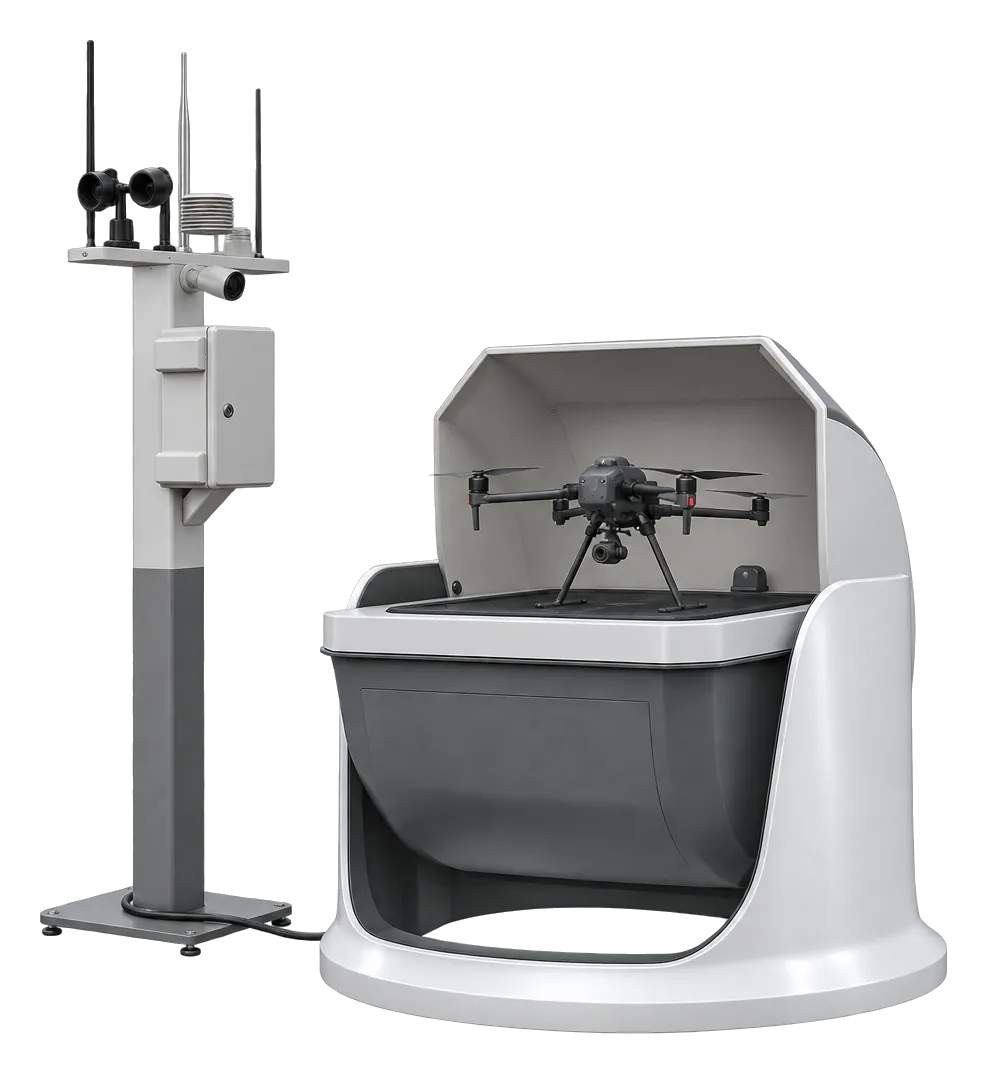
| Dock site | Power draw in W, network type, IP rating, temperature range | Datasheet plus site survey |
| Interference near high-voltage assets | Behaviour on link loss, RTK and positioning accuracy | Return-to-home test and hover log |
| Altitude | Maximum operating altitude | Datasheet |
| Data | Formats, storage on your servers, user access | Demonstration and document |
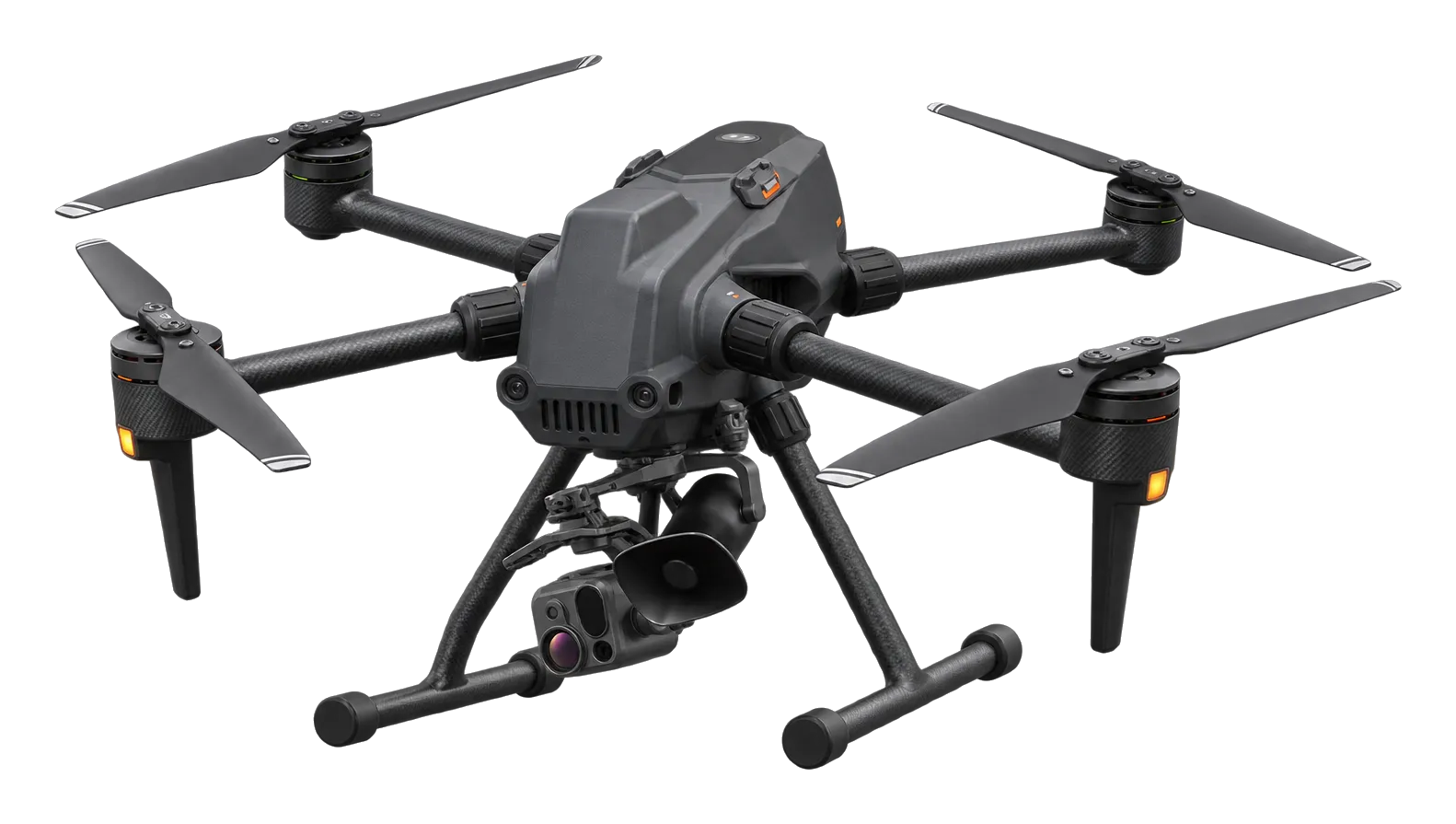
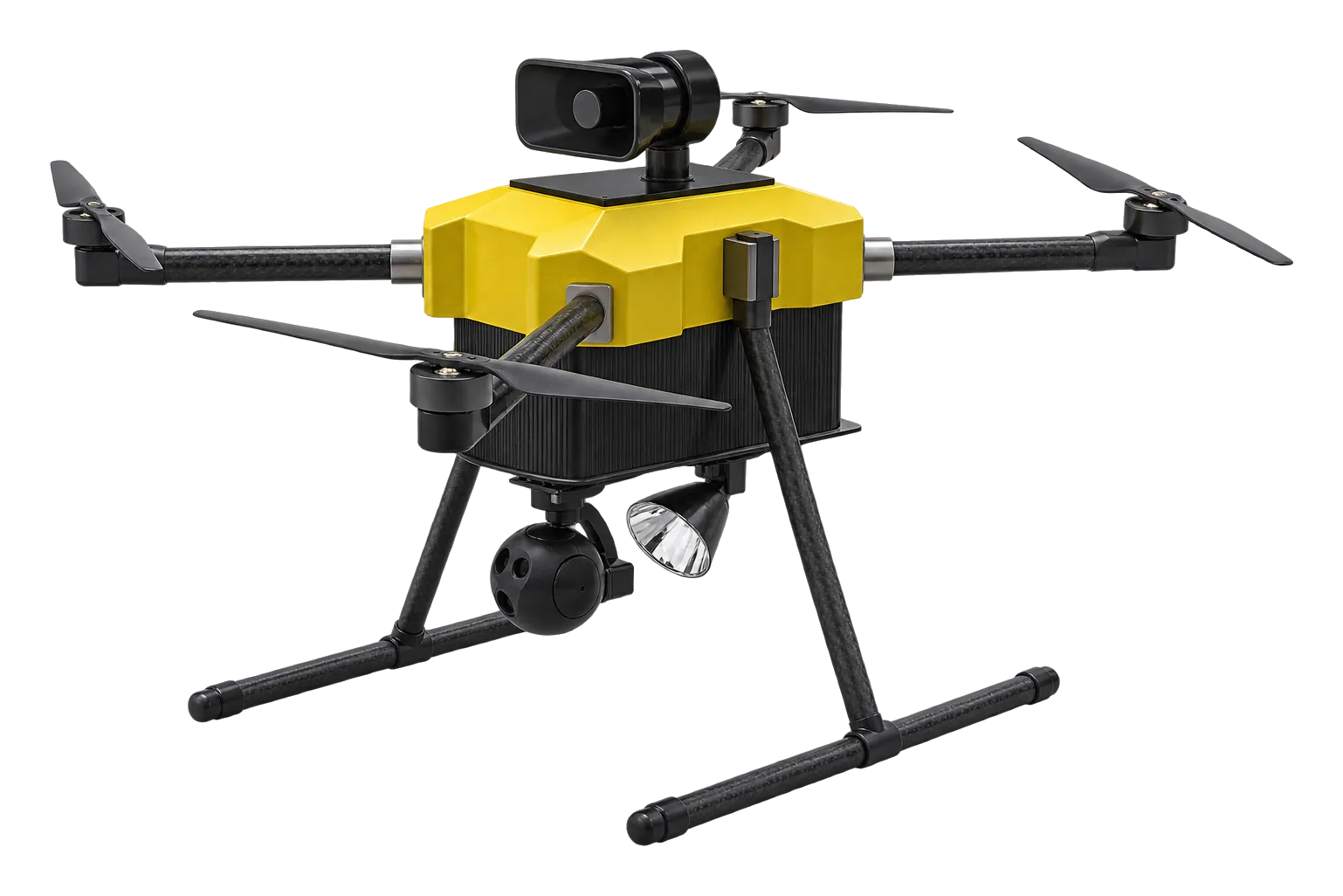
Reference figures from our product files show how such lines look. The IS-9 lists about 90, 75, 65, 60 and 50 minutes at 1, 2, 3, 4 and 5 kg payload, so a line reading “maximum endurance 120 min” would hide a 60 % loss at full payload. The IS-4 lists RTK hover accuracy of ±0.1 m; the DS-1 lists an 8 km control distance, IP54, 1,700 W maximum power and −35 °C to 50 °C.
How do you write a line a bidder can prove?
| Weak line | Why it fails | Measurable line |
|---|---|---|
| “DJI Dock 3 or equal” | Brand-locked, equal is undefined | Dock with automatic launch, landing and charging, IP54 or better, −35 °C to 50 °C, 8 km control distance, Ethernet, UPS |
| “Minimum 40 min flight” | No payload, wind or method | “At least 40 min at 2 kg payload and 8 m/s wind, measured at site altitude per the stated method” |
| “Weatherproof” | No standard | “IP45 or better per IEC 60529; certificate supplied” |
| “High-resolution camera” | Untestable | “Reads a 5 cm marker at 50 m” (set your own figure) |
US federal rules prefer performance specifications (FAR 11.104(a)) and, when a brand-name-or-equal line is used, require salient physical, functional or performance characteristics (11.104(b)). Elsewhere, the World Bank’s procurement framework asks for fitness for purpose and value for money, which points the same way.
Dock tenders: the extra lines
- Compatibility: which aircraft the dock supports and how many cycles per day it must handle.
- Power and network: peak draw, backup duration (UPS), fallback if the link is lost.
- Environment: temperature and ingress protection of the dock cover, not only of the aircraft.
- Control: web back-end, user rights, and an SDK or API if your platform must connect.
- Local rules: whether remote launches are permitted at your site.
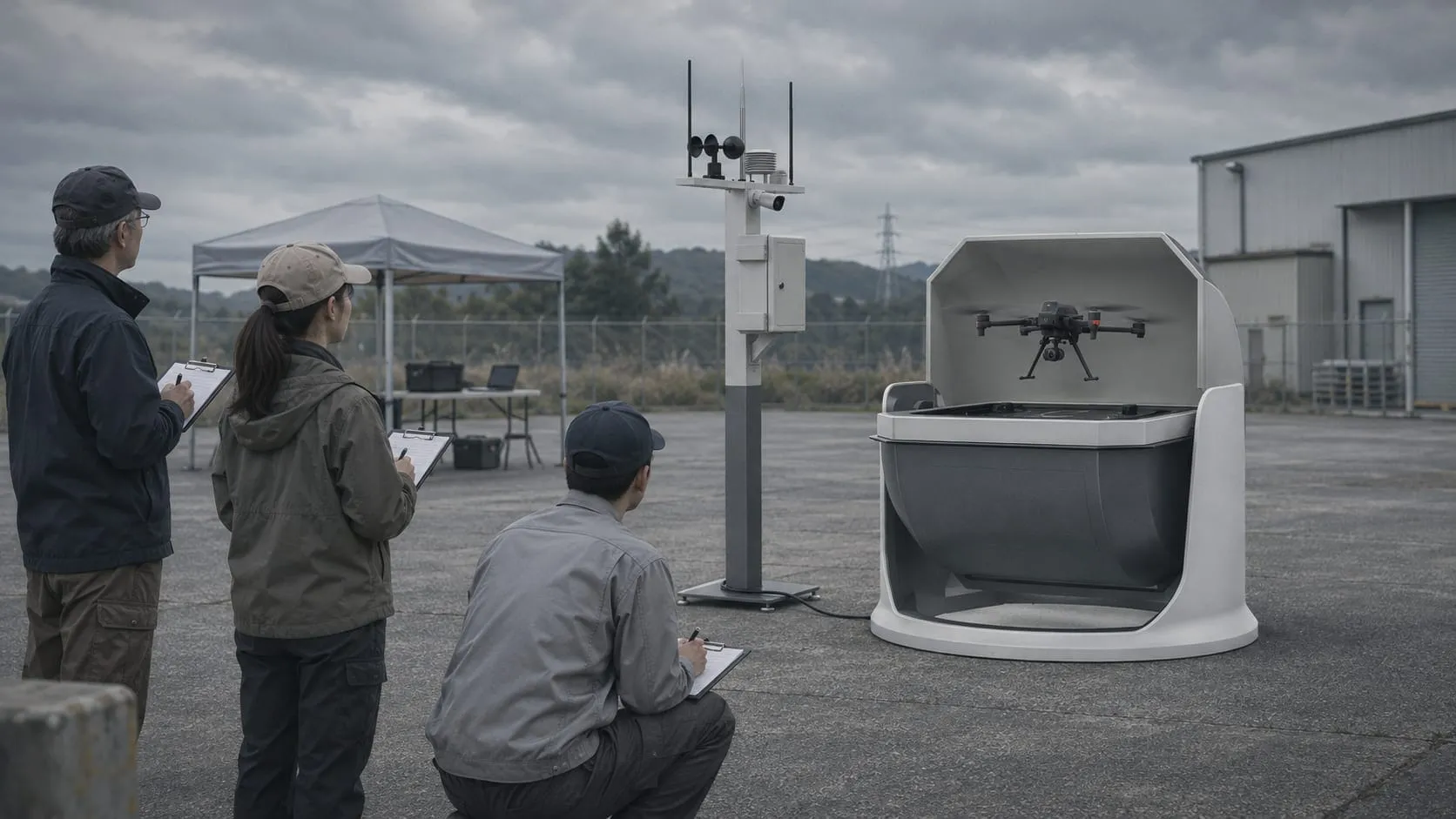
Acceptance tests: what to witness
| Test | Method | Pass value (set your own) | Witness |
|---|---|---|---|
| Endurance | Flight at stated payload and wind | At or above the specified minutes | Buyer’s engineer |
| Video and control range | Fly out along a clear line | Specified km with stable link | Buyer |
| Hover accuracy | RTK hover over a surveyed point | Within the stated metres | Buyer |
| Dock landings | Automatic cycles | e.g. 20 in a row without fault | Buyer |
| IP claim | Certificate review | Matches the specification | Buyer |
| Documents | Check list | All delivered | Procurement |
Worked example: a substation cluster tender
Example with assumed figures. A utility wants 3 docks for substations spread over a 4 km × 2 km area. The longest straight distance is √(4² + 2²) = 4.5 km, so a control distance of 8 km (the DS-1 figure) leaves a margin. A round patrol of 9 km at 10 m/s takes 900 seconds, which is 15 minutes; add 20 % reserve and the minimum is 18 minutes. So the tender should ask for “at least 30 minutes at the mission payload”, not a maximum figure of 63 minutes, which was measured in light wind without a heavy payload. Two lines now bind the bidder to a result.
What legal filters apply before you publish?
In the US, check three things before ordering a foreign-built drone: its FCC Covered List status, the Section 232 duty and FAA approval for aircraft of 55 lb or more. Confirm with your customs broker and the FAA. Federal contracts add FAR 52.240-1, which bars delivery of UAS made by covered foreign entities and, from 22 December 2025, their use in contract performance; federal grant funds follow OMB M-26-02. See our guides on importing industrial drones from China and FCC certification. Other countries have their own procurement and customs rules.
Which mistakes shrink the bidder list?
Naming a brand, asking for a figure only one product reaches, and omitting test conditions are the usual ones. A line copied from another country’s tender can contradict your rules. Use the Association for Drones tender programme and a technical reviewer to check the draft before it goes out.
Best for …
- Best for fixed sites with repeat routes: a DS-1 and IS-4 specification set, with cycle-based acceptance.
- Best for long linear assets: IS-9 style lines that fix endurance at payload (50 min at 5 kg).
- Best for budget patrol tenders: IS-4X lines, since it is IP67 with 6 kg MTOW.
- Best for US federally funded buyers: check FASC, FCC and duty rules first.
Next step
Send your draft specification and we reply line by line with a test method for each, through the contact form; the inspection range lists the reference values for the aircraft mentioned here.
Q & A
Common questions
01What should a drone tender specification include?
The mission and site, the aircraft performance at stated conditions, the payload and sensors, protection and temperature ratings, data and software requirements, documents, training, spares and warranty, plus acceptance tests and scoring.
02How do you avoid brand-locked specifications?
Describe performance, not a product. If a brand-name-or-equal line is unavoidable, US federal rules (FAR 11.104) require the salient physical, functional or performance characteristics to be listed, so state them.
03How do you test endurance and range at acceptance?
Fix the payload, wind, altitude and temperature in the specification and run the flight in front of a witness. Ask bidders which method their figure comes from; export classification in China uses a full-load level-flight method, which differs from a hover figure.
04What documents should bidders submit?
Datasheet with test conditions, IP certificate or test report, battery and shipping documents, software and data-handling description, training plan, spares list, warranty and the origin of key components.
05Can US public bodies buy foreign drones?
Not freely. Federal contracts have restrictions on drones from covered foreign entities, federal grant money cannot buy prohibited drones, and the FCC and customs rules also apply. Confirm with your procurement officer and counsel.
06What sensor resolution should we ask for?
Ask for the result you need, such as a minimum pixel count on a named target at a stated distance, instead of a camera model. Written targets can be tested.
References
- 1FAR 11.104 Use of brand name or equal purchase descriptions — Acquisition.gov
- 2FAR 11.002 Policy — Acquisition.gov
- 3FAR 52.240-1 Prohibition on UAS Manufactured or Assembled by ASDA-Covered Foreign Entities — Acquisition.gov
- 4Drone Tender & Procurement Program — Association for Drones
- 5IEC 60529 Degrees of protection provided by enclosures (IP Code) — IEC
- 6Procurement Framework for IPF Projects — World Bank
- 7Drone Tendering: Considerations before Buying or Building — Sprayers 101
VEXAFLY Aviation Technology Co., Ltd.. VEXAFLY Aviation Technology Co., Ltd. — industrial drone maker in Nanjing. Our application engineers write and check these pages and configure inspection, cleaning, lift and fire-response systems for project buyers. About VEXAFLY