Agriculture
Agricultural Drone Tender Specification (2026): What to Write and How to Test
How to write an agricultural drone tender specification in 2026: measurable values, proof from bidders, an acceptance test, documents and Kenya checks.
- Author
- VEXAFLY Aviation Technology Co., Ltd.
- Scope
- Agriculture
- Published
- Length
- 5 min read · 10 sources
Short answer: an agricultural drone tender specification should state each requirement as a measurable number, say how the bidder proves it and say how you will test it at delivery. In 2026 the minimum set is tank litres and payload kilograms (separately), take-off weight, effective swath with its CV, flow range, droplet range, IP rating, loaded flight time and spreader capacity if you spread. ‘Tender’ also means a refill trailer in this trade; this guide is about buying aircraft.
What should an agricultural drone tender specify?
| Requirement | Write it as | Bidder proves it with | You test it by |
|---|---|---|---|
| Tank and payload | Spray tank of at least N litres and rated payload of at least N kilograms | Data sheet with both | Fill to the mark, weigh the loaded aircraft |
| Take-off weight | Not above N kg with battery and full tank | Data sheet, registration papers | Weighing; compare with your authority’s categories |
| Effective swath | At least 8 m at CV 25 % or better, at stated height and speed | Pattern-test report | Cards across three passes |
| Flow range | Minimum and maximum L/min | Data sheet | Time a block, measure litres used |
| Droplet size | A range in µm, or an ASABE S572.3 class | Nozzle data sheet | Spray cards |
| Ingress protection | IP code under IEC 60529 at the level your climate needs | Test report or declaration | Check the label and report |
| Loaded flight time | At least N minutes at stated payload and altitude | Flight log | Timed sortie at delivery |
| Spreading | Hopper litres, granule size in mm, rate in kg/min | Data sheet | Spread a weighed quantity on trays |
How do you match the specification to your fields?
Start from the site: crop, plot size, slope, water and power decide the class. Our size calculator and hilly terrain guide show how. Write ranges, not one brand’s exact numbers; a specification copied from one brochure becomes a single-brand tender and invites challenges.
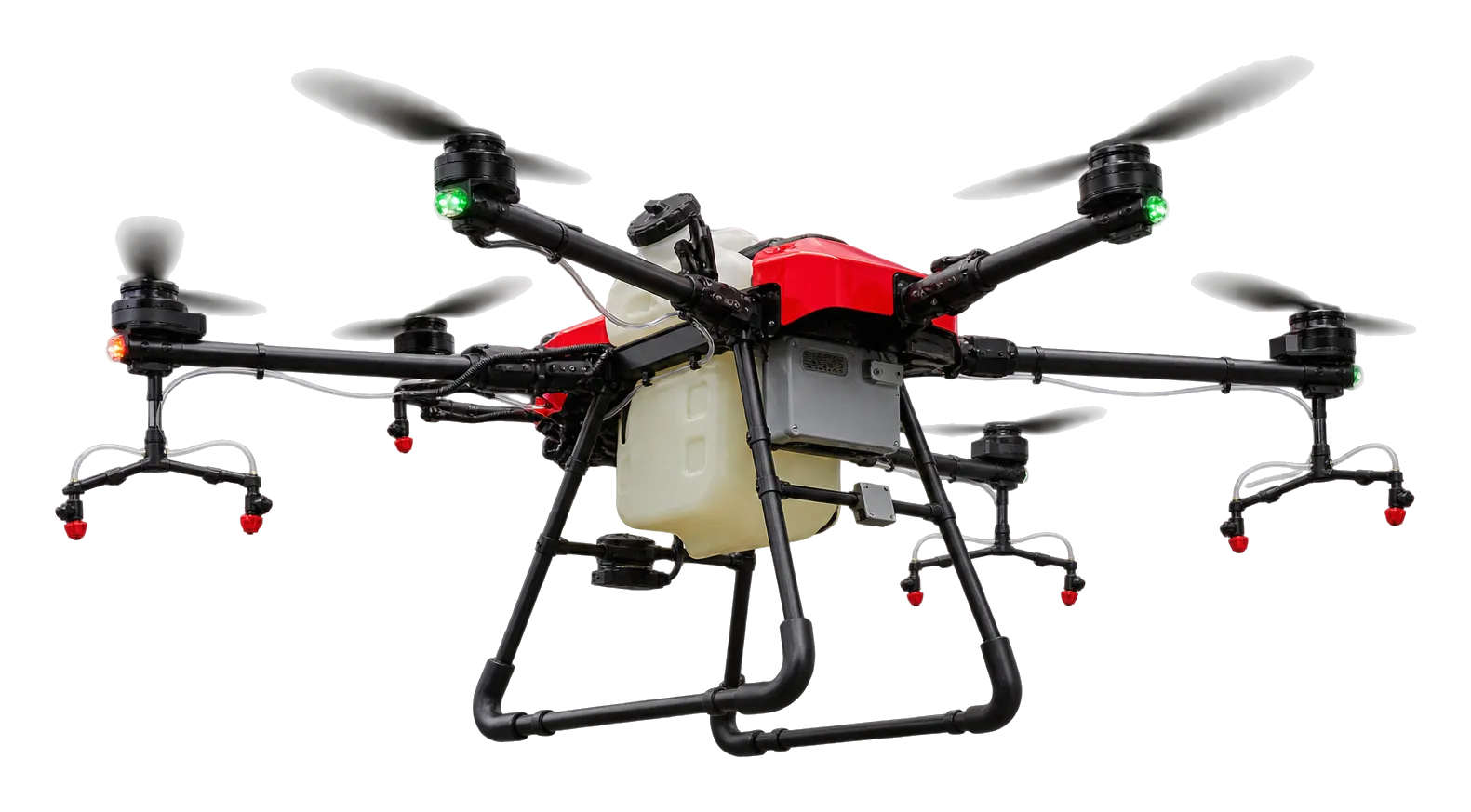
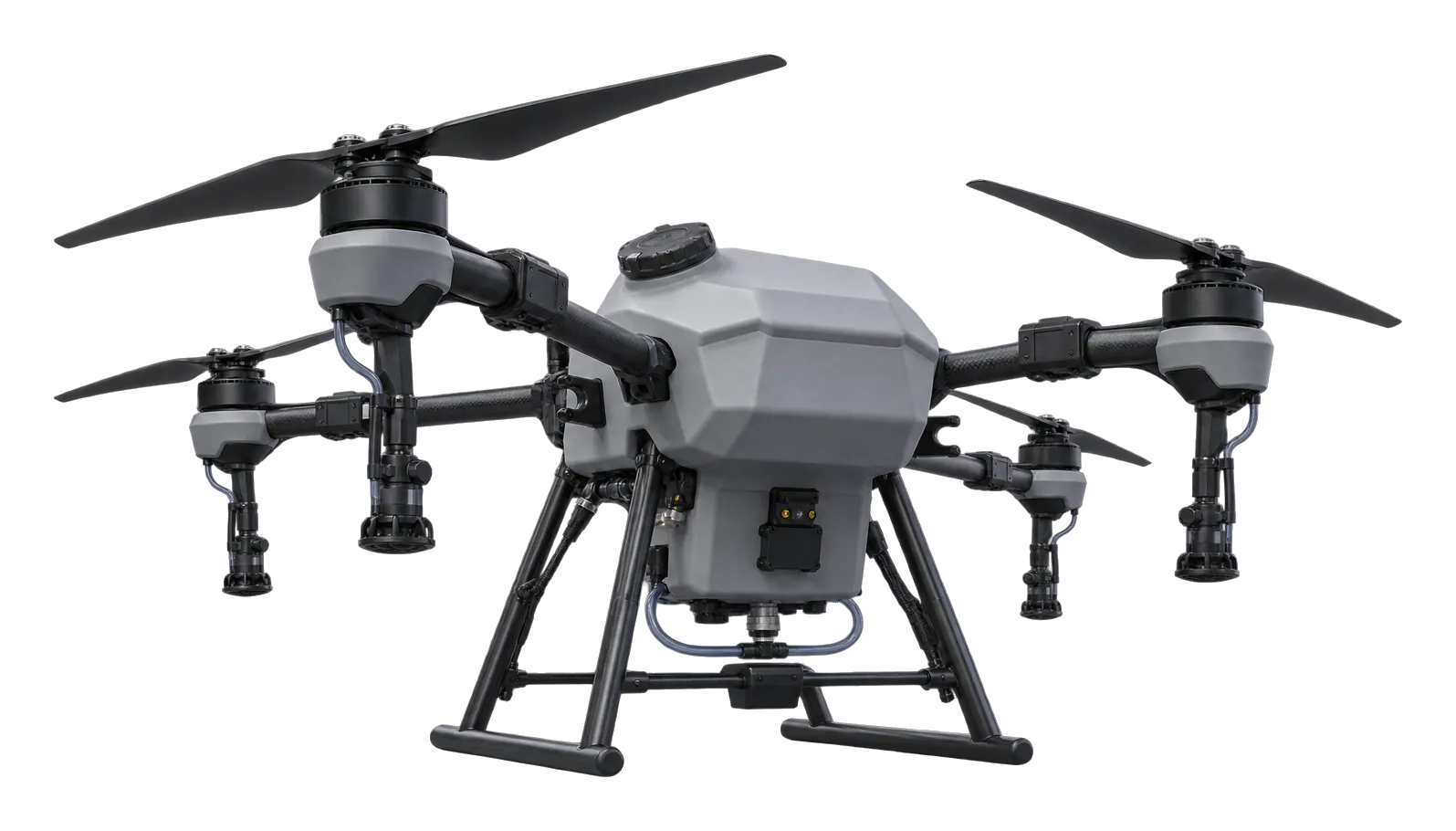
- Best for smallholder rice programmes: the AS-30, 30 L spray plus 40 L spreader, IP67, up to 68 kg take-off weight.
- Best for large state farms: the AS-50 / AS-65, 8–20 m swath, 20 L/min, 99 / 111 kg take-off weight.
How will bidders prove each value?
Ask for data sheets, test reports, flight logs and customer references. ISO 23117-1:2023 sets environmental requirements for unmanned aerial spraying systems and does not apply above 150 kg take-off weight, so ask for conformity where it applies and an equivalent statement where it does not. IEC 60529 defines the IP code. The FAO and WHO guidance on aerial application of pesticides is a useful reference for the operating procedures bidders must describe. Reject ‘up to’ claims without conditions.
What documents should bidders submit?
- Company registration and tax compliance.
- Evidence of the KCAA import permit and dealer authorisation.
- Data sheets and test reports that match the specification.
- Warranty terms in months, a parts list with unit prices and delivery time.
- A training plan (hours, content, trainer) and customer references.
The procuring entity’s documents and Kenya’s public procurement rules decide the rest; check the Public Procurement Regulatory Authority.
Example: an acceptance test for four aircraft
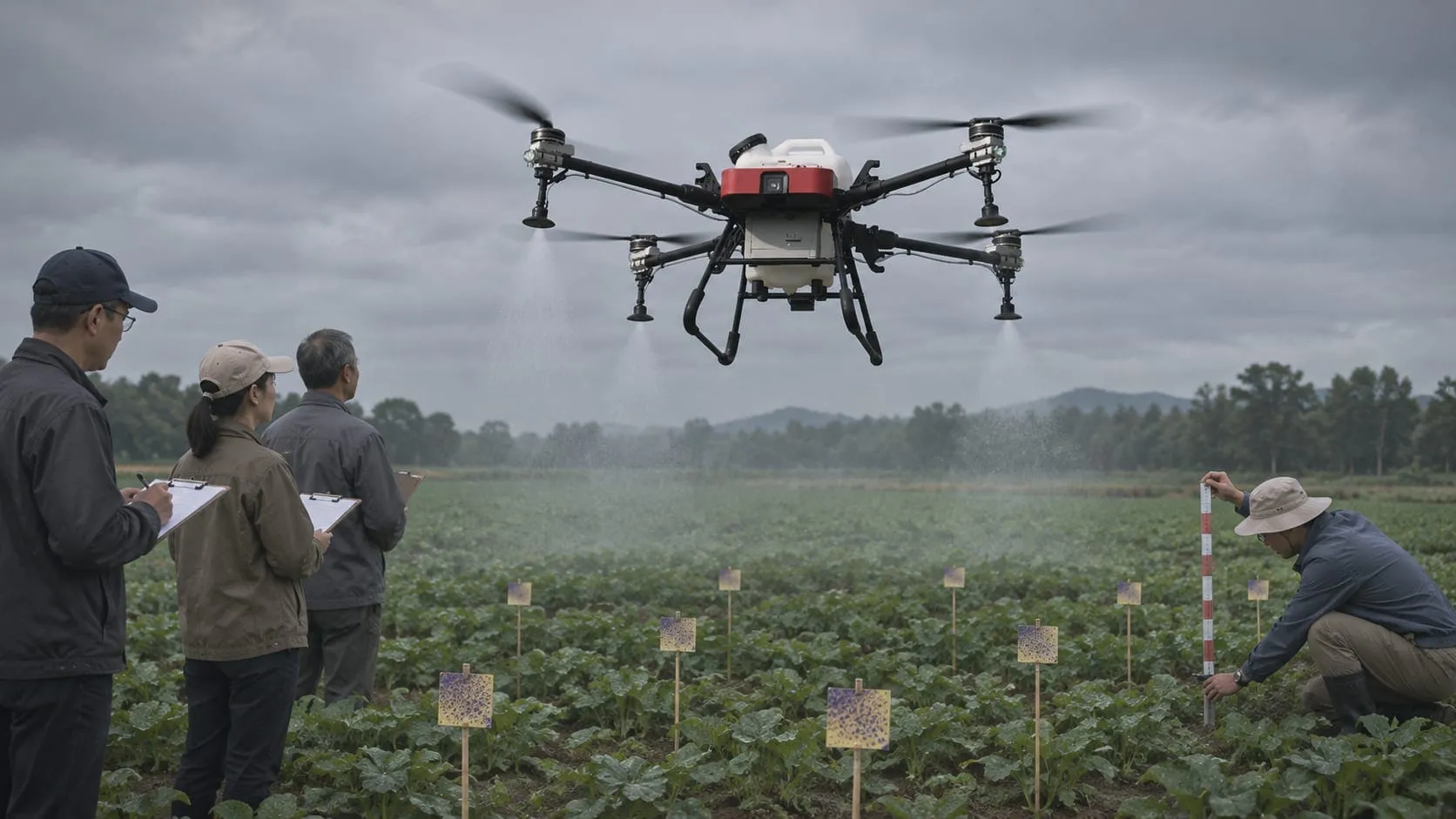
Example: a county rice programme buys four AS-30-class aircraft. The specification asks for an effective swath of at least 8 m at CV 25 % or better and a dose of 15 L/ha. For each aircraft the buyer lays cards across three passes (Virginia Tech’s method), computes the width above 50 % of peak coverage, then sprays a 2 ha block.
Expected use: 2 × 15 = 30 L, or 27–33 L with a ±10 % tolerance, the buyer’s own choice. Expected time at 8 m × 6 m/s × 0.5 = 24 m²/s, which is 8.6 ha/h: about 14 minutes for 2 ha. Four aircraft take 8 ha, about 120 L and about 56 minutes of spraying, plus refills.
| Check | Method | Pass mark in this example |
|---|---|---|
| Effective swath | Cards across three passes | 8 m or more at CV 25 % or better |
| Dose | 2 ha block, litres used | 27–33 L |
| Rate | Time the block at 6 m/s | About 14 minutes |
| Battery | Log charge and flight time | At least the stated loaded flight time |
| Weight | Weigh the loaded aircraft | At or below declared take-off weight |
Can you score training, spare parts and warranty?
Yes. Award points for training hours, a spare parts list per aircraft with delivery time, response time to a fault and warranty length. Purdue Extension advises asking about parts supply and repair before buying. Buyers already ask for more than the aircraft: FAO’s Lesotho notice covers the spraying system and accessories, and its Vihiga retender asks bidders to know drone licensing in Kenya.
What must happen in Kenya before delivery?
Under the Civil Aviation (Unmanned Aircraft Systems) Regulations 2020, importing a UAS or component needs a KCAA permit (regulation 7), dealing in UAS needs authorisation (regulation 8) and each UAS is registered (regulation 9). Category A covers up to 25 kg including payload; the AS-30 reaches up to 68 kg at take-off, so heavier categories apply. KCAA lists a newer regulation set, so check the current rules. Spray products fall to the Pest Control Products Board and the label. This is a guide, not legal advice. See dealer stock and the Kenya market page.
Which specification mistakes block good bids?
- Tank litres without payload kilograms.
- ‘Maximum’ figures with no conditions, such as a peak hectares-per-hour value.
- One brand’s exact numbers, which shut out equivalents.
- No tolerance or test method, so acceptance becomes an argument.
- No spare parts, training or response time.
Related: supplier testing, service and partners.
Next step
Send the technical schedule of your tender through the contact form. We return our data-sheet value for each line and say plainly where we cannot meet one.
Q & A
Common questions
01What are typical tender requirements for buying agricultural drones for a government programme in Africa?
Tank and payload, take-off weight, swath, flow, endurance, spreading capacity, warranty, training, spare parts, delivery time and proof of local authorisation. FAO's Lesotho notice covers the spraying system and accessories, and its Vihiga (Kenya) retender asks bidders to know local drone licensing.
02What documents are needed for an agricultural drone government tender?
Company registration, KCAA import and dealer authorisations, aircraft data sheets, test reports, warranty terms, a parts list with prices, a training plan and references, plus what the procuring entity requires under Kenya's procurement rules. Check the tender document and the PPRA.
03How do we test a drone at delivery?
Weigh the loaded aircraft, run a card test across three passes, spray a measured block and compare litres with dose, time the block and log a full battery cycle. Write the pass marks into the tender.
04Can we ask for training and spare parts in the tender?
Yes, and you should. Score training hours, a parts list per aircraft with response time, and warranty terms. Purdue Extension advises asking about parts supply and repair before any drone purchase.
05Does ISO 23117-1 apply to every drone?
No. It sets environmental requirements for unmanned aerial spraying systems and, per the standards body's listing, does not apply above 150 kg take-off weight. Ask for conformity where it applies.
References
- 1Spray Drones in Agriculture: Technology, Regulation and Field Operations (SPES-819) — Virginia Cooperative Extension
- 2ISO 23117-1:2023 Unmanned aerial spraying systems — Part 1: Environmental requirements — Estonian Centre for Standardisation (ISO reseller)
- 3IEC 60529 Degrees of protection provided by enclosures (IP Code) — IEC
- 4The Civil Aviation (Unmanned Aircraft Systems) Regulations, 2020 — Kenya Civil Aviation Authority
- 5Public Procurement Regulatory Authority — PPRA Kenya
- 6Pest Control Products Board — Pest Control Products Board (Kenya)
- 72024/045 Retender Procurement of Drone — FAO via UN Global Marketplace
- 8Supply and Delivery of Agriculture Drones with Spraying System and Accessories (Lesotho) — FAO via UN Global Marketplace
- 9Guidance for aerial application of pesticides (International Code of Conduct) — FAO and WHO
- 10Considerations Before Purchasing a Drone (PPP-154) — Purdue Extension
VEXAFLY Aviation Technology Co., Ltd.. VEXAFLY Aviation Technology Co., Ltd. — industrial drone maker in Nanjing. Our application engineers write and check these pages and configure inspection, cleaning, lift and fire-response systems for project buyers. About VEXAFLY