Agriculture
What Size Spray Drone Do I Need? A Five-Step Calculation With a 500 ha Example (2026)
What size spray drone do you need in 2026? Five steps from hectares and spray window to tank class, with a 500 ha worked example and a battery check.
- Author
- VEXAFLY Aviation Technology Co., Ltd.
- Scope
- Agriculture
- Published
- Length
- 5 min read · 7 sources
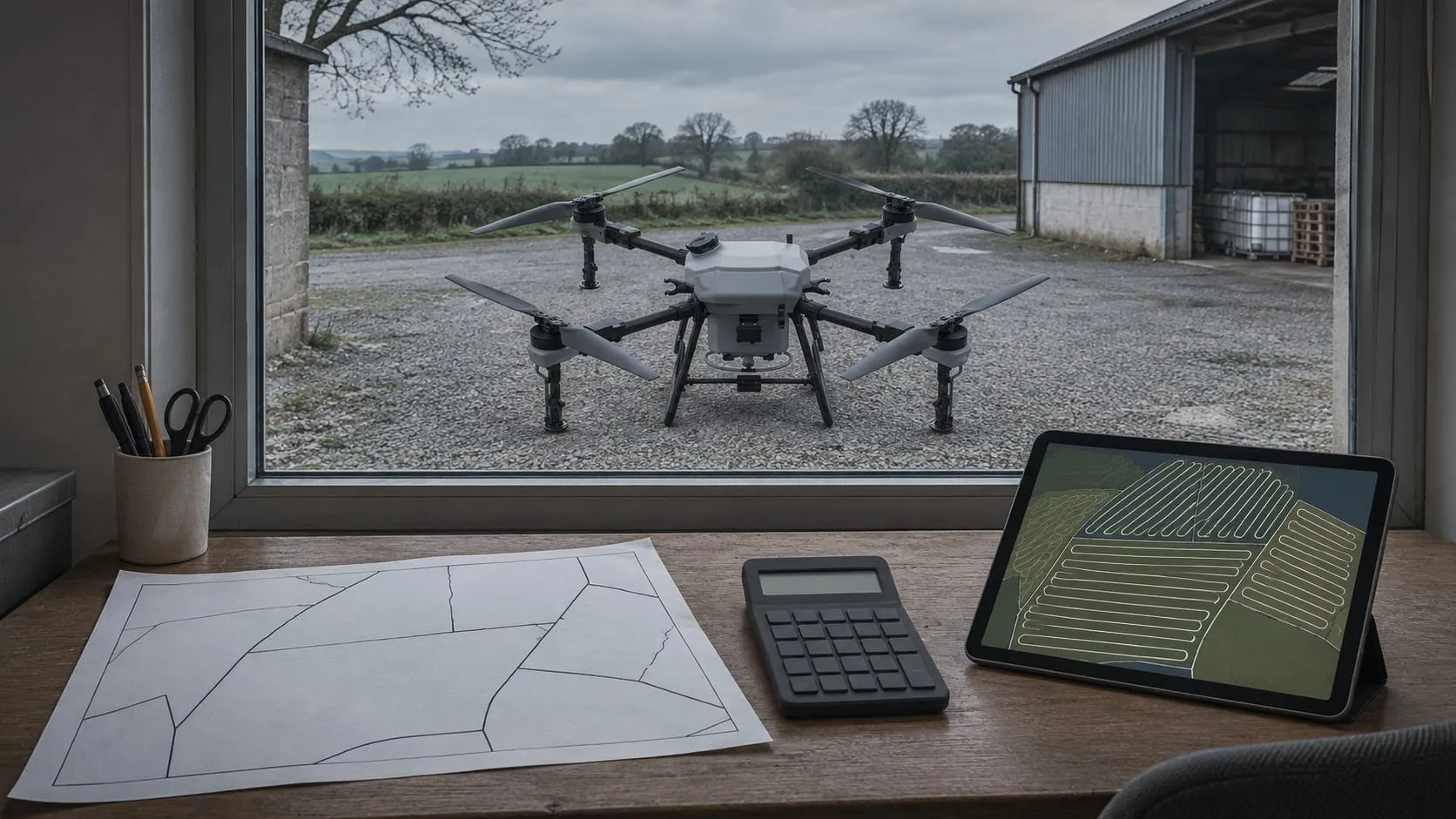
Short answer: to answer what size spray drone do I need, divide your hectares by the flying hours in your spray window to get the hectares per hour you must achieve, then pick the tank class that delivers that rate with refills included. In 2026 a first guide is: up to about 1,000 ha in a three-week window a 30 L class; up to about 1,500 ha a 40–50 L class; up to about 2,400 ha a 70–100 L class. Then run the battery check.
What size fits my area and spray window?
The University of Kentucky model, at 2 gal/acre (18.7 L/ha) and 40 flying hours a week, gives the largest area each class can treat in a three-week, 120-hour window.
| Tank class in the model | Largest area in the window | Closest VEXAFLY class |
|---|---|---|
| 8 L | about 372 ha (919 acres) | AS-10 / AS-20, 10–20 L |
| 30 L | about 1,036 ha (2,561 acres) | AS-30, 30 L |
| 40 L | about 1,567 ha (3,872 acres) | AS-50, 50 L |
| 72 L | about 2,418 ha (5,974 acres) | AS-100, 100 L |
Step 1: how many hectares per hour do you need?
Required rate (ha/h) = area ÷ (window days × spray hours per day). The last column is the example below.
| Input | Symbol | 500 ha example |
|---|---|---|
| Area | A | 500 ha |
| Window and hours per day | D, H | 7 days × 6 h = 42 h |
| Dose from the label | L | 15 L/ha |
| Effective width | W | 9–12 m |
| Speed | v | 6 m/s |
| In-field efficiency | e | 70 % |
| Overhead per load | t | 6 min |
| Loaded flight time | F | 8 min |
Example: 500 ÷ 42 = 11.9 ha/h.
Step 2: how much liquid per hectare?
Take it from the label. Kentucky puts drone volumes at 2–5 gal/acre (19–47 L/ha), Ohio State at 1.5–2 (14–19 L/ha) for row crops; 1 gal/acre = 9.35 L/ha. Each extra gallon above 2 cuts acres per hour by about 15–30 %.
Step 3: what does one aircraft really cover per hour?
Rate (ha/h) = width (m) × speed (m/s) × efficiency × 0.36. Add ground time: loads = total litres ÷ tank, at about 6 minutes each (4 for take-off, ferry and landing, 2 between flights, per Kentucky).
Example: 500 ha, seven days, 15 L/ha
Example: 500 ha in 42 hours needs 7,500 L and 11.9 ha/h. Assumptions are 6 m/s, 70 % efficiency, 6 minutes per load, and effective widths of 9 m for the AS-30 and 12 m for the AS-50 and AS-100.
| Aircraft | Rate | Loads if the tank empties | Overhead | Spraying | Total if tank-limited | Total with an 8-min battery limit |
|---|---|---|---|---|---|---|
| AS-30, 9 m | 13.6 ha/h | 250 | 25.0 h | 36.7 h | 61.7 h | 64.3 h |
| AS-50, 12 m | 18.1 ha/h | 150 | 15.0 h | 27.6 h | 42.6 h | 48.3 h |
| AS-100, 12 m | 18.1 ha/h | 75 | 7.5 h | 27.6 h | 35.1 h | 48.3 h |
The first total flatters the big tanks; plan with the last column.
Step 4: does one battery empty the tank?
With 8 minutes at 12 m, one battery covers 480 s × 50.4 m²/s = 24,192 m², 2.4 ha, which is 36 L at 15 L/ha. A 50 L load would need 11 minutes of spraying and a 100 L load 22, so neither tank empties in one flight. The AS-50 and AS-100 each need about 207 flights and 48.3 hours; the AS-30 needs 276. The extra tank buys nothing, and every option needs two aircraft to fit 42 hours. Cross-check: the Missouri model assumes 6.5 acres (2.6 ha) per charge for a 40 L-class aircraft, about 15 L/ha with a full tank.
At 30 L/ha the picture changes. One flight still covers 2.4 ha, now 72.6 L. The AS-100 needs 207 flights and 48.3 hours; the AS-50, limited by its 50 L tank, needs 15,000 L ÷ 50 = 300 loads, 30 hours of overhead and 57.6 hours in all. The 100 L tank saves about 9 hours, 16 %. Ask for loaded flight time at your dose; brochure full-load hover (7 minutes for the AS-50, 8 for the AS-100) is the worst case.
Step 5: what must water, batteries and power deliver?
Mix rate = hectares per hour × litres per hectare. The job needs 7,500 L in 42 hours, at least 179 L/h, so a 200 L drum or a bowser refilled every hour. Keep three battery sets per aircraft (Ohio State) and size the generator to the charger input; see generators and batteries.
When should you buy two smaller drones instead of one big one?
The Kentucky model found four 8 L drones cost about US$14.18 per acre against US$6.50 for one 40 L drone on 3,000 acres in three weeks, so very small aircraft suit small jobs. Between 30 L and 50 L the gap is small, and two aircraft add redundancy. Next: the 50 L guide, the 100 L guide and the price guide.
- Best for up to about 1,000 ha in a three-week window: the AS-30, 30 L spray, 4–9 m swath, 8 nozzles.
- Best for about 1,000–1,600 ha: the AS-50 / AS-65, 50 or 62 L, 8–20 m swath, 20 L/min.
- Best for 1,600–2,400 ha, or 30 L/ha and more: the AS-100, 100 L, 24 L/min.
What should US buyers check before ordering?
For a US purchase, three checks come before the order: FCC Covered List status, the Section 232 duty (100 % above 25 kg take-off weight from 3 September 2026) and the FAA route for aircraft of 55 lb or more. All three sizes exceed 25 kg at full load. Our import guide and FCC guide cover the steps; your customs broker and the FAA confirm them.
Next step
Send hectares, window and dose through the contact form. We run the five steps and return a class and an aircraft count.
Q & A
Common questions
01What size agricultural drone tank do I need for 500 hectares?
It depends on window and dose. In seven six-hour days at 15 L/ha, two aircraft of the 30–50 L class do the job, because one battery cannot empty a bigger tank at that dose. At 30 L/ha a 100 L tank saves about nine hours.
02How many acres can a T50 drone spray an hour?
The T50 has a 40 L tank. In the University of Kentucky model a 40 L class covers 32.2 acres an hour at 2 gal/acre and 13.4 at 5 (13.0 to 5.4 ha/h).
03How long does it take a drone to spray 40 acres?
About 1.9 hours with a 30 L class at 2 gal/acre, 1.2 hours with a 40 L class and under an hour with a 72 L class (Kentucky model). Forty acres is 16 ha.
04What dose should I put in the calculation?
The litres per hectare on the product label for drone or aerial application. Typical drone volumes are 2–5 gal/acre (19–47 L/ha); Penn State Extension notes a drone must meet the label minimum.
05What should I ask the maker besides tank size?
Loaded flight time at your dose, effective swath at a stated CV, flow in L/min, charging time and battery sets in the price. Full-load hover time is the worst case.
References
- 1Drone Sprayer Sizing for Agricultural Applications (AEN-174) — University of Kentucky Cooperative Extension
- 2Economics of Drone Ownership for Agricultural Spray Applications (G1274) — University of Missouri Extension
- 3Drones for Spraying Pesticides: Opportunities and Challenges — The Ohio State University CFAES
- 4Herbicide Applications with Drones: Stay On-Label and On-Target — Penn State Extension
- 5Spray Drones in Agriculture: Technology, Regulation and Field Operations (SPES-819) — Virginia Cooperative Extension
- 6Adjusting Imports of Unmanned Aircraft Systems and UAS Components into the United States — The White House
- 7Conditional approval and exemption of certain UAS from the FCC Covered List (DA 26-875) — Federal Communications Commission
VEXAFLY Aviation Technology Co., Ltd.. VEXAFLY Aviation Technology Co., Ltd. — industrial drone maker in Nanjing. Our application engineers write and check these pages and configure inspection, cleaning, lift and fire-response systems for project buyers. About VEXAFLY