Agriculture
Spray Drone Generator Size and Batteries in 2026: Plan Power for the Field Edge
Spray drone generator size for 2026: batteries per aircraft, charger input, single or three-phase power, fuel per day and what to ask for on the quotation.
- Author
- VEXAFLY Aviation Technology Co., Ltd.
- Scope
- Agriculture
- Published
- Length
- 4 min read · 5 sources
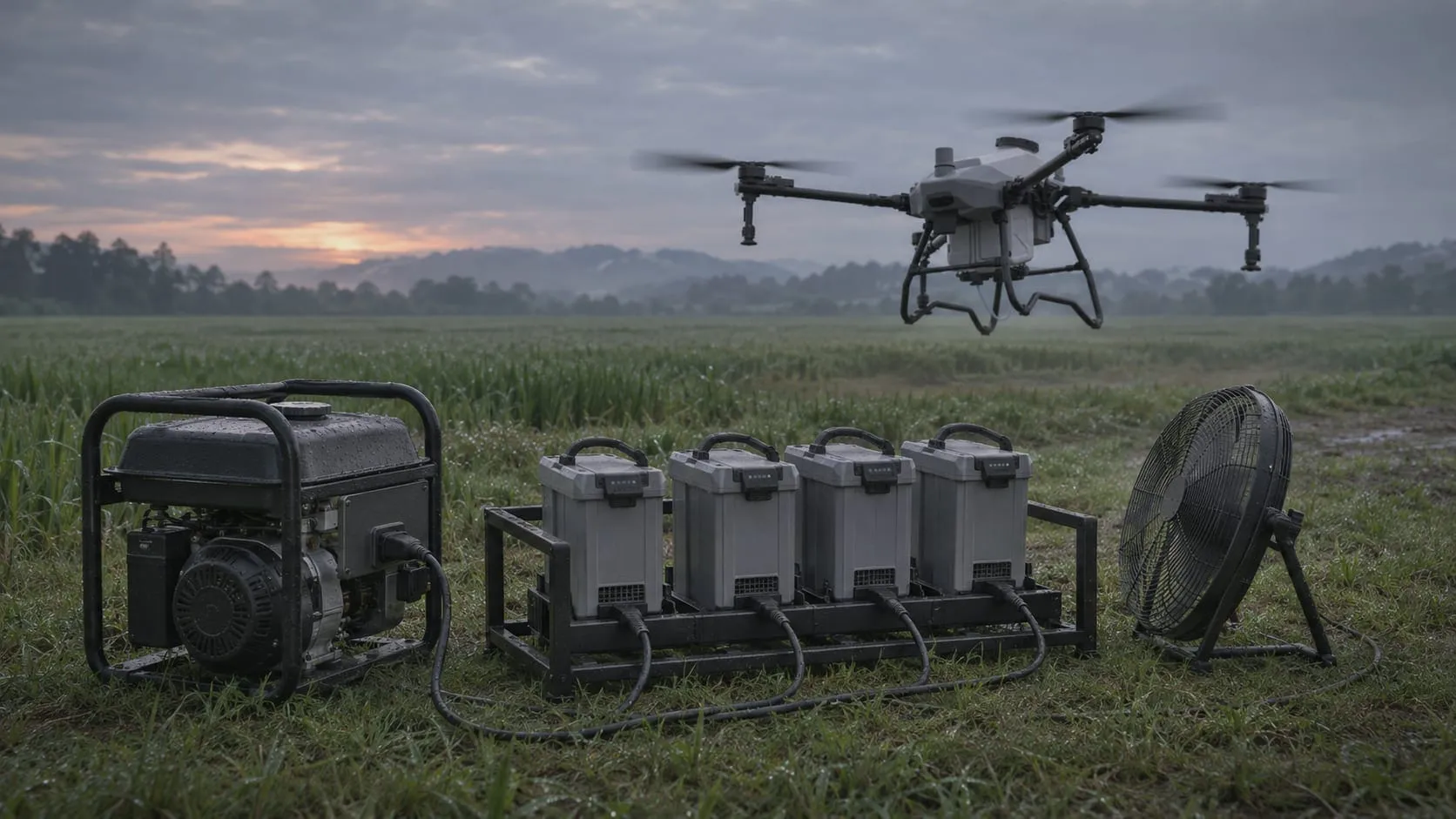
Short answer: in 2026 your spray drone generator size follows from the charger’s input power, not from the drone’s tank. Find the charger input kW and phase, add the pump and lights, add a margin, and plan about three battery sets per aircraft. For our AS / AR models the charger kW and battery Wh come with the quotation; this guide shows the method using public DJI figures.
What does your site have for power?
| Site | Power plan | Watch for |
|---|---|---|
| Farm yard with a grid connection | Charge from the grid, on a dedicated circuit | Single-phase supply may cap charger speed |
| Fields with a trailer and generator | Generator sized to charger plus pump | Fuel, noise, a flat place for the trailer |
| Remote plantation, two aircraft | Larger set or two sets, three-phase if the chargers need it | Generators lose output in heat and at altitude |
| Hire crew moving daily | Generator in a vehicle or trailer, inverter type | Weight and loading time |
How many batteries does one spray drone need?
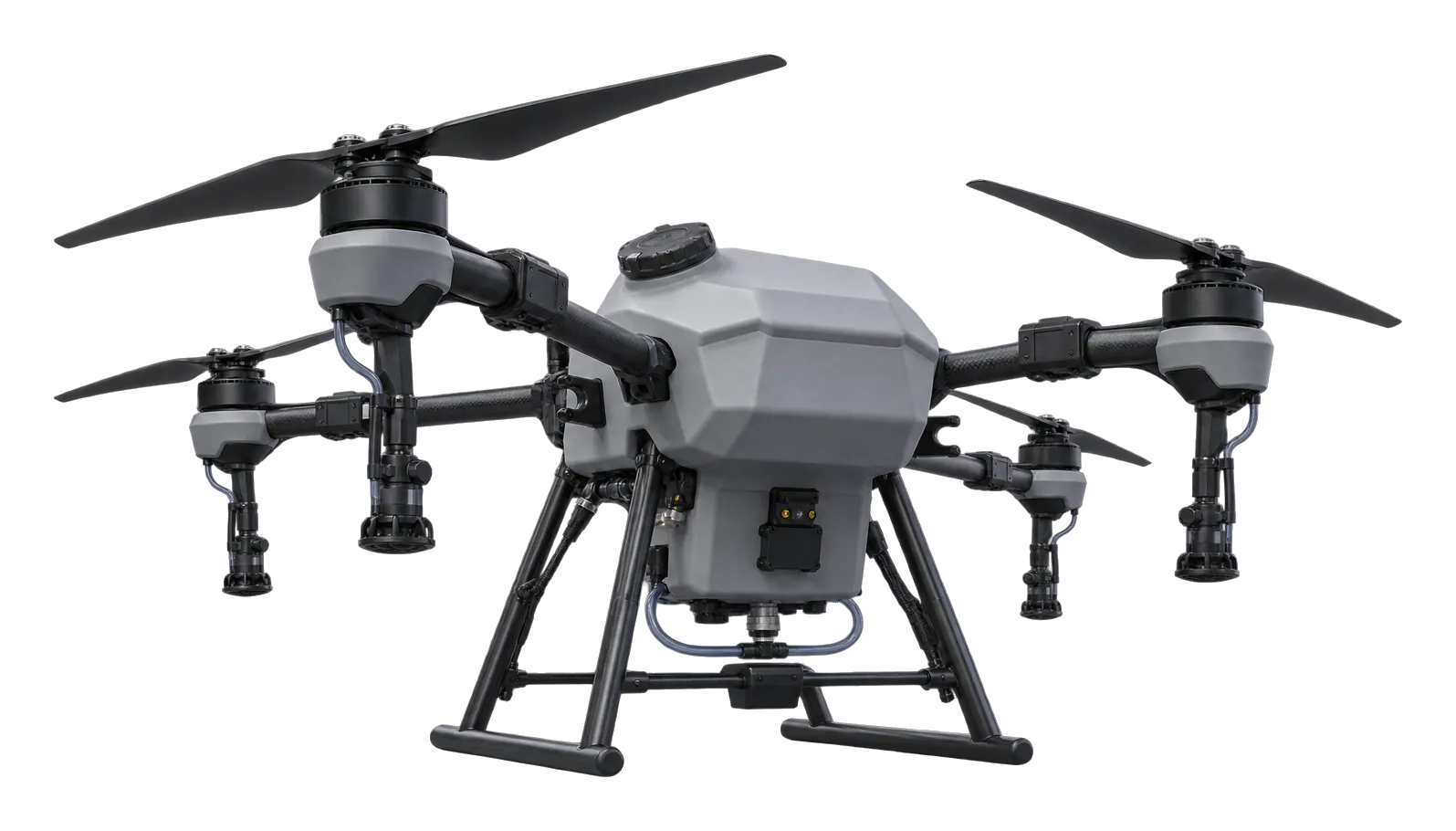
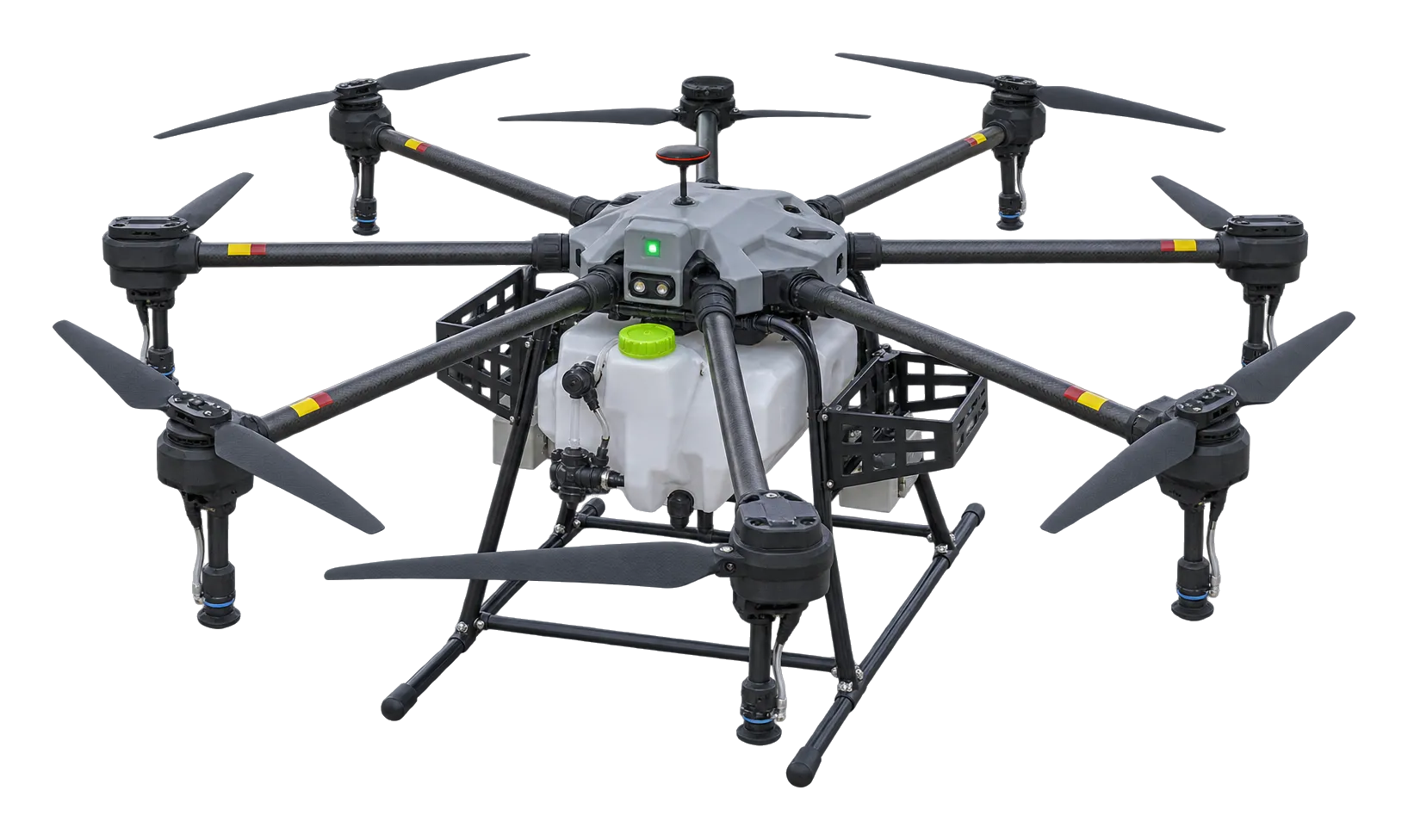
A simple rule: batteries = charge time ÷ cycle time + 1 in the aircraft + 1 spare. Cycle time is flight plus refill. With an AS-50 / AS-65 full-load hover of 7 minutes, a three-minute refill and an 8.5-minute charge: 8.5 ÷ 10 = 0.85, plus two, gives about three sets. Ohio State’s description of three charged batteries per drone matches. A bigger aircraft’s battery changes the arithmetic. The AS-50 battery is about 15 kg and the AS-100’s about 30 kg by the weights in our product files.
What size generator, and single- or three-phase?
Public DJI figures show the shape of the problem. A T100 battery is 41,000 mAh at 52 V, about 2.13 kWh. Its C12000 charger delivers 12,000 W on three-phase 380 V but only 3,000 W on single-phase 220 V, and the maker’s matching D14000iE inverter generator supplies 11,500 W of DC charging output with a 30 L tank. A US dealer’s FAQ pairs smaller DJI chargers with 4,500 W, 7,500 W and 9,000 W generators and notes 50 A, 240 V circuits for the largest. Able Power warns that a 10 kW single-phase set runs one 8 kW-input charger and nothing else.
Worked example: fuel for one charging day
Example using public DJI figures, not our aircraft. One battery charged from 30 % to 95 % takes 0.65 × 2.13 ≈ 1.39 kWh in about 8.5 minutes, an average of about 9.8 kW into the battery before charger losses.
| Step | Calculation | Result |
|---|---|---|
| Energy per charge | 0.65 × 2.13 kWh | about 1.39 kWh |
| Fuel at 500 mL/kWh | 1.39 × 0.5 L | about 0.7 L |
| 50 charges in a day | 50 × 0.7 L | about 35 L |
| Tank of 30 L | 35 ÷ 30 | one refill |
Add a 1.1 kW (1.5 hp) transfer pump and lights, and the generator should deliver about 11–13 kW continuously. For your own aircraft repeat the sum with the charger input kW from your quotation.
What changes in heat or at altitude?
Generator output falls with high temperature and thin air. We do not quote a percentage because it differs by engine; check the maker’s derating table, and note the D14000iE’s stated operating range of 0–40 °C. Batteries are not charged below 0 °C.
Can I charge from the grid at the farm yard?
Often yes, but check the supply. A charger that needs three-phase power will not reach full speed on single-phase, and a shared farm circuit may trip. Have an electrician confirm voltage, phase and breaker size before you order.
What should I ask for on the quotation?
- Charger input power in kW and the phase it needs.
- Battery energy in Wh and rated cycles.
- Minutes to charge between the limits you will use.
- Number of battery sets and chargers in the package.
- Battery mass and the dangerous-goods paperwork for shipping; see drone lithium battery shipping and IATA’s lithium battery guidance.
Cost and US buyers
University of Missouri’s 2025 budget lists a US$7,500 generator and US$2,500 batteries rated 1,000 cycles or five years; treat it as a US reference only. In the US, check three things before ordering a foreign-built drone: its FCC Covered List status, the Section 232 duty and FAA approval for aircraft of 55 lb or more. Confirm with your customs broker and the FAA; see the import guide.
Best for:
- Best for medium farms with one aircraft: AS-50 / AS-65, battery about 15 kg, three sets.
- Best for contractors on big blocks: AS-100, larger batteries, ask whether three-phase power is needed.
Next step
Send us your site’s power supply, the number of aircraft and hectares a day, and we will list the chargers and generator class to price. Related: spray drone size calculator, drone spraying business equipment, our service page and contact form.
Q & A
Common questions
01How many batteries does one spray drone need?
Usually three sets: one in the aircraft, one charging and one waiting. Ohio State describes three charged batteries per drone. Fast chargers can reduce that; a long refill time can increase it.
02What size generator do I need?
It must supply the charger input power plus the pump and a margin. A dealer FAQ lists, for DJI chargers, 4,500 W running for a 3,500 W charger and 9,000 W or more for an 8,000 W-plus charger. For our models use the charger input kW on your quotation.
03Single-phase or three-phase?
DJI's T100 charger delivers 12,000 W on three-phase 380 V and only 3,000 W on single-phase 220 V. If your charger needs three-phase power, a single-phase generator will charge slowly or not at all.
04How much fuel does a day of charging use?
At DJI's reference figure of 500 mL per kWh, about 1.4 kWh of battery charge costs roughly 0.7 L of petrol; 50 such charges use about 35 L before losses. Your generator's consumption table gives the real number.
05Can one generator run the charger and the water pump?
Yes if the total load fits. Able Power warns that a 10 kW single-phase set runs one 8 kW-input charger only; adding a 1.5 hp pump pushed its example to 13 kVA.
06What should I ask the supplier for?
Charger input kW and phase, battery energy in Wh, rated cycles, time to charge between your working limits, and the battery mass for shipping by air or sea.
References
- 1DJI Agras T100 specs (battery, C12000 charger, D14000iE generator) — DJI Agriculture
- 2Frequently Asked Questions (generator sizes per model) — Agri Spray Drones (US DJI dealer)
- 3Best Generator for Charging Drone Batteries: Sizing Guide — Able Power
- 4Drones for Spraying Pesticides: Opportunities and Challenges — The Ohio State University CFAES
- 5Batteries (lithium battery shipping guidance) — IATA
VEXAFLY Aviation Technology Co., Ltd.. VEXAFLY Aviation Technology Co., Ltd. — industrial drone maker in Nanjing. Our application engineers write and check these pages and configure inspection, cleaning, lift and fire-response systems for project buyers. About VEXAFLY