Buying
Drone Battery Shipping in 2026: Air or Sea for Industrial Lithium Packs
Drone battery shipping in 2026: UN3480 and UN3481, 30 % charge for air, the 35 kg cargo-aircraft package limit and why heavy-aircraft battery sets go by sea.
- Author
- VEXAFLY Aviation Technology Co., Ltd.
- Scope
- Buying
- Published
- Length
- 4 min read · 5 sources
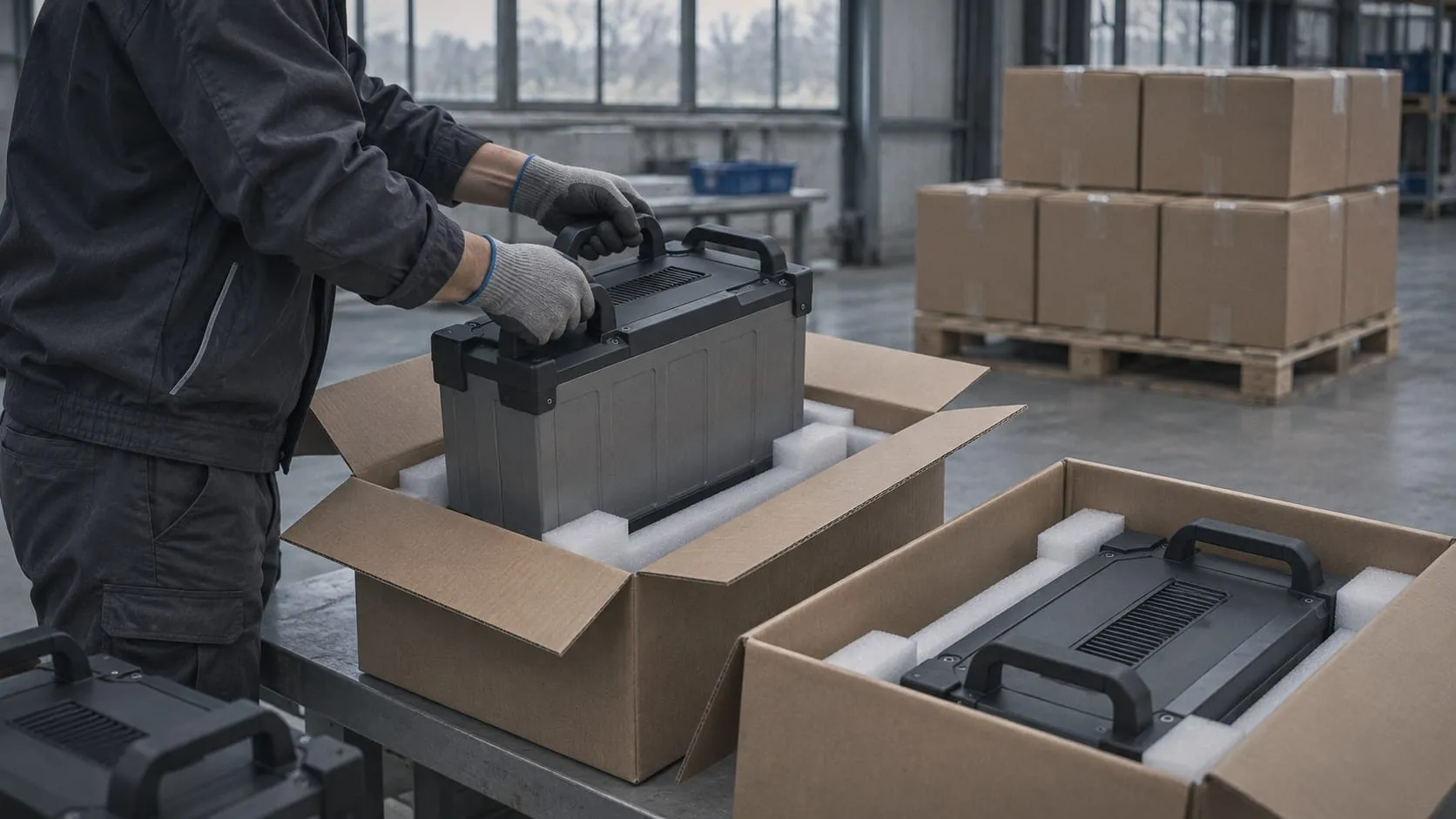
Short answer: for drone battery shipping of industrial packs in 2026, the aircraft class decides the route. Small spare packs can go by cargo aircraft at 30 % charge or less. Full battery sets for heavy aircraft normally go by sea, because the air-freight limit is 35 kg of net battery weight per package for packs above 100 Wh and an aircraft such as the HL-200 carries about 44 kg of battery in total.
How should industrial drone batteries travel?
Consumer pages discuss packs under 100 Wh. Packs of this size are far above that; the exact watt-hour rating is on the battery’s UN38.3 test summary, so use that figure, not ours.
| Aircraft | Battery mass per aircraft (weight with minus without battery) | Alone or with aircraft | Practical route |
|---|---|---|---|
| Small inspection (IS-4 class) | Small packs | UN3480 / UN3481 | Air cargo or courier if the carrier accepts it, 30 % charge |
| CW-65 | About 22 kg (55.8 − 33.4) | UN3480 or UN3481 | Sea; air for one spare pack |
| AS-100 | About 30 kg (104 − 74) | UN3480 or UN3481 | Sea for sets; air for a spare |
| HL-200 | About 44 kg (132 − 88) | UN3480 or UN3481 | Sea for sets; air only for a spare pack |
Shipped alone or with the aircraft: what changes?
Batteries shipped alone are UN3480, packing instruction 965. They are forbidden on passenger aircraft and need the Cargo Aircraft Only label on the package. Batteries packed with equipment are UN3481, packing instruction 966; batteries contained in equipment are packing instruction 967. The guidance gives different weight limits for each. A forwarder must classify the shipment, and for large packs the classification is the forwarder’s call, so ask for it in writing before booking.
What changed for air freight on 1 January 2026?
From 1 January 2026 lithium-ion batteries packed with equipment (UN3481, packing instruction 966) must also be at 30 % of rated capacity or less. Before that the 30 % rule applied to batteries shipped alone. For batteries contained in equipment (packing instruction 967) the guidance gives 30 % as a strong recommendation, not a requirement. Plan for a lower charge on arrival and charge before the first flight according to the manual.
How heavy can one air package be?
For packs above 100 Wh the IATA document sets these net battery weight limits per package:
| Shipment | Passenger aircraft | Cargo aircraft only |
|---|---|---|
| UN3480, batteries alone | Forbidden | 35 kg |
| UN3481, packed with equipment (Section I) | 5 kg | 35 kg |
If a single pack weighs more than that, it cannot go by air under these limits. Check each pack’s weight on the data sheet.
Example: battery sets for a heavy-lift drone
Example only. The real pack count and watt-hours come from the test summary. An HL-200 buyer wants three battery sets. Each set is about 44 kg (derived from 132 kg minus 88 kg), so the total is 3 × 44 = 132 kg of batteries. At 35 kg per package on a cargo aircraft, 132 ÷ 35 = 3.8, so at least four packages, cargo-aircraft only, each with dangerous-goods paperwork. Add dangerous-goods surcharges and the space on freighter flights, and sea is the practical route, with the fill level arranged for the voyage.
Which documents must the forwarder see?
- UN38.3 test summary, which manufacturers and distributors of batteries made after 30 June 2003 must make available.
- Safety data sheet.
- Packing list with watt-hours and number of batteries per box.
- Dangerous-goods declaration prepared by a trained person; ask the forwarder who signs it.
- For sea, a forwarder that accepts dangerous goods under the IMDG Code. Consolidators of mixed cargo may refuse it.
For the US domestic leg, 49 CFR 173.185 governs lithium cells and batteries and 49 CFR Part 175 carriage by aircraft.
What to do with damaged packs and on arrival
Never ship a swollen, leaking or hot pack. Isolate it in a non-flammable place and ask the maker. On arrival, check each pack against the packing list, store at the charge level in the manual and do the first full charge before test flights. This belongs in your pre-shipment inspection record.
Best for …
- Best for urgent spares: one pack by cargo aircraft, below 35 kg, 30 % charge, with a forwarder who handles dangerous goods.
- Best for full fleets and spare sets: sea freight (the HL-200 carries about 44 kg of battery per aircraft).
- Best for small inspection kits: courier or air cargo after the carrier confirms acceptance in writing.
Next step
Ask your seller for the test summary and data sheet before booking, then read how the freight terms move cost in our Incoterms guide and the import guide. For the service and spares plan, send the model and fleet size through the contact form.
Q & A
Common questions
01Can drone batteries be shipped by air?
Yes, as dangerous goods. Packs sent alone (UN3480) cannot fly on passenger aircraft; on cargo aircraft they ship at 30 % charge or less unless the origin and operator states approve otherwise.
02Can UN3481 go on a passenger plane?
Batteries packed with equipment can, within limits: for packs above 100 Wh the guidance gives 5 kg net battery weight per package on passenger aircraft and 35 kg on cargo aircraft. Check with the airline and forwarder.
03What state of charge for shipping?
For air freight, 30 % or less of rated capacity for UN3480, and since 1 January 2026 also for lithium-ion batteries packed with equipment (UN3481). Batteries contained in equipment have a strong recommendation of 30 %.
04What is the difference between UN3480 and UN3481?
The number tells the carrier how the packs travel: UN3480 means packs on their own, UN3481 means packs inside the box with the aircraft or fitted to it.
05What papers does a battery shipment need?
The UN38.3 test summary, a safety data sheet, a packing list with watt-hours per battery and, for most routes, a dangerous-goods declaration made by a trained shipper.
06Can I ship a damaged battery?
No. A swollen, leaking or damaged pack must not be shipped; contact the maker and a specialist for disposal or return.
References
- 1IATA Battery Guidance Document (2026 regulations) — IATA
- 2Lithium Batteries — IATA
- 3Interactive Guide to Shipping Lithium Batteries — Federal Aviation Administration
- 449 CFR 173.185: Lithium cells and batteries — eCFR (National Archives)
- 5The International Maritime Dangerous Goods (IMDG) Code — International Maritime Organization
VEXAFLY Aviation Technology Co., Ltd.. VEXAFLY Aviation Technology Co., Ltd. — industrial drone maker in Nanjing. Our application engineers write and check these pages and configure inspection, cleaning, lift and fire-response systems for project buyers. About VEXAFLY