Agriculture
100 Liter Agricultural Drone in 2026: Which Sites Justify a 100 L Aircraft?
A 100 liter agricultural drone in 2026: which sites justify it, litres versus kilograms, the 150 kg weight line, one 100 L versus two 50 L, ground station.
- Author
- VEXAFLY Aviation Technology Co., Ltd.
- Scope
- Agriculture
- Published
- Length
- 5 min read · 9 sources
Short answer: a 100 liter agricultural drone justifies its size on large open blocks, at doses of about 30 L/ha or more, or for heavy granule spreading. At low doses the battery, not the tank, decides how much area one flight covers. In 2026 also check the aircraft’s take-off weight against your authority’s limits before you choose above 150 kg.
Which sites justify a 100 L drone?
| Site factor | Favours 100 L | Favours smaller |
|---|---|---|
| Block size | Contiguous blocks above 50 ha | Plots under 20 ha, fragmented |
| Dose | 30 L/ha or more | Under 15 L/ha |
| Spreading share | Fertiliser or seed on much of the area | Spraying only |
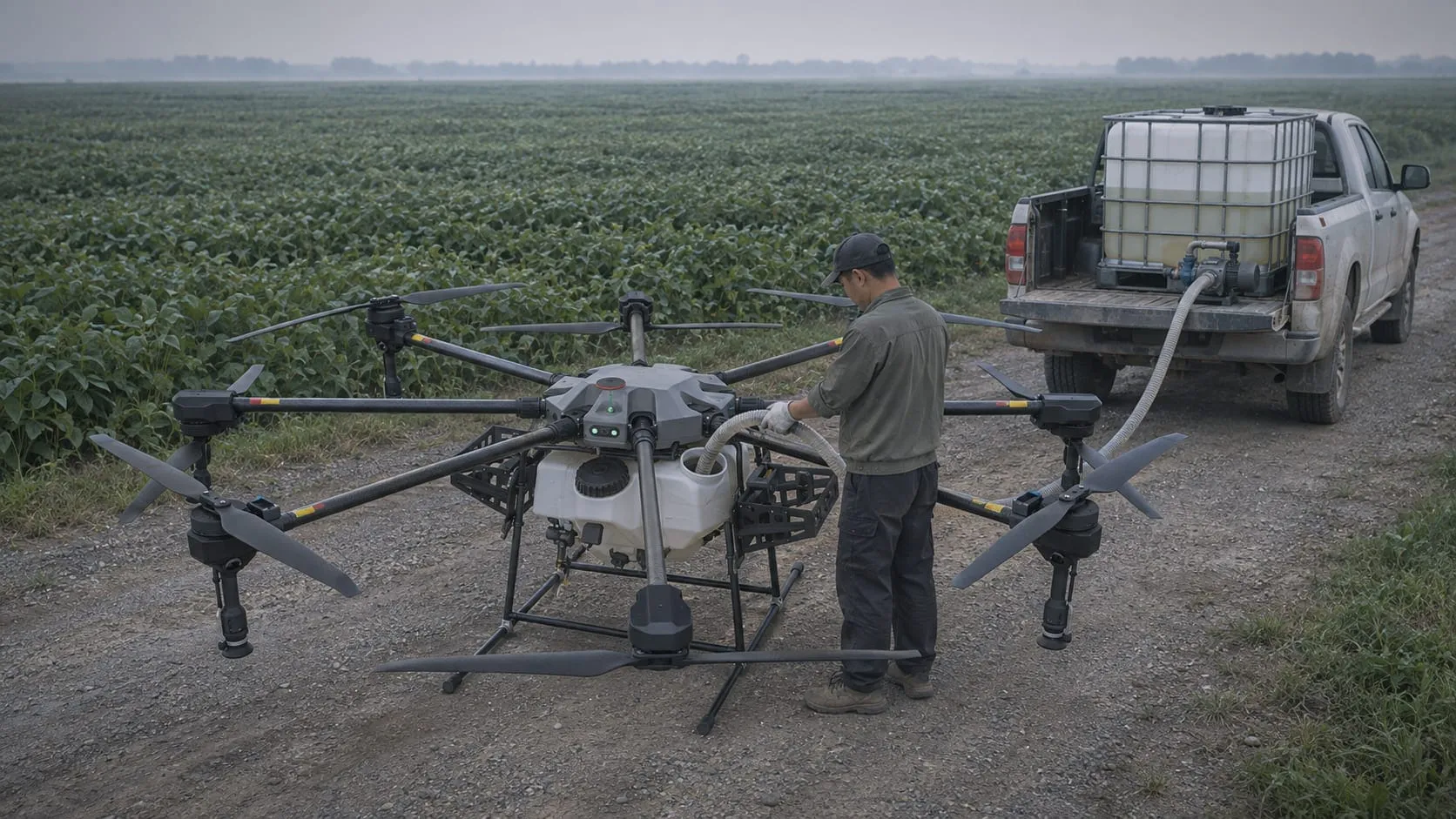
| Road access | Pickup bed or trailer for a 2.3 m tall folded aircraft | Narrow tracks, motorbike access |
Is a ‘100 L drone’ really 100 litres and 100 kilograms?
Check the tank, not the model number: the Joyance JT100, for example, lists 70 L for spraying and 100 L for spreading.
| Aircraft | Spray tank | Payload figure | Max take-off weight | Also published |
|---|---|---|---|---|
| DJI Agras T100 | 100 L | 100 kg | 175 kg (spraying) | 150 L spreader; 30–40 L/min |
| EAVISION EA-J150 | 70 L rated (73 L full) | not listed here | 145 kg spraying, 149.9 kg spreading | 4–15 m swath |
| EFT Z80 | 80 L | not listed here | 149.9 kg | 120 L spreader, 36 L/min |
| Joyance JT100 | 70 L rated | not listed here | 150 kg rated | 100 L spreading, 30 L/min |
| VEXAFLY AS-92 | 92 L | not listed here | 193 kg | 170 L spreader, 24 L/min |
| VEXAFLY AS-100 | 100 L | 120 kg of granules | 254 kg | 24 L/min, 8–15 m |
| VEXAFLY AS-150 | 150 L | 210 L spreader | 311 kg | 60 L/min |
All figures are the makers’ own, measured under their own conditions.
Why do so many large aircraft stop at 149.9 kg?
ISO 23117-1:2023, which sets environmental requirements for unmanned aerial spraying systems, does not apply above 150 kg take-off weight. DJI’s T100 page tells buyers in Australia and Turkey to keep it at 149.9 kg. Our AS-92, AS-100 and AS-150 are all above that line, so ask your aviation authority how your country treats heavier aircraft.
US buyers: before ordering any foreign-built spray drone, check its FCC Covered List status, the Section 232 duty (100 % on aircraft above 25 kg from 3 September 2026) and the FAA route for aircraft of 55 lb or more, which follows Part 137 with an exemption. Our guides to importing industrial drones from China and FCC certification list the steps. Your customs broker and the FAA have the final word.
Example: does a 100 L tank empty in one flight?
Example: assume a 10 m effective width, 7 m/s, spraying time per flight equal to the brochure full-load hover time (AS-100 8 min, AS-50 7 min; conservative, because flights lengthen as the tank empties) and 6 minutes on the ground per load. One battery covers 10 × 7 × 480 s = 33,600 m², 3.36 ha, with the AS-100, and 10 × 7 × 420 s = 29,400 m², 2.94 ha, with the AS-50.
| Dose | What limits the flight | AS-100 per flight | AS-50 per flight | One-pilot rate, AS-100 | One-pilot rate, AS-50 |
|---|---|---|---|---|---|
| 15 L/ha | Battery | 3.36 ha, 50 L used | 2.94 ha, 44 L used | 14.4 ha/h | 13.6 ha/h |
| 30 L/ha | Tank | 3.33 ha, 100 L used | 1.67 ha, 50 L used | 14.4 ha/h | 10.0 ha/h |
At 15 L/ha half of the 100 L tank is never used, and the one-pilot rates differ by only 6 %. At 30 L/ha the big tank is full every flight and wins by 43 % per pilot. Flow stays far below the 24 L/min limit (12.6 L/min at 30 L/ha).
One 100 L drone or two 50 L drones?
| Factor | 1 × AS-100 | 2 × AS-50 |
|---|---|---|
| Reference price (FOB China) | US$24,200–29,100 | US$14,600–26,600 |
| Area per hour at 30 L/ha (example above) | 14.4 ha/h | 20.1 ha/h |
| Pilots needed | 1 | 2 |
| Folded size and weight | 1010 × 870 × 2320 mm, 104 kg with battery | 1240 × 840 × 872 mm, 49 kg each with battery |
| If one aircraft fails | Work stops | Work halves |
What does the ground station need?
- Mix rate: hectares per hour × litres per hectare. At 14.4 ha/h and 30 L/ha that is 432 L/h, about 7 L/min.
- Batteries and power: three sets per aircraft at minimum (Ohio State), plus chargers; see generators and batteries.
- Transport: the AS-150 folds to 1450 × 1150 × 1005 mm and weighs 161 kg with battery, so plan a trailer or flatbed and a ramp.
- Granules: 120–210 kg per load means a loader or two people; see fertiliser spreading drones.
Our service page covers training for crews setting this up.
Where is a 100 L drone the wrong choice?
Fragmented plots, terraces, weak power or slow water supply, doses below 15 L/ha where the tank never empties, and countries that cap weight at 149.9 kg. For farms of 200–1,000 ha the 50 L class is usually easier to run. For the biggest tanks see the largest agricultural drones; for whole-farm planning, drones for large farms.
- Best for plantations with heavy spreading: the AS-92, 170 L spreader, 5,000 m ceiling (maker figure).
- Best for contractors on large open blocks: the AS-100, 100 L tank, 24 L/min, 8–15 m swath.
- Best for hundreds of hectares a day with a full crew: the AS-150, 150 L tank, 60 L/min, 360° radar, maker rate up to 40 ha/h.
Next step
List your largest block, typical dose, water source and your authority’s weight limit, and send them through the contact form. We say plainly if a smaller aircraft fits better.
Q & A
Common questions
01What is the largest agricultural drone?
Among the aircraft in this guide the AS-150 has the biggest tank at 150 L, with a 210 L spreader and 311 kg take-off weight. Sizes keep changing, so compare tank, payload and take-off weight in current maker data.
02What area does a 100 L aircraft cover per hour?
The AS-100 maker figure is up to 35 ha/h, about 86 acres. In our example at 30 L/ha with one pilot the all-in rate is about 14 ha/h, around 36 acres, because refills and battery changes take time.
03Is a 100 kg payload aircraft better than two 50 kg aircraft?
At 30 L/ha two 50 L aircraft cover more area per hour but need two crews. At 15 L/ha the battery limits both and the one-pilot rates are almost equal. See the comparison table above.
04How much does a 100 L agricultural drone cost?
Our reference FOB China prices are US$24,200–29,100 for the AS-100, US$15,400–29,100 for the AS-92 and US$29,000–34,800 for the AS-150. Batteries, charging gear, freight and duty are extra; final prices are on the quotation.
05Do I need special approval for a drone above 150 kg?
Possibly. Some authorities and standards treat aircraft above 150 kg differently, and ISO 23117-1 does not apply above that weight. Ask your aviation authority before you order.
References
- 1DJI Agras T100 specs — DJI Agriculture
- 2ISO 23117-1:2023 Unmanned aerial spraying systems — Part 1: Environmental requirements — Estonian Centre for Standardisation (ISO reseller)
- 3Drone Sprayer Sizing for Agricultural Applications (AEN-174) — University of Kentucky Cooperative Extension
- 4EFT Z80 — EFT
- 5EA-J150 specs — EAVISION
- 6JT100 agricultural drone — Joyance Tech
- 7Dispensing Chemicals and Agricultural Products (Part 137) with UAS — Federal Aviation Administration
- 8Adjusting Imports of Unmanned Aircraft Systems and UAS Components into the United States — The White House
- 9Conditional approval and exemption of certain UAS from the FCC Covered List (DA 26-875) — Federal Communications Commission
VEXAFLY Aviation Technology Co., Ltd.. VEXAFLY Aviation Technology Co., Ltd. — industrial drone maker in Nanjing. Our application engineers write and check these pages and configure inspection, cleaning, lift and fire-response systems for project buyers. About VEXAFLY