Agriculture
50 Liter Agricultural Drone in 2026: Is 50 L the Right Size for Your Site?
A 50 liter agricultural drone in 2026: when 50 L fits, tank litres versus payload kilograms, nozzles, a 40 ha refill example, batteries and weight rules.
- Author
- VEXAFLY Aviation Technology Co., Ltd.
- Scope
- Agriculture
- Published
- Length
- 5 min read · 8 sources
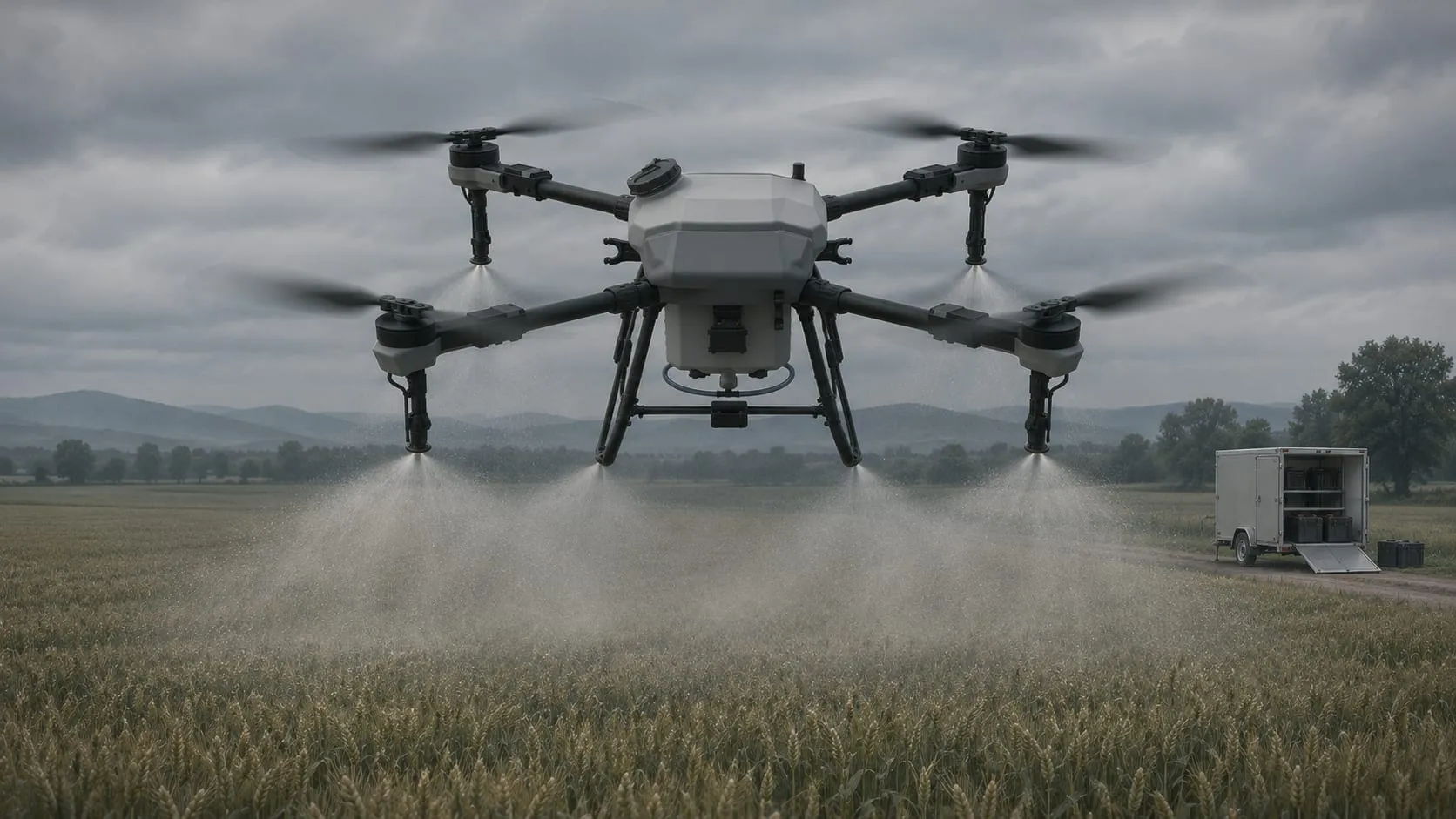
Short answer: a 50 liter agricultural drone is the right size for open cereal, rice and soy blocks of roughly 50 to 1,000 ha, where one refill every 2–3 ha beats the handling cost of a bigger aircraft. Go smaller on terraces and in tight orchards, and bigger when your dose is 30 L/ha or more on large blocks. In 2026 read the tank in litres and the payload in kilograms: they are not the same number.
Is 50 L the right size for your site?
| Your site | Is 50 L right? | What to do |
|---|---|---|
| Open fields of 50–1,000 ha, refill point within a few hundred metres | Yes | AS-50 at 8–20 m swath |
| Fields under 20 ha, terraces, tight orchards | No, go smaller | 10–30 L aircraft: easier to land and turn |
| Hilly mixed farm that also spreads granules | Yes, with the right nozzle | AR-50, flying 2.5–3.5 m above the crop |
| Doses of 30 L/ha or more on blocks above 1,000 ha | Probably go bigger | See the 100 L class |
Is a ‘50 L drone’ really 50 litres?
Results for this phrase are dominated by an aircraft whose tank is 40 L. Compare what makers publish.
| Aircraft | Spray tank | Payload figure | Max take-off weight | Also listed |
|---|---|---|---|---|
| DJI Agras T50 | 40 L | 40 kg | 92 kg (spraying, sea level) | 75 L spreader, 50 kg |
| XAG P100 Pro | 50 L | 50 kg | not listed here | 22 L/min |
| TopXGun FP700 | 60 L | 70 kg maximum | not listed here | 4 rear centrifugal nozzles |
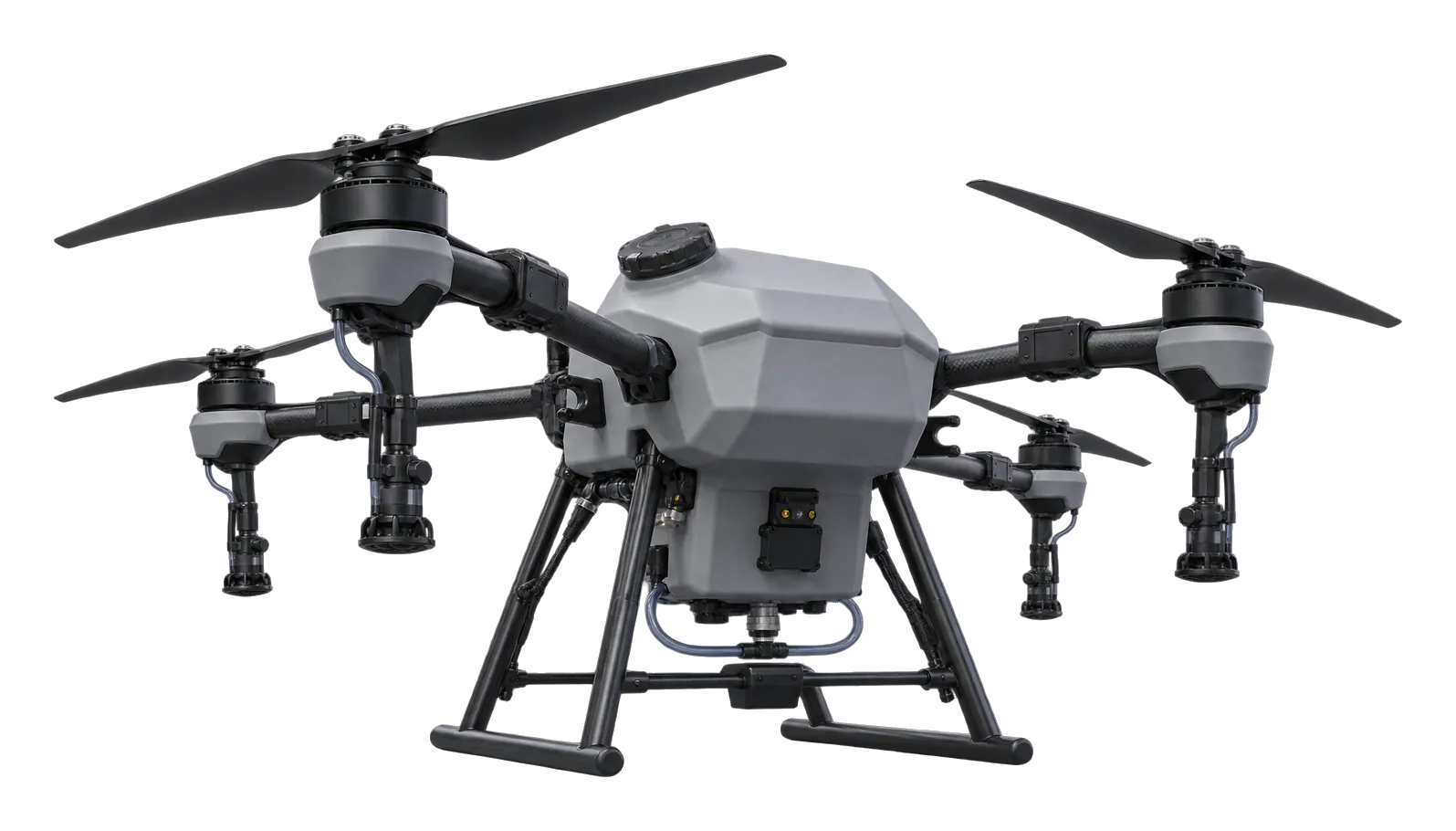
| VEXAFLY AS-50 | 50 L | about 50 kg of water | 99 kg | 2 centrifugal nozzles, 20 L/min |
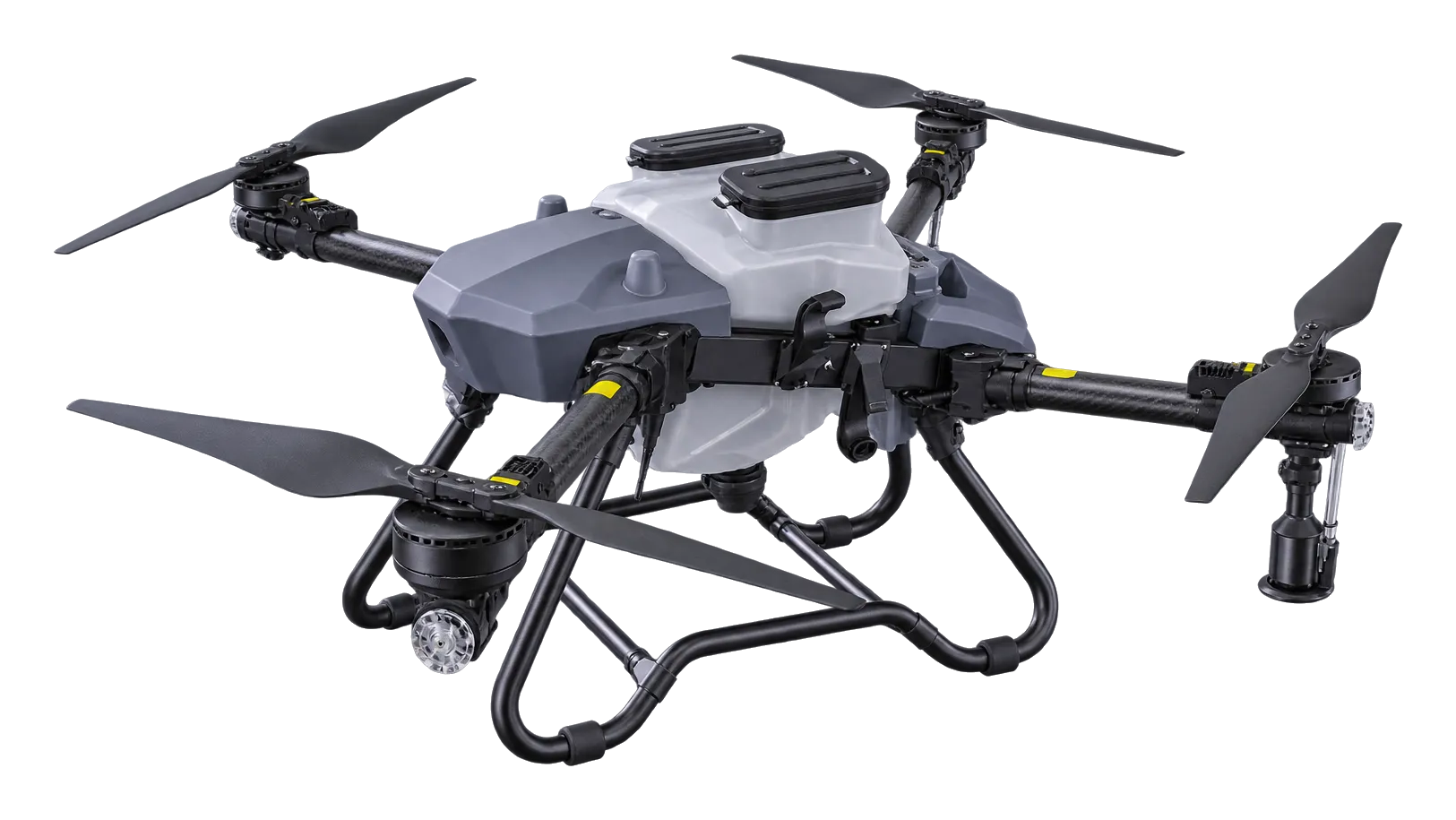
| VEXAFLY AR-50 | 50 L | about 50 kg of water | 95 kg | centrifugal, 16 L/min |
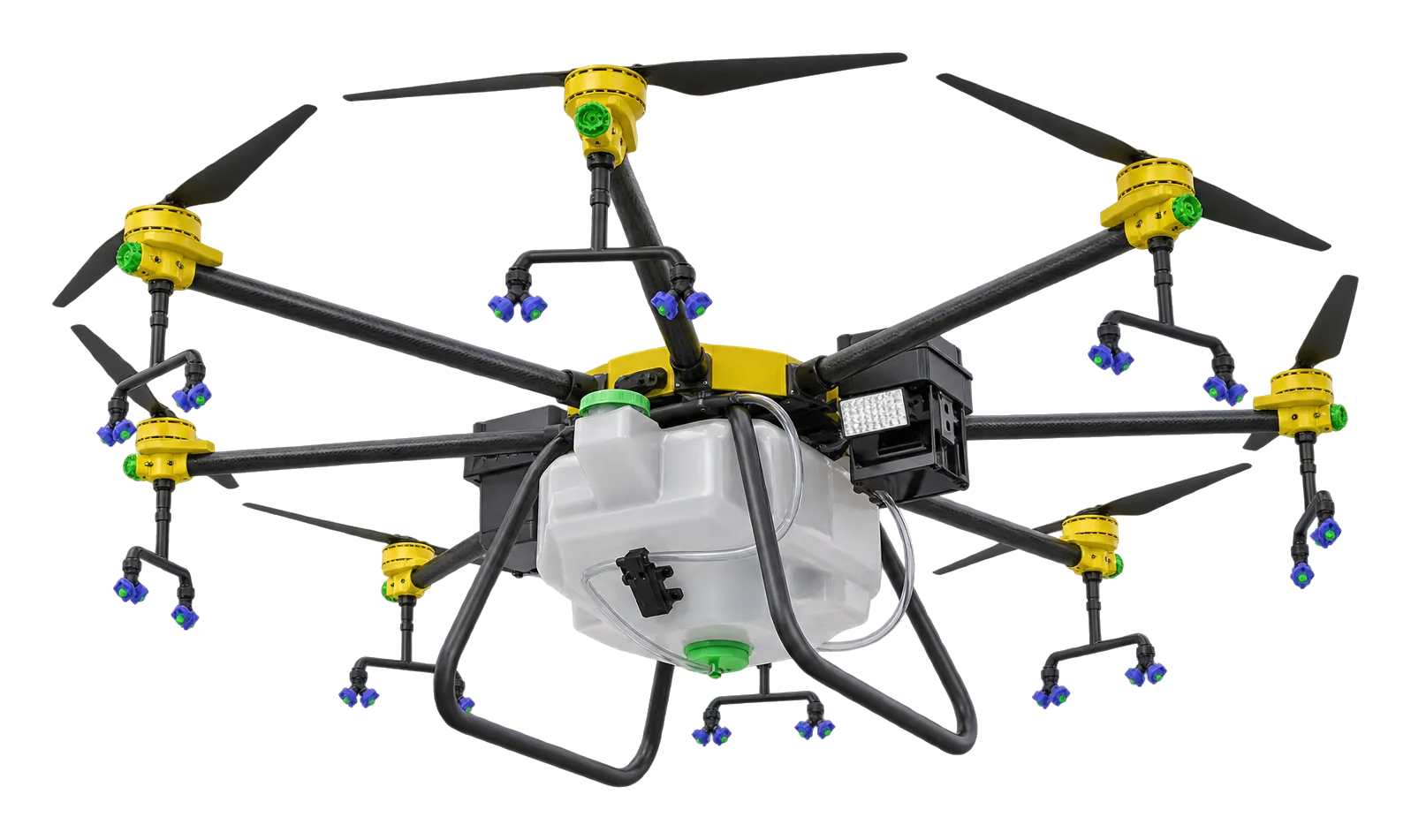
| VEXAFLY AS-52 | 52 L | about 52 kg of water; 60 kg spreader box | 113 kg | high-pressure, 16 L/min |
For water, 1 L weighs 1 kg, and the arithmetic closes: the AS-50 weighs 49 kg with battery, plus 50 kg of water, which is its 99 kg maximum take-off weight. Granules vary in bulk density, so ask for kilograms of your product, not litres of box.
Centrifugal or high-pressure nozzles at 50 L?
The AS-50 and AR-50 use centrifugal nozzles (30–500 µm and 50–500 µm), where disc speed sets droplet size; the AS-52 uses high-pressure nozzles (30–400 µm). Virginia Cooperative Extension notes that rotary atomisers do better flown slightly higher and hydraulic nozzles slightly lower, at a typical 2.1–3.0 m. Choose by the label’s droplet requirement.
Example: a 40 ha wheat block
Example: 40 ha at 20 L/ha (an assumed dose; follow your label) needs 800 L. Assumptions: 6 m/s, 70 % in-field efficiency, 6 minutes per load for take-off, landing and battery change (the University of Kentucky allowance), effective width 12 m for the AS-50 and 8 m for the AS-30.
| AS-50 (50 L) | AS-30 (30 L) | |
|---|---|---|
| Area per load at 20 L/ha | 2.5 ha | 1.5 ha |
| Loads for 800 L | 16 | 27 |
| Overhead at 6 min per load | 96 min | 162 min |
| Work rate | 12 × 6 × 0.7 = 50.4 m²/s, 18.1 ha/h | 8 × 6 × 0.7 = 33.6 m²/s, 12.1 ha/h |
| Spraying time | 2.2 h | 3.3 h |
| Total | about 3.8 h | about 6.0 h |
A refill point 500 m from the block adds about 100 seconds per load at 10 m/s: 27 minutes for the AS-50, 45 for the AS-30.
Battery check. One 50 L load at 20 L/ha covers 2.5 ha, or 25,000 m². At 50.4 m²/s that is 496 seconds, about 8.3 minutes of spraying, while the AS-50 brochure lists 7 minutes of hover at full load. Flights lengthen as the tank empties, but test it: if a battery cannot finish the load, fill 40 L instead. Flow is no problem: 50 L in 8.3 minutes is 6 L/min against a 20 L/min system maximum.
How many batteries and how much power does it need?
Ohio State advises three charged batteries per drone, and the rotation agrees. Assume a 30-minute charge (ask for the real figure): a battery is out of service for 8.3 minutes of flight plus 30 of charging, and a fresh one is needed every 14.3 minutes (8.3 flying plus 6 on the ground). 38.3 ÷ 14.3 = 2.7, so three sets, four with margin.
What rules change at this weight?
The AS-50’s 99 kg take-off weight (about 218 lb) is far above the 25 kg line many authorities use. In the US, check three things before ordering a foreign-built drone: FCC Covered List status, the Section 232 duty (100 % above 25 kg from 3 September 2026) and FAA approval, because aircraft of 55 lb or more with their load follow a separate Part 137 path. Our guides on importing from China and FCC certification explain the steps; confirm with your customs broker and the FAA.
50 L or 100 L?
Move up only when dose or block size justifies it. At 15 L/ha one battery covers about the same area in either class; at 30 L/ha the 100 L aircraft pulls ahead. The 100 L guide works through both, and the size calculator turns your hectares and window into a class.
- Best for open cereal and rice blocks: the AS-50 / AS-65, 8–20 m swath, 20 L/min.
- Best for spraying plus heavy spreading on paddies: the AS-52, 52 L tank and a 60 kg spreader box.
- Best for hilly mixed farms that still want 50 L: the AR-50, 2.5–3.5 m above the crop, 70 L spreader.
Next step
Send your largest block, the distance to the refill point, your label dose and the power at the field. We rerun the 40 ha table with your numbers.
Q & A
Common questions
01How much can an agricultural drone carry?
It depends on the class and on spraying versus spreading. A 50 L spray aircraft carries about 50 kg of water; the spreader hopper and maximum take-off weight set the granule load. Read tank litres and payload kilograms as two figures.
02How much does a 50 L agricultural drone cost?
Our reference FOB China prices are US$7,300–13,300 for the AS-50 / AS-65, US$7,300–16,400 for the AS-52 / AS-72 and US$5,800–14,000 for the AR-30 / AR-50. Freight, duty and extra batteries are separate.
03For a 50 L spray drone, what battery count and charger size keep it flying all day?
Start with three sets per aircraft, and four if charging is slow. Match the generator to the rated input power printed in the charger manual, never to a figure quoted for a different model.
04Can a 50 L drone also spread fertiliser?
The AS-50 / AS-65 has a 70 L spreader for 0.5–10 mm granules, the AS-52 a 60 kg box, and the AR-50 a 70 L hopper for 0.5–6 mm granules. Check bulk density against the limits.
05How many hectares per hour does a 50 L drone cover?
At a 12 m effective width, 6 m/s and 70 % efficiency the AS-50 sprays about 18 ha/h. Refills and battery changes bring the all-in rate lower, as the example shows.
References
- 1Drone Sprayer Sizing for Agricultural Applications (AEN-174) — University of Kentucky Cooperative Extension
- 2Drones for Spraying Pesticides: Opportunities and Challenges — The Ohio State University CFAES
- 3DJI Agras T50 specs — DJI Agriculture
- 4XAG P100 Pro — XAG
- 5TopXGun FP700 agriculture drone — TopXGun
- 6Dispensing Chemicals and Agricultural Products (Part 137) with UAS — Federal Aviation Administration
- 7Adjusting Imports of Unmanned Aircraft Systems and UAS Components into the United States — The White House
- 8Conditional approval and exemption of certain UAS from the FCC Covered List (DA 26-875) — Federal Communications Commission
VEXAFLY Aviation Technology Co., Ltd.. VEXAFLY Aviation Technology Co., Ltd. — industrial drone maker in Nanjing. Our application engineers write and check these pages and configure inspection, cleaning, lift and fire-response systems for project buyers. About VEXAFLY