Agriculture
Fertilizer Spreading Drone 2026: Match the Product, Box Size and Field
Fertilizer spreading drone selection for 2026: granule size, box litres versus kilos, rate and loads per field, uniformity checks and reference prices.
- Author
- VEXAFLY Aviation Technology Co., Ltd.
- Scope
- Agriculture
- Published
- Length
- 4 min read · 5 sources
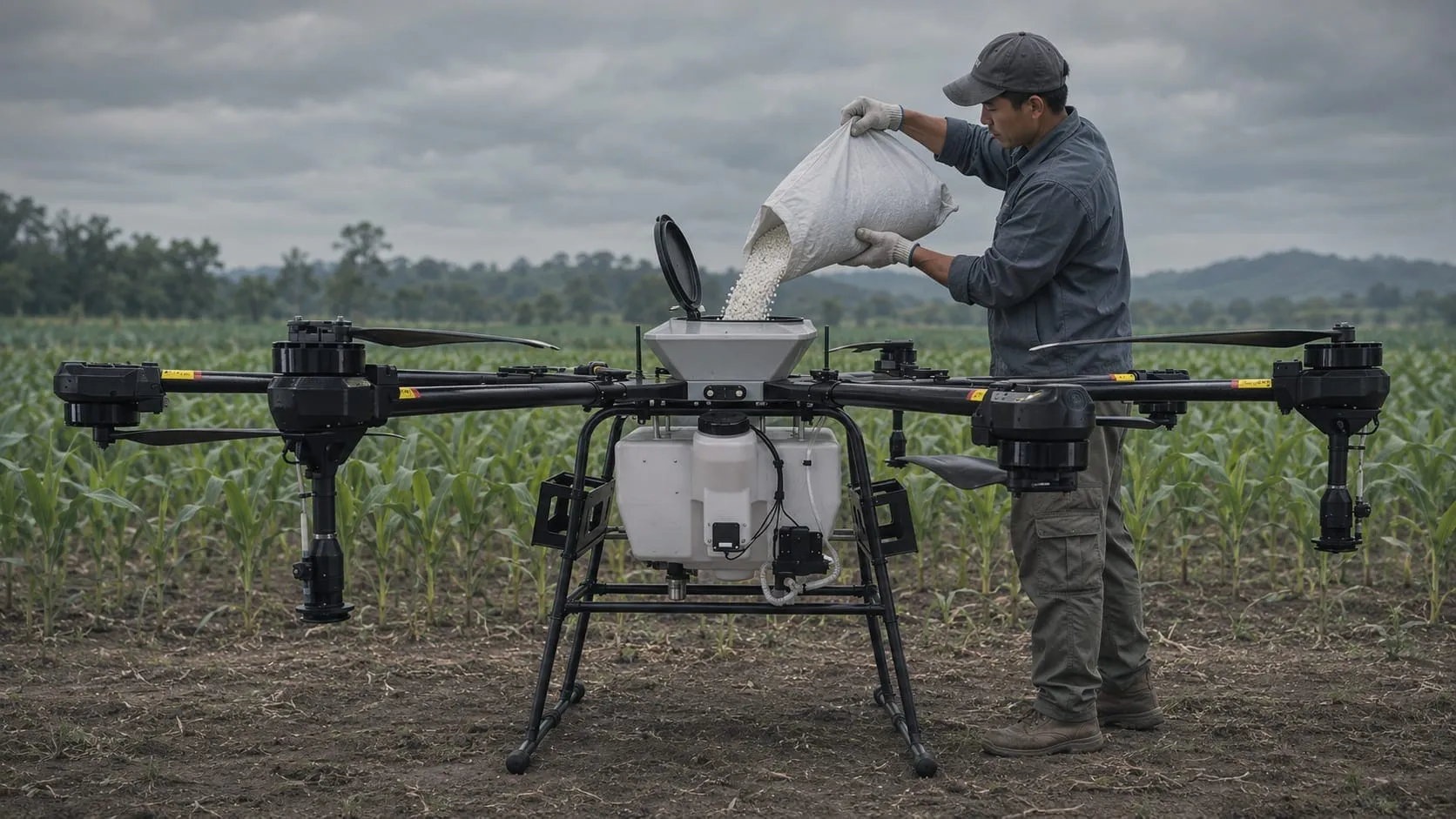
Short answer: in 2026 a fertilizer spreading drone works well for free-flowing granules on rice, wheat and plantations, and badly for dust and lime. Pick the box by the kilos it carries of your product, pick the aircraft by the granule range, and pick the class by how many landings you can afford per hectare.
Which product on which site?
| Product and site | Granule or rate | Box that fits | Limit |
|---|---|---|---|
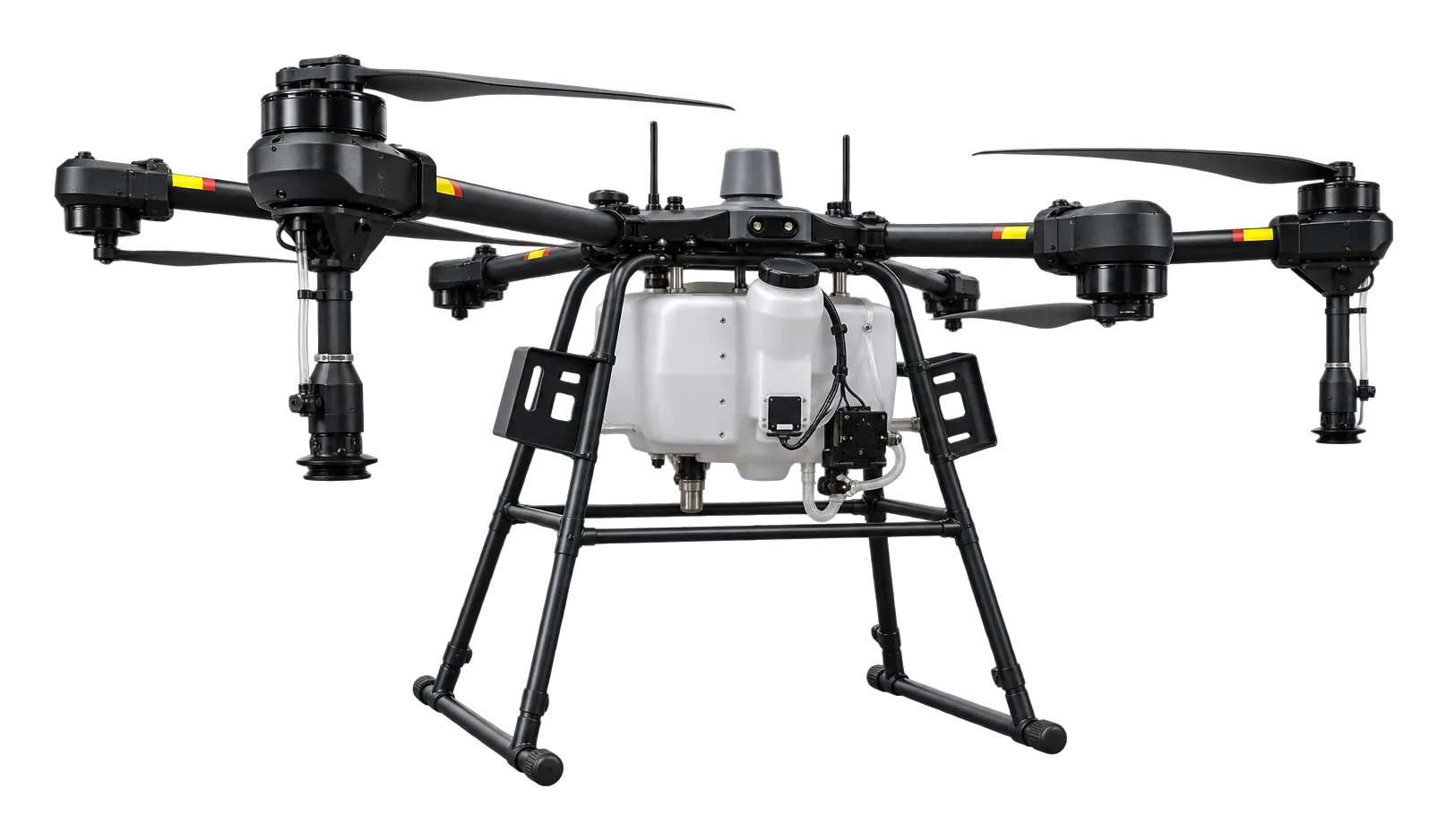
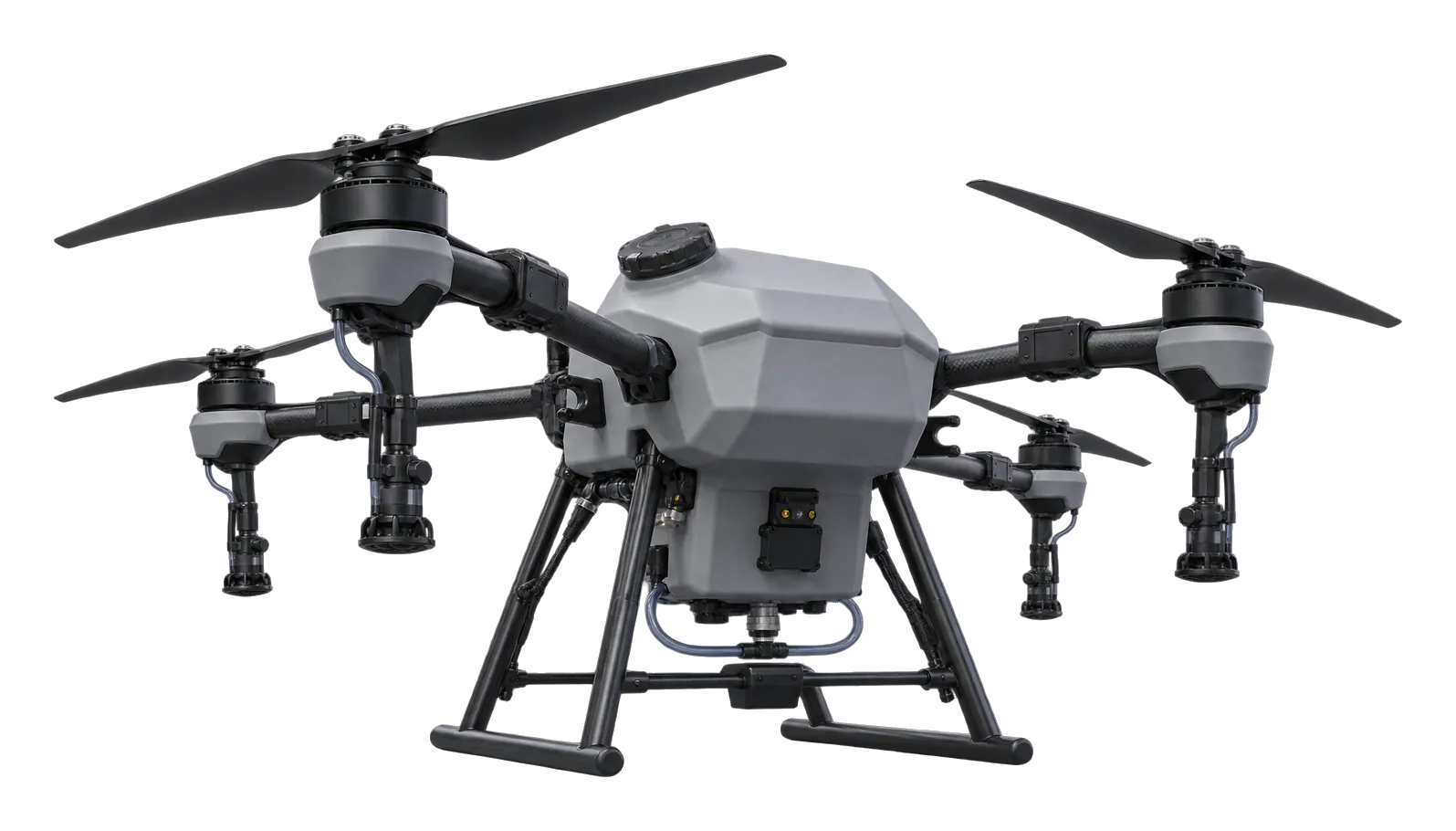
| Urea top-dress on rice or wheat | Prills, about 50–150 kg/ha | AS-50 / AS-65, 70 L, 0.5–10 mm | Humid air makes prills cake in the box |
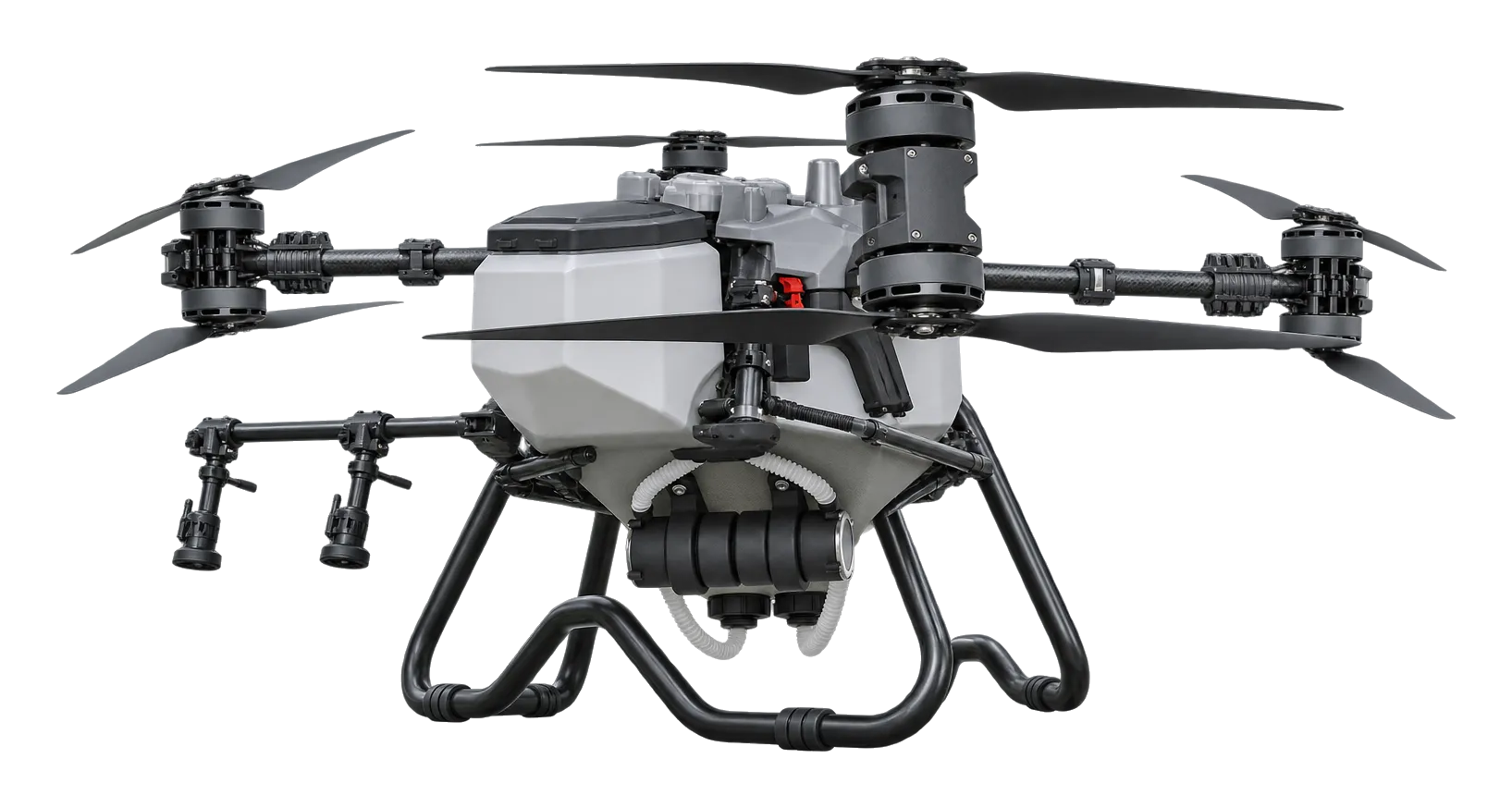
| Compound NPK on palm or sugarcane blocks | Mixed granules, heavier rates | AS-92, 170 L, 1–10 mm | Mixes with unequal granule sizes separate |
| Slow-release coated granules | Larger granules | AS-92 or AS-150, 1–10 mm | Check the coating does not crumble in the auger |
| Large blocks with a loading crew | Any free-flowing granule | AS-150, 210 L | Landing site and loader needed |
| Agricultural lime, dusty blends | Powder | Not suited | Does not meter or throw evenly |
| Slug or rodent bait | Small pellets | Check the label | Label rules may not allow aerial use |
Why does a 70 L box not carry 70 kg?
Because a litre of fertilizer rarely weighs a kilo, and because the aircraft has a take-off weight limit. Published makers’ figures show the gap:
| Aircraft | Spreader box | Stated payload |
|---|---|---|
| DJI Agras T50 | 75 L | 50 kg |
| DJI Agras T100 | 150 L | 100 kg operating payload |
| XAG P150 Max | 115 L | 80 kg |
| VEXAFLY AS-52 | 60 kg box (spreader) | 60 kg |
| VEXAFLY AS-100 | listed in kg | 120 kg |
| VEXAFLY AS-92 / AS-150 | 170 L / 210 L | weigh your product |
Reference values from the maker’s brochures; check the page before quoting a competitor number. Weigh one full box of your own product and write that figure on the job sheet.
How many loads does my field need?
Loads = (rate in kg/ha × hectares) ÷ kilos per load. Time per load matters too: Weedsmart reports that a DJI T50 empties a full 50 kg load in about 30 seconds, so the aircraft spends more time on the ground than spreading.
Worked example: urea on 60 ha of rice
Example only — assumed densities, weigh yours. Urea at 100 kg/ha on 60 ha needs 6,000 kg.
| Aircraft | Assumed kg per load | Hectares per load | Loads for 60 ha |
|---|---|---|---|
| AS-150 (210 L box) | 140 kg | 1.4 | about 43 |
| AS-50 / AS-65 (70 L box) | 50 kg | 0.5 | 120 |
The larger box makes a third as many landings. On a 20 ha farm of bunded 0.3 ha paddies, though, partial loads make the smaller aircraft the better fit.
How even is a drone spread, and how do you check it?
Evenness comes from calibration. Ohio State advises checking disc speed against new with a tachometer and cleaning worn serrations. Put out a row of trays across the swath, fly one pass at the planned height and speed and compare the weights. Set the route spacing from where the spread falls off, not from the catalogue swath. Ohio State puts the best swath of two-disc rotary drones at about 9–11 m. Alabama Extension adds that wind pushes spread sideways, so fly in calm air.
When should you not use a drone?
- Lime and dusty blends: they bridge in the box and blow away.
- Very high rates: at 750 kg/ha a 50 kg load covers 650 m².
- Windy sites: fine prills drift; stop when swath edges blur.
- Labels that prohibit aerial use: some bait and nematicide labels do.
What does it cost?
| Model | Box | Reference price (FOB China) |
|---|---|---|
| AS-50 / AS-65 | 70 L, 0.5–10 mm | US$7,300–13,300 |
| AS-92 | 170 L, 1–10 mm | US$15,400–29,100 |
| AS-150 | 210 L, 1–10 mm | US$29,000–34,800 |
Prices are reference FOB China and vary by configuration and quantity; final prices are on the quotation. Compare with the weight-based comparison in largest agricultural drone before choosing a class.
US buyers and next step
In the US, check three things before ordering a foreign-built drone: its FCC Covered List status, the Section 232 duty and FAA approval for aircraft of 55 lb or more. Confirm with your customs broker and the FAA. Our import guide and FCC guide explain the steps.
Best for:
- Best for rice and wheat top-dressing: AS-50 / AS-65, 70 L box, granules 0.5–10 mm.
- Best for plantations with heavy NPK rounds: AS-92, 170 L box, 1–10 mm.
- Best for very large blocks with a loader: AS-150, 210 L box, 8–15 m swath.
Planning a plantation programme? Read palm oil plantation drones and sugarcane drone spraying, see the agriculture range, or send us your product, rate and area via the contact form.
Q & A
Common questions
01Can you spread fertilizer with a drone?
Yes. A spreader box with a metering gate and a spinning disc throws granules sideways as the drone flies. It suits urea, compound NPK and other free-flowing granules; powders and lime dust do not flow or spread well.
02How many kilos does a 70 L spreader carry?
It depends on the product and on the aircraft's take-off weight, so there is no single answer. Weigh one full box of your own fertilizer. The published pairs show that litres and kilos differ: DJI T50 75 L and 50 kg, XAG P150 Max 115 L and 80 kg.
03How even is a drone spread?
It depends on calibration, wind and the product. Ohio State recommends checking disc speed with a tachometer and cleaning worn serrations, and a tray test shows the real swath. Set the route spacing from the test, not from a catalogue figure.
04How much does a fertilizer spreading drone cost?
Our reference FOB China prices run from US$7,300 to US$13,300 for the AS-50 / AS-65 class, US$15,400–29,100 for the AS-92 and US$29,000–34,800 for the AS-150. Final prices depend on configuration and quantity.
05What rate can a drone apply?
DJI's maker guide quotes 50–750 kg/ha at 6–7 m/s. Very high rates need many landings, so a ground spreader may be quicker above a few hundred kilos per hectare.
06Can I import one into the US?
In the US, check three things before ordering a foreign-built drone: its FCC Covered List status, the Section 232 duty and FAA approval for aircraft of 55 lb or more. Confirm with your customs broker and the FAA.
References
- 1DJI Agras T100 specs (battery, C12000 charger, D14000iE generator) — DJI Agriculture
- 2DJI Agras T50 specs — DJI Agriculture
- 3XAG P150 Max — XAG
- 4Use of Drones for Aerial Seeding of Cover Crops — Alabama Cooperative Extension System
- 5Drone spraying and spreading technology update — WeedSmart
VEXAFLY Aviation Technology Co., Ltd.. VEXAFLY Aviation Technology Co., Ltd. — industrial drone maker in Nanjing. Our application engineers write and check these pages and configure inspection, cleaning, lift and fire-response systems for project buyers. About VEXAFLY