Agriculture
Agricultural Drones for Large Farms in 2026: Fleet Size, Spray Windows and Support Kit
Agricultural drone for large farms in 2026: size the fleet from the spray window, compare one large aircraft with two medium ones, and budget the support kit.
- Author
- VEXAFLY Aviation Technology Co., Ltd.
- Scope
- Agriculture
- Published
- Length
- 5 min read · 5 sources
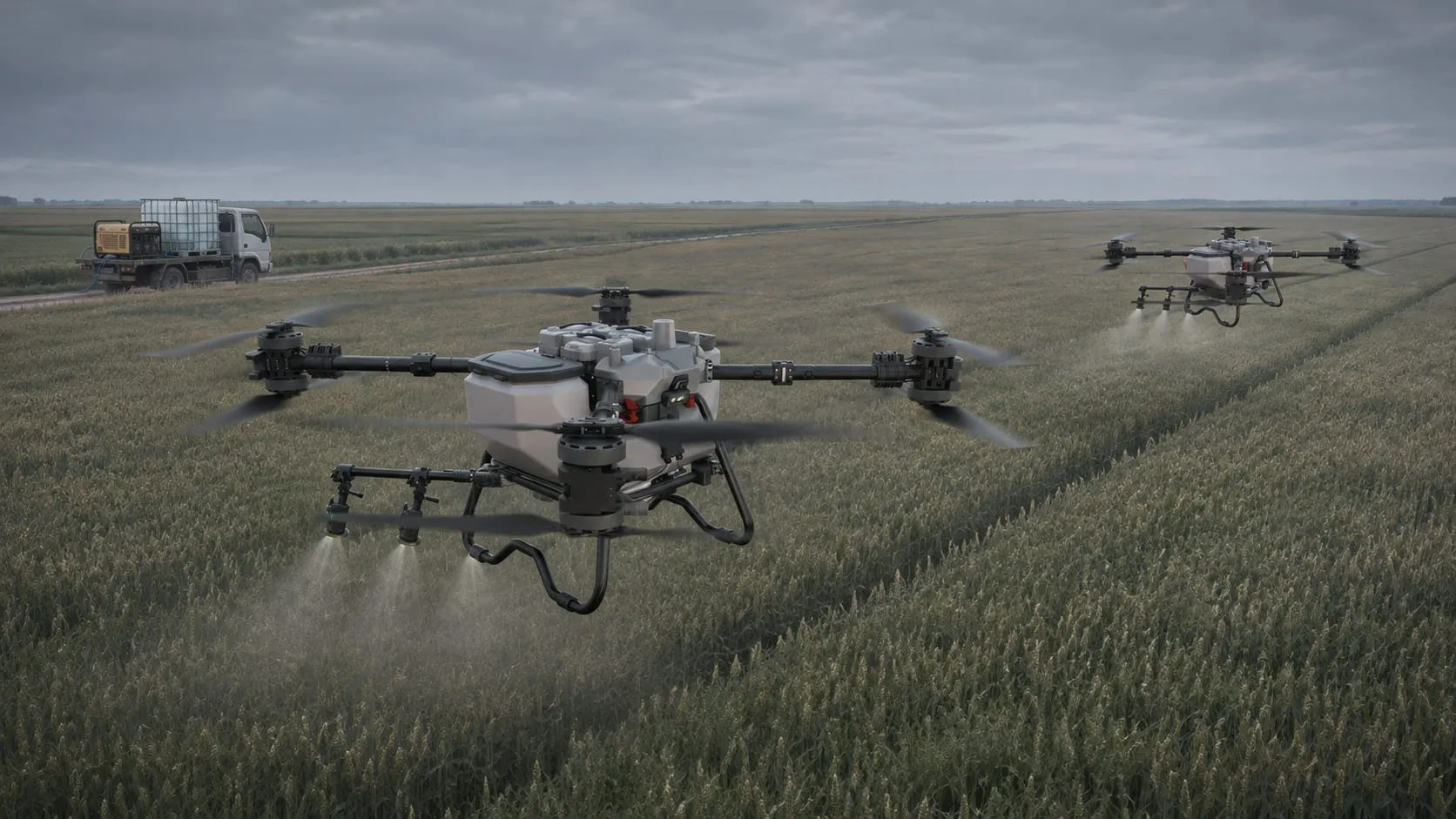
Short answer: in 2026 an agricultural drone for large farms is chosen by the spray window: hectares to cover, days available and the rate per hour, from which the number and class of aircraft follow. For 1,000–3,000 ha with one crew, a 100 L class aircraft such as the AS-100 is the usual starting point; above 3,000 ha, the AS-150 with a full ground team. Budget the support kit as carefully as the aircraft.
How many drones does a large farm need?
The matrix below combines farm size and window.
| Farm size | Window | Typical set-up | Why |
|---|---|---|---|
| 1,000–3,000 ha | 7–10 days | One AS-100 plus nurse tank, or two AS-50 / AS-65 | One crew, redundancy optional |
| 3,000–10,000 ha | 7–14 days | Two to four AS-150 or AS-100 | Several crews and water points |
| Heavy spreading, plantations | Any | AS-92 (170 L spreader) | Weigh the hopper |
| Mixed fields under 100 ha each | Any | Medium aircraft | Turns and refills dominate |
Start from the spray window, not the tank
University of Kentucky extension publication AEN-174 gives rates including overhead at 2 gal/acre (about 18.7 L/ha): 3.1 ha/h for an 8 L drone, 8.6 for 30 L, 13.0 for 40 L and 20.2 for 72 L. Its window table (40 h a week, 2 gal/acre) shows the maximum area in three weeks: about 1,036 ha for 30 L, 1,567 ha for 40 L and 2,418 ha for 72 L. Each gallon per acre above 2 cuts the rate by about 15–30 %. Smaller aircraft lose on refills: for 3,000 acres in three weeks Kentucky puts four 8 L drones at about US$14.18 per acre against US$6.50 for one 40 L drone.
What does a 1,200 ha fungicide window look like?
Example (assumed inputs, an estimate): 1,200 ha (about 2,965 acres) of corn and soy needs fungicide in seven days at 2 gal/acre, flying 8 h a day.
- Needed rate: 1,200 ÷ (7 × 8) = 21.4 ha/h.
- Kentucky’s 72 L-class figure is 20.2 ha/h: just short with one aircraft; two give about 40.4 ha/h, so about 30 flying hours, 3.7 days of 8 h.
- Water: 1,200 ha × 18.7 L/ha ≈ 22,440 L, so a nurse tank and a transfer pump are part of the plan.
- Our makers quote up to 35 ha/h for the AS-100 and 40 ha/h for the AS-150. Treat these as maker figures to be checked in your field test.
One large drone or two medium ones?
A single large aircraft needs one pilot and one set-up. If it is grounded in the window, the job stops. Two medium aircraft give redundancy and one can fly while the other refills, but each needs its own pilot in most jurisdictions. The Hylio exemption granted in 2024 allows one pilot to fly up to three AG-230 aircraft of 165 lb each in the US; the company reported about 150 acres an hour for three. Treat it as an exception: outside such cases, more aircraft means more crew.
What does the support kit cost?
The University of Missouri model lists a battery at about US$2,500, a generator at US$7,500 and a trailer at US$9,000 for a farm or US$14,500 for a custom operator, with maintenance at about US$1 per acre; break-even for a farm against custom hire at US$16 per acre is about 980 acres a year. These are US figures for other aircraft; use them to see which items you must budget, not as quotations. See agricultural drone spare parts and wear.
Which weight limits apply?
Aircraft above 25 kg need special approval in many countries, and the US threshold is 55 lb: Section 44807 exemption and Part 137 for dispensing. The AS-92 (193 kg MTOW), AS-100 (254 kg) and AS-150 (311 kg) are above 150 kg, where ISO 23117-1 does not apply and many “large RPA” categories begin. One maker notes that Australia and Turkey keep its 100 L model at 149.9 kg MTOW. Ask your authority before ordering; read 100 litre agricultural drone selection and the largest agricultural drone.
What should US buyers check?
In the US, check three things before ordering a foreign-built drone: its FCC Covered List status, the Section 232 duty and FAA approval for aircraft of 55 lb or more. Confirm with your customs broker and the FAA. See importing industrial drones from China and drone FCC certification. We do not state that our aircraft can be imported or flown in the US. China’s export controls from 18 November 2026 cover some drones and sprayers with large tanks; export licensing is checked per model and destination and can add time to the lead time. Full battery sets of large aircraft normally travel by sea (battery shipping).
How do you spread at scale?
The AS-92 carries a 170 L spreader (1–10 mm), the AS-150 a 210 L spreader, and the AS-100 about 120 kg of granules. Litres are not kilograms: bulk density of urea, potash and seed differs, so weigh one full hopper. At 150 kg/ha and about 120 kg per load, each flight treats under a hectare, so the loading team, not the aircraft, sets the pace. See spray drone size calculator.
What are the alternatives at this scale?
Ground rigs remain the benchmark when soil is dry and fields are regular. Autonomous fixed-wing aircraft, such as the Pyka Pelican-2 (80 gal payload and about 222 acres/h as reported by RFD-TV), are another class and are not comparable on price. Drones win where fields are wet, irregular or already planted and tracks would damage the crop. See drone vs tractor spraying and cotton drone spraying.
Best for …
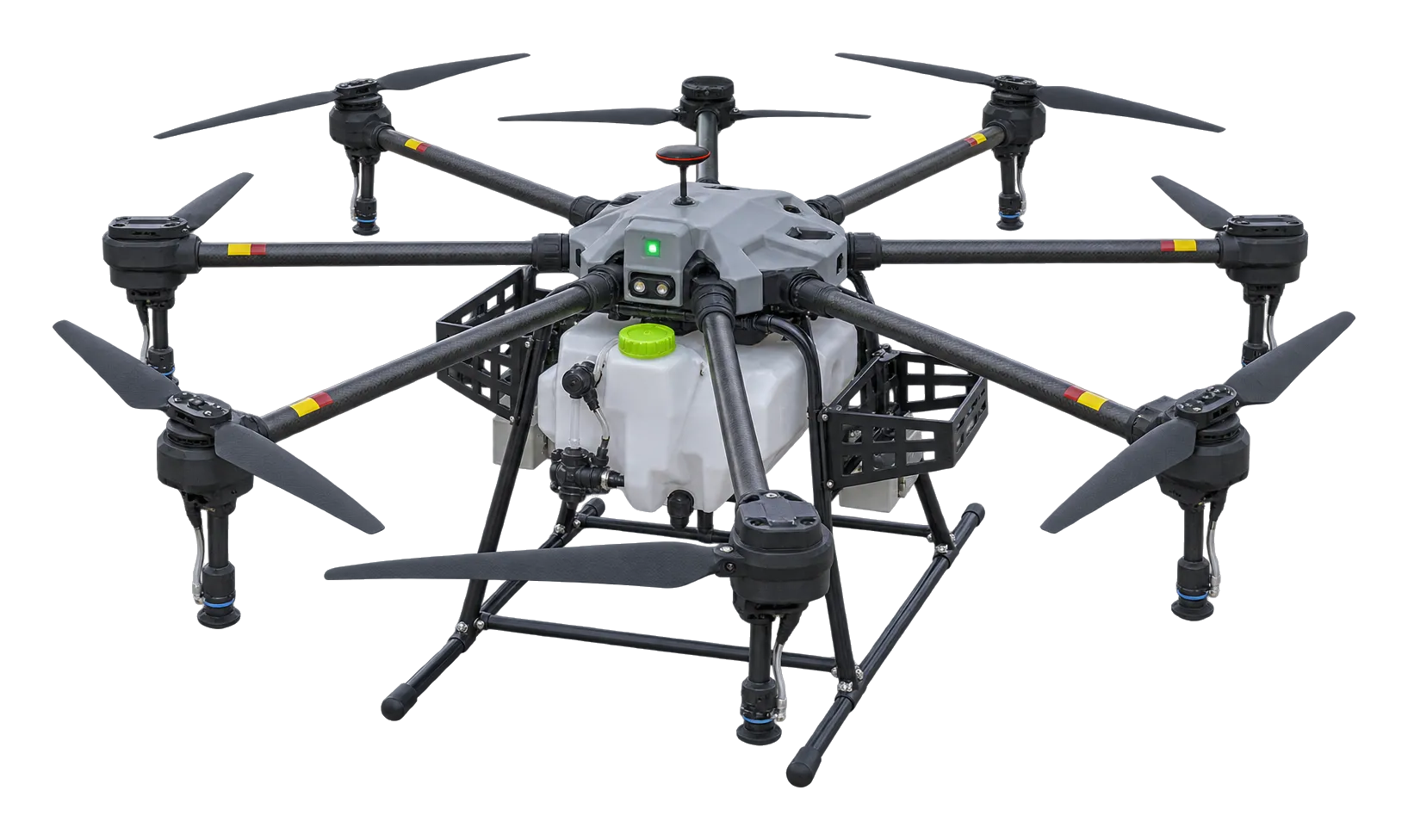
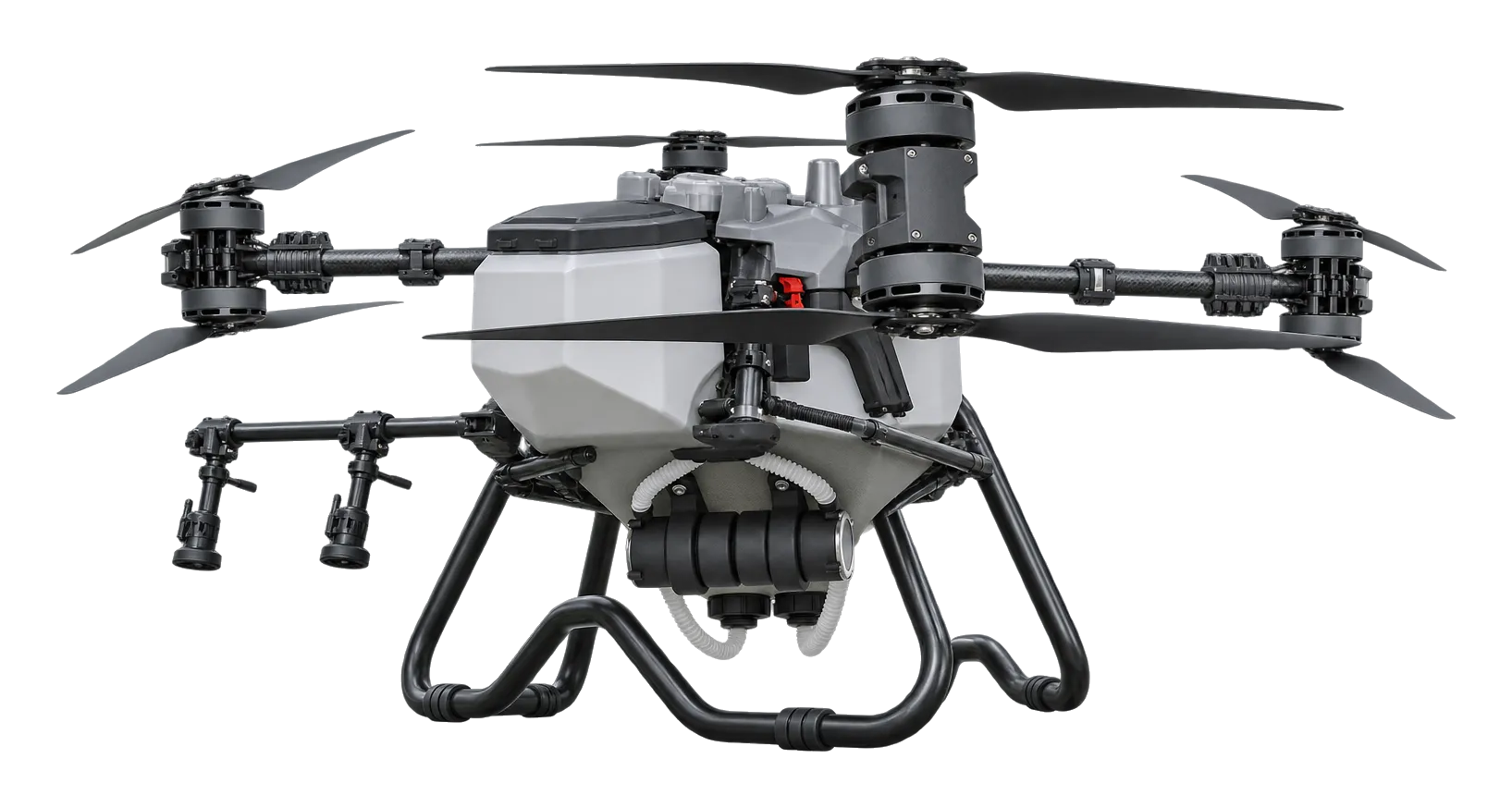
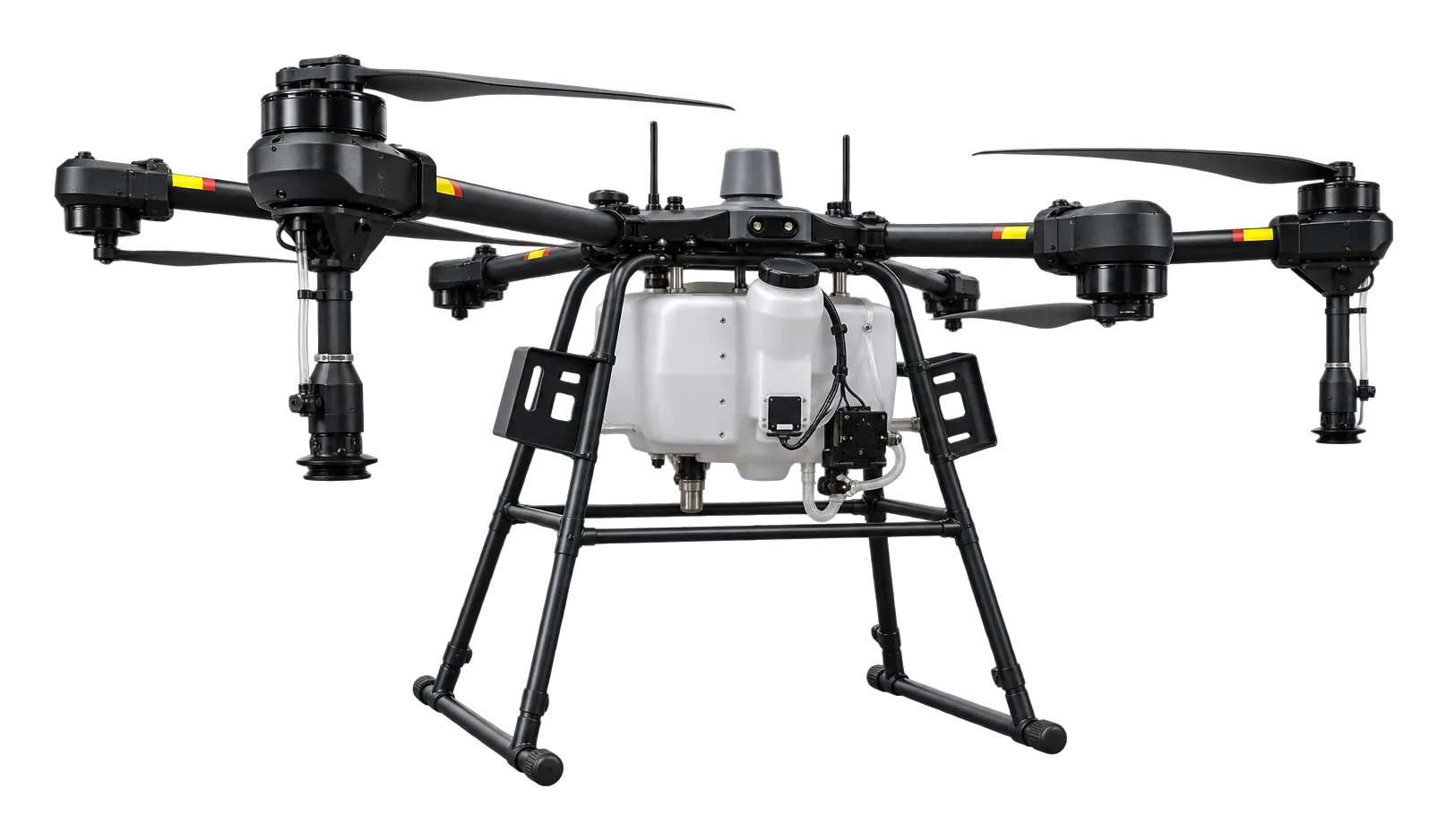
- Best for 1,000–3,000 ha with one crew: the AS-100, 100 L tank, 254 kg MTOW, 8–15 m width.
- Best for 3,000 ha+ and contractors: the AS-150, 150 L tank, 60 L/min, 360° radar.
- Best for plantations and heavy spreading: the AS-92, 170 L spreader, ceiling of 5,000 m by the maker.
Next step
Send us the hectares, the window in days, the product, the water source and your country. We reply with an aircraft count, a loads-per-day table and the support kit that fits.
Q & A
Common questions
01How much is a large agricultural drone?
Our reference FOB China prices are US$15,400–29,100 for the AS-92, US$24,200–29,100 for the AS-100 and US$29,000–34,800 for the AS-150 (varies with configuration and quantity; final price on quotation). Duties, freight, batteries and the support kit are extra.
02How many acres can an agricultural drone spray per hour?
Kentucky data at 2 gal/acre give about 3.1 ha/h for an 8 L drone, 8.6 for 30 L, 13.0 for 40 L and 20.2 for 72 L, including overhead. Our makers quote up to 35 ha/h for the AS-100 and 40 ha/h for the AS-150; test in your field before relying on them.
03What is the best drone for farms over 1,000 ha?
It depends on the window, not size alone. For 1,000–3,000 ha with one crew, a 100 L class aircraft such as the AS-100; above 3,000 ha or for contractors, the AS-150 with a full support team.
04One large drone or two medium ones?
One large aircraft needs less crew; two medium ones give redundancy and keep working during refills. In the US each aircraft normally needs its own pilot unless an exemption such as Hylio’s allows one pilot for up to three.
05Do I need an extra permit for a drone above 150 kg?
In many countries, yes. Rules change at 25 kg, 55 lb and 150 kg, and ISO 23117-1 does not apply above 150 kg. Ask your aviation authority before you order; Australia and Turkey, for example, keep one maker’s model at 149.9 kg MTOW.
References
- 1Drone Sprayer Sizing for Agricultural Applications (AEN-174) — University of Kentucky Cooperative Extension
- 2Economics of Drone Ownership for Agricultural Spray Applications (G1274) — University of Missouri Extension
- 3FAA Exemption Expands Drone Use in Ag — Farm Policy News, University of Illinois
- 4ISO 23117-1:2023 Unmanned aerial spraying systems: Part 1: Environmental requirements — Estonian Centre for Standardisation (ISO reseller)
- 5Section 44807: Special Authority for Certain Unmanned Aircraft Systems — FAA
VEXAFLY Aviation Technology Co., Ltd.. VEXAFLY Aviation Technology Co., Ltd. — industrial drone maker in Nanjing. Our application engineers write and check these pages and configure inspection, cleaning, lift and fire-response systems for project buyers. About VEXAFLY