Agriculture
Agricultural Drone Spare Parts in 2026: What Wears, When to Replace and What to Stock
Agricultural drone spare parts in 2026: which parts wear under dust, wet season and heat, battery life, a stock list by workload and a 2,000 ha season example.
- Author
- VEXAFLY Aviation Technology Co., Ltd.
- Scope
- Agriculture
- Published
- Length
- 5 min read · 8 sources
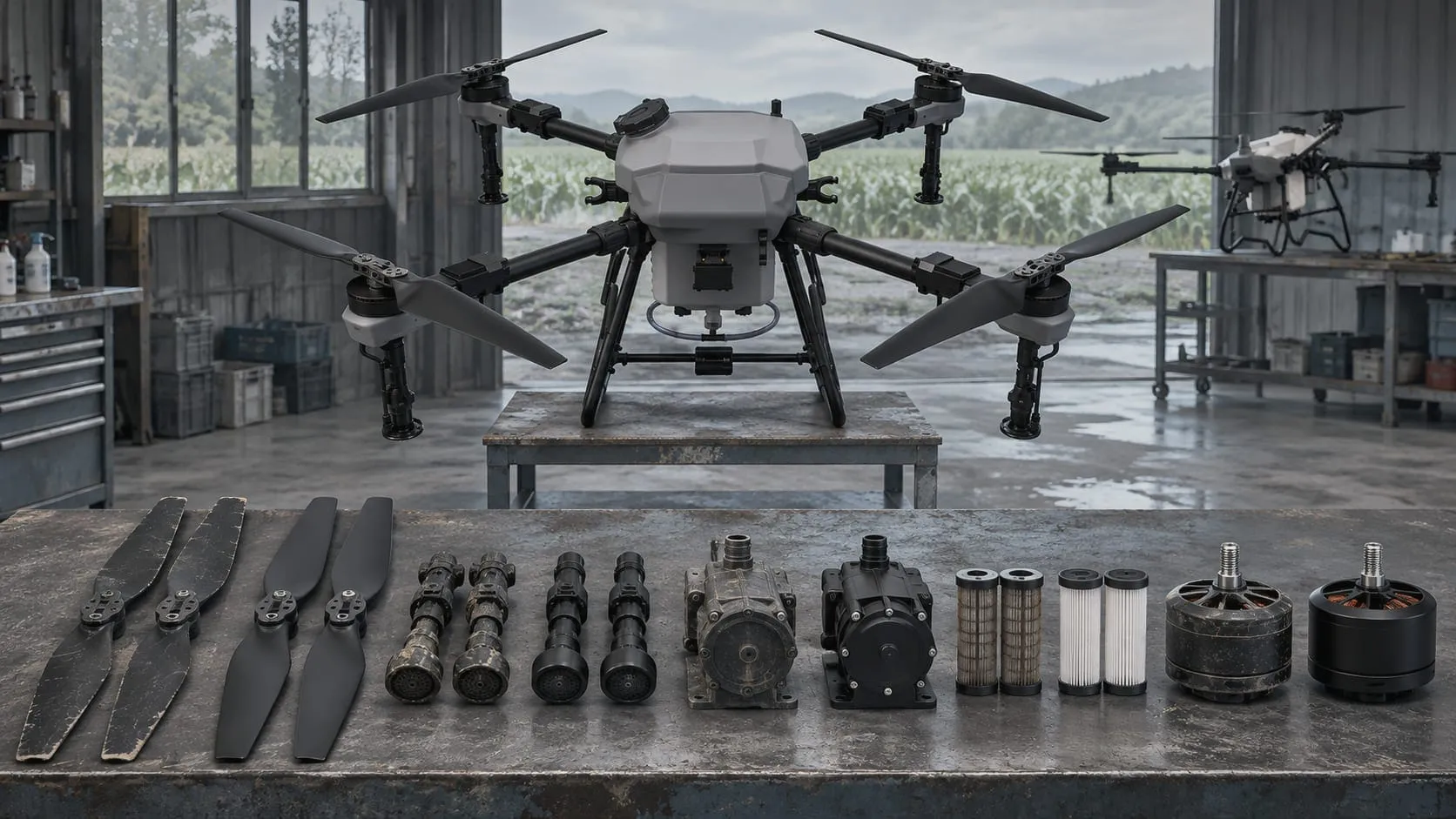
Short answer: the agricultural drone spare parts that matter most are batteries, propellers, nozzles or discs, pump parts, strainers and seals, and structural parts such as arms and landing gear. How fast they wear depends on hectares per season and on site conditions such as dust, wet season and rough take-off spots. In 2026 stock for your workload, inspect on condition and keep a use log, because few makers publish part-by-part intervals.
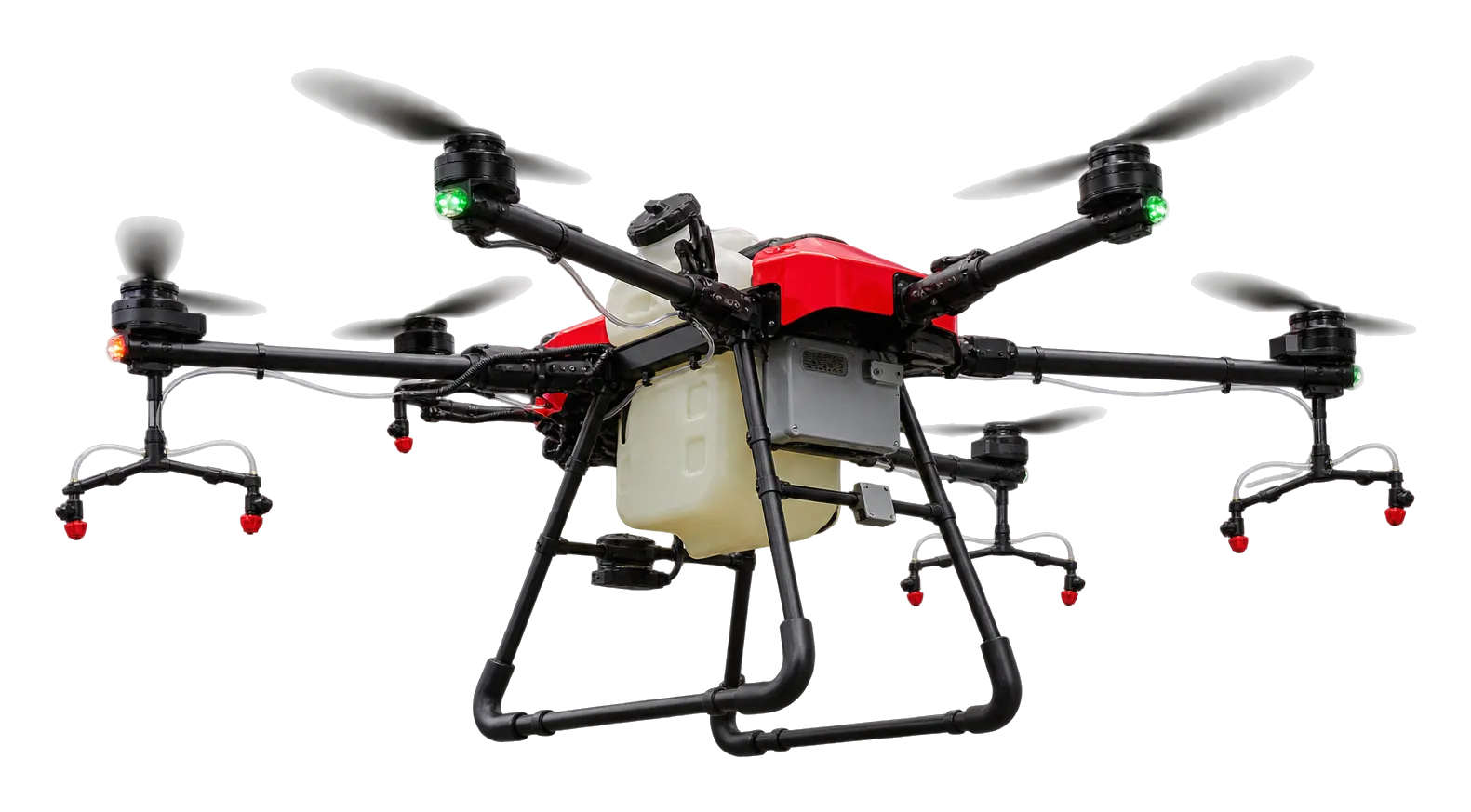
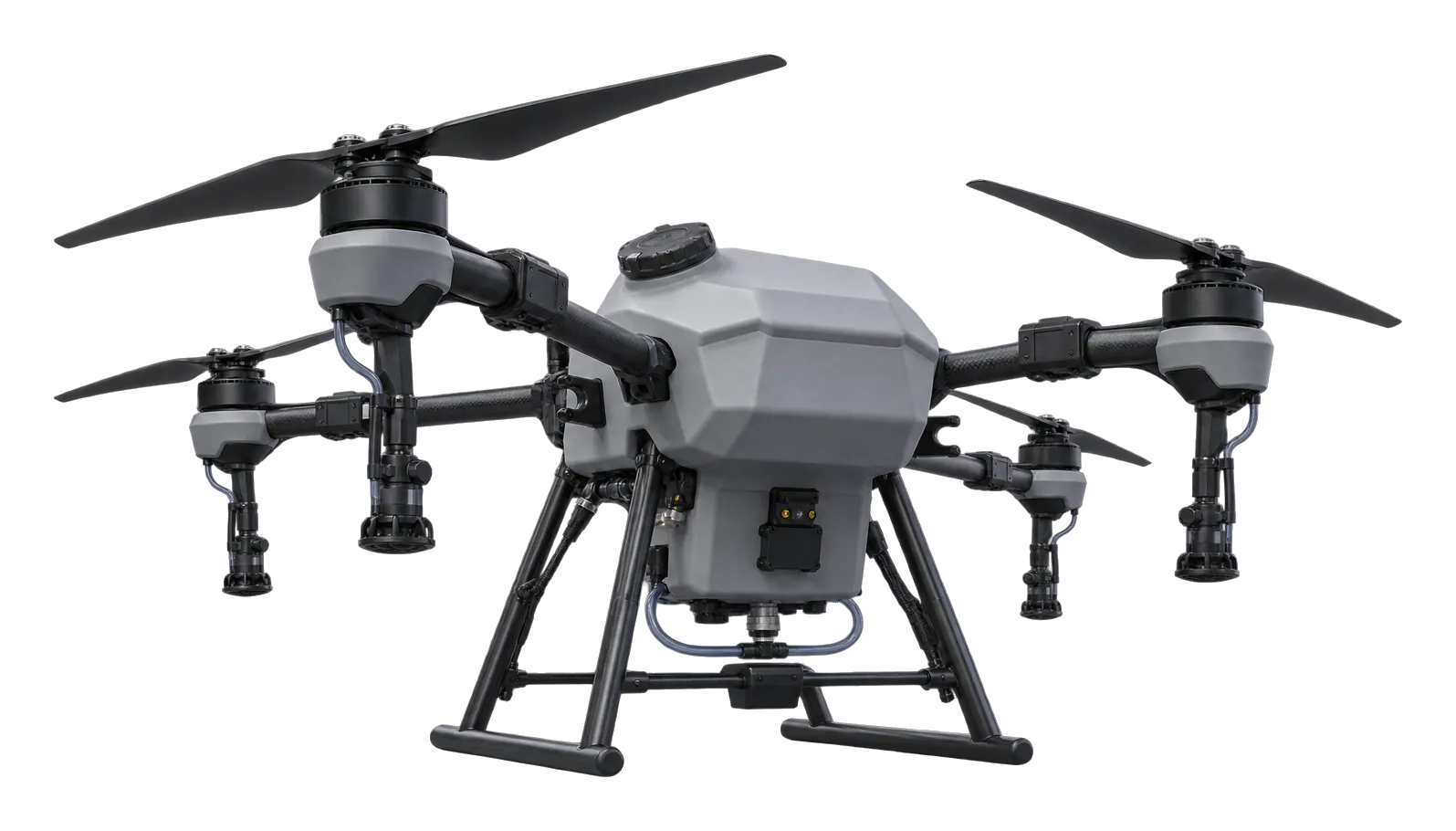
Which parts does an agriculture drone have, and which wear?
| Part | What wears or damages it | Daily check | Stock |
|---|---|---|---|
| Frame and folding arms | Crashes, vibration, hinge play | Play at hinges, cracks | Spare arms; AF frames |
| Motors and propellers | Grit, strikes, imbalance | Nicks, play, noise before each flight | Spare propeller sets |
| Battery and charger | Charge cycles, heat, age | Log each cycle; check swelling and contacts | Extra sets |
| Pump and flow meter | Powders, dirt, dry running | Flush with clean water; compare flow with the set rate | Pump kit, seals |
| Nozzles and discs | Plugging, abrasion, disc speed drift | Clean orifices; tachometer on discs | Spare tips or discs |
| Tank and strainers | Residue, blockages | Clean after every product | Strainer sets |
| Spreader auger or disc | Granule abrasion | Look for wear and play | Per spreader kit |
| Radar, RTK, remote | Knocks, dirt, water | Wipe sensor faces | Usually repair, not stock |
Which parts wear fastest in your conditions?
| Site condition | Parts at risk | Habit that helps |
|---|---|---|
| Dust or red soil | Motors, pump, discs, seals | Rinse and dry after each day |
| Wet season, heavy dew | Connectors, battery contacts, tank residue | Dry the contacts; store indoors |
| Powders and suspensions | Nozzles, strainers, pump | Flush with clean water after each tank |
| High heat | Batteries, speed controllers | Shade; let batteries cool before charging |
| Coastal salt air | Fasteners, connectors | Rinse with fresh water, dry fully |
| Rough take-off spots | Landing gear, arms, propellers | Use a landing mat; walk the spot first |
IP67, the airframe rating of our AS-30 and AS-50 under IEC 60529, means dust-tight and protected against temporary immersion. It does not stop abrasion, so rinse daily.
How long do batteries last?
The Missouri model assumes 1,000 charge cycles or five years and US$2,500 per battery for a 40 L-class aircraft, one cycle per flight and about 6.5 acres (2.6 ha) per charge. The AS-10 / AS-20 batteries charge in about 30 minutes. Ask us for cycle life and end-of-life capacity for your model, and log cycles per battery from day one.
Example: a 2,000 ha season with two AS-30
Example: assumptions are two AS-30 aircraft, 15 L/ha, 2 ha per 30 L load, one battery cycle per flight and four battery sets per aircraft.
| Quantity | Calculation | Result |
|---|---|---|
| Flights in the season | 2,000 ha ÷ 2 ha | 1,000 (500 per aircraft) |
| Cycles per battery set | 500 ÷ 4 sets | 125 per season |
| Share of a 1,000-cycle life | 125 ÷ 1,000 | 12.5 % per season |
| Seasons until 1,000 cycles | 1,000 ÷ 125 | 8, so five years comes first |
| Hectares per aircraft | 2,000 ÷ 2 aircraft | 1,000 ha |
| Seasons to the Missouri airframe life | 3,240 ha ÷ 1,000 ha | about 3.2 |
| Maintenance budget | 4,940 acres × US$1 | about US$4,900 (US cost basis, 2025) |
The Missouri figures describe a US 40 L-class aircraft, not ours; plan with them, then replace them with the maker’s data.
How do you check rotary discs and nozzles?
Ohio State’s method for rotary atomisers: measure disc RPM with a digital tachometer, compare it with the RPM when new, clean the serrations and replace the disc at the maker’s replacement speed, if given. Narrow low-flow orifices plug more often, so keep strainers clean. Virginia Tech shows that flow changes droplet size: on one atomiser, raising flow from 2.4 to 6.0 L/min raised the median droplet size by about 100 µm. Recheck flow after any nozzle or pump change.
What should be in the season kit?
Quantities per aircraft are our planning assumptions, not maker intervals; adjust after one season of your own log.
| Item | Up to 500 ha per aircraft | 500–2,000 ha | Above 2,000 ha |
|---|---|---|---|
| Battery sets | 3 | 4 | 5 |
| Spare propeller sets | 1 | 2 | 3 |
| Spare nozzle or disc sets | 1 | 2 | 3 |
| Strainers and seals | 2 sets | 4 sets | 6 sets |
| Spare arm | none | 1 | 1 |
| Landing gear | none | 1 | 1 |
| Pump repair kit | none | 1 | 1 |
- Best for operators rebuilding after crashes: the AF-30 frame with spare arms, US$500–1,100 per frame.
- Best for dusty dry-season work: the IP67 AS-30 or AS-50 airframe with a daily rinse.
- Best for high-hour contractors: the AS-50 / AS-65 with two pumps and 20 L/min of system flow.
How do you ship spare batteries and parts?
Lithium batteries are dangerous goods when shipped by air; IATA’s guidance explains the rules, and your forwarder knows which options your route allows. Label parts with part numbers so customs can match them to the aircraft. For US imports, check FCC Covered List status, the Section 232 duty on aircraft above 25 kg (and which components the proclamation lists) and FAA approval for aircraft of 55 lb or more. Our guides on importing from China and FCC certification have the steps; confirm with your broker.
When is a crash a new frame?
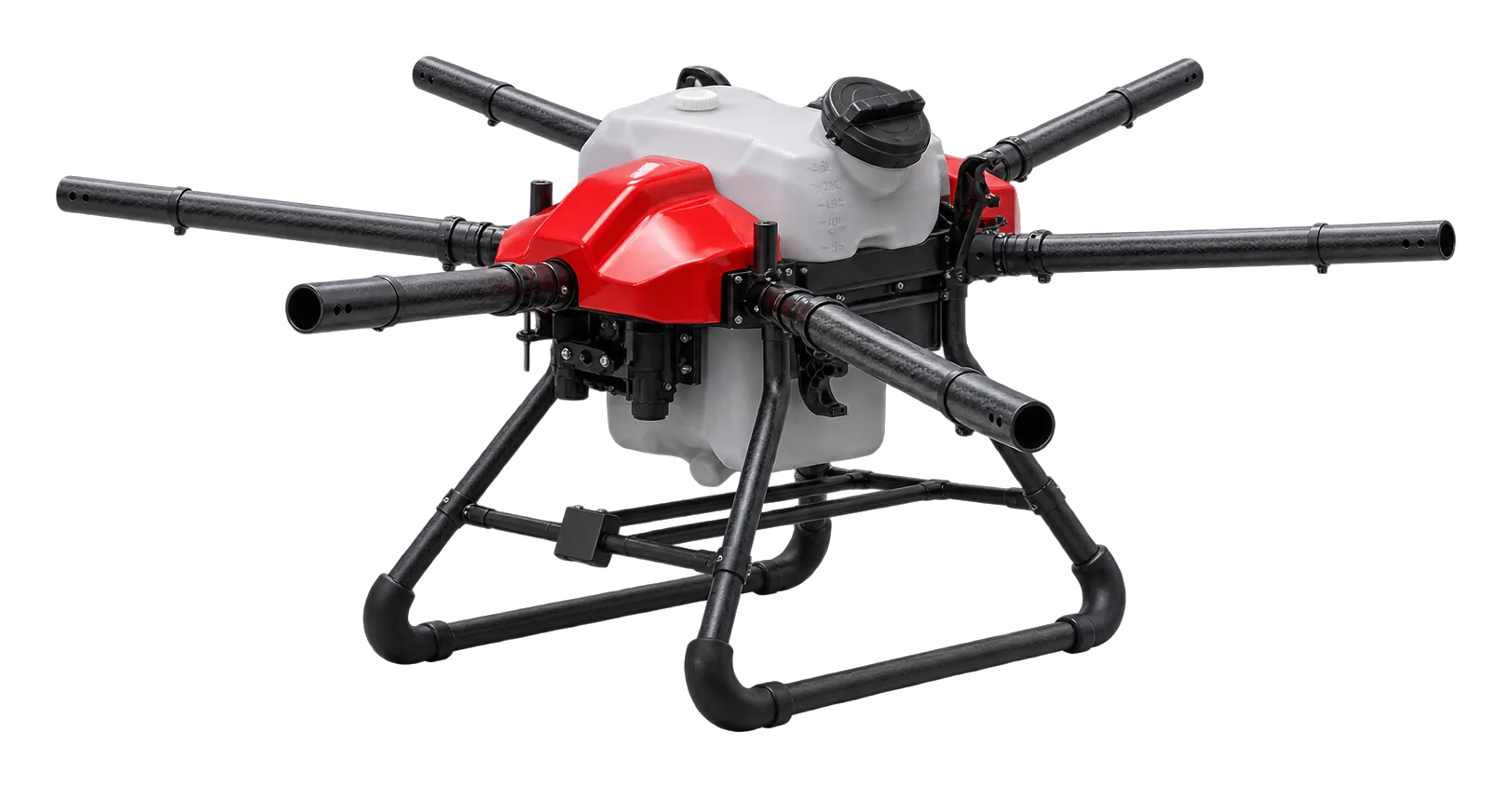
Arms and landing gear are replaceable; if the central structure cracks, replace the frame. The AF frames come bare, with a tank or with motors and propellers, and spare arms and structural parts are available. For other models send the model and part. See also the frame guide, generators and batteries, dealer stock and service.
Next step
Send the model, your hectares per aircraft and your site conditions through the contact form. We return a season kit list with quantities and prices on separate lines.
Q & A
Common questions
01Where can I buy parts for my agricultural drone?
Buy from the maker or its authorised dealer, because parts must match the model and revision. For our aircraft, send the model, a photo and the part you need and we quote. Purdue Extension advises asking about parts supply and repair before buying any drone.
02What are the names of the parts of an agriculture drone?
Frame and folding arms, motors, propellers, speed controllers, flight controller, battery and charger, pump and flow meter, tank with strainer, nozzles or centrifugal discs, spreader, radar, RTK receiver and remote controller. The part table above shows which wear.
03How many propellers and nozzles should I carry?
Our planning assumption is one spare propeller set and one spare nozzle set per aircraft for light use, two of each for 500–2,000 ha per aircraft and three above that. These are not maker intervals; adjust after one season of your own log.
04Can I buy agricultural drone parts wholesale?
Yes, for dealers and workshops. The minimum order is one unit for aircraft; spare quantities are agreed in the quotation. See the AF frames page for frame kits and structural spares.
05How long do drone batteries last?
The Missouri model assumes 1,000 charge cycles or five years. Real life depends on heat, charging habits and depth of discharge, so ask the maker for cycle life and its end-of-life capacity, and log cycles per battery.
References
- 1Economics of Drone Ownership for Agricultural Spray Applications (G1274) — University of Missouri Extension
- 2Drones for Spraying Pesticides: Opportunities and Challenges — The Ohio State University CFAES
- 3Considerations Before Purchasing a Drone (PPP-154) — Purdue Extension
- 4Spray Drones in Agriculture: Technology, Regulation and Field Operations (SPES-819) — Virginia Cooperative Extension
- 5Batteries (lithium battery shipping guidance) — IATA
- 6IEC 60529 Degrees of protection provided by enclosures (IP Code) — IEC
- 7Adjusting Imports of Unmanned Aircraft Systems and UAS Components into the United States — The White House
- 8Conditional approval and exemption of certain UAS from the FCC Covered List (DA 26-875) — Federal Communications Commission
VEXAFLY Aviation Technology Co., Ltd.. VEXAFLY Aviation Technology Co., Ltd. — industrial drone maker in Nanjing. Our application engineers write and check these pages and configure inspection, cleaning, lift and fire-response systems for project buyers. About VEXAFLY