Agriculture
Agricultural Drone Supplier Checks in 2026: Field Tests to Run Before You Pay
How to vet an agricultural drone supplier in 2026: six field tests by site condition (heat, rain, slope, RTK, flow, swath), pass criteria and what to film.
- Author
- VEXAFLY Aviation Technology Co., Ltd.
- Scope
- Agriculture
- Published
- Length
- 5 min read · 6 sources
Short answer: in 2026 a trustworthy agricultural drone supplier is one that lets you test the aircraft against your own site before you pay. Run six tests chosen by site condition — heat, wash-down, slope, RTK repeat, flow calibration and swath — agree the pass figures in writing, and ask for the factory’s inspection records.
Which tests matter for your site?
Most supplier pages are shop fronts that list models and prices. They do not tell you how to check one. Choose the tests that match what can go wrong on your land:
| Your site condition | Test to request | How | What a pass looks like | Spec it proves |
|---|---|---|---|---|
| Hot season (35 °C and above) | Back-to-back sorties | Five full-tank flights, log battery temperature | No thermal warnings; hover time within the agreed figure | Battery and ESC derating |
| Wet season, daily wash-down | Rinse and power-on test | Rinse after spraying, then power up and fly | No faults; the parts covered by IP67 are named | IP rating (IEC 60529) |
| Slopes and terraces | Terrain-follow run | Fly across a known slope at set height | Height held inside an agreed band | Radar, slope limit |
| Many small fields | RTK repeat route | Fly the same route twice | Lines overlap within the RTK figure | RTK accuracy |
| Label-driven dose | Flow calibration | Catch all nozzle output for 60 seconds | Within an agreed tolerance of the set rate | Pump and flow meter |
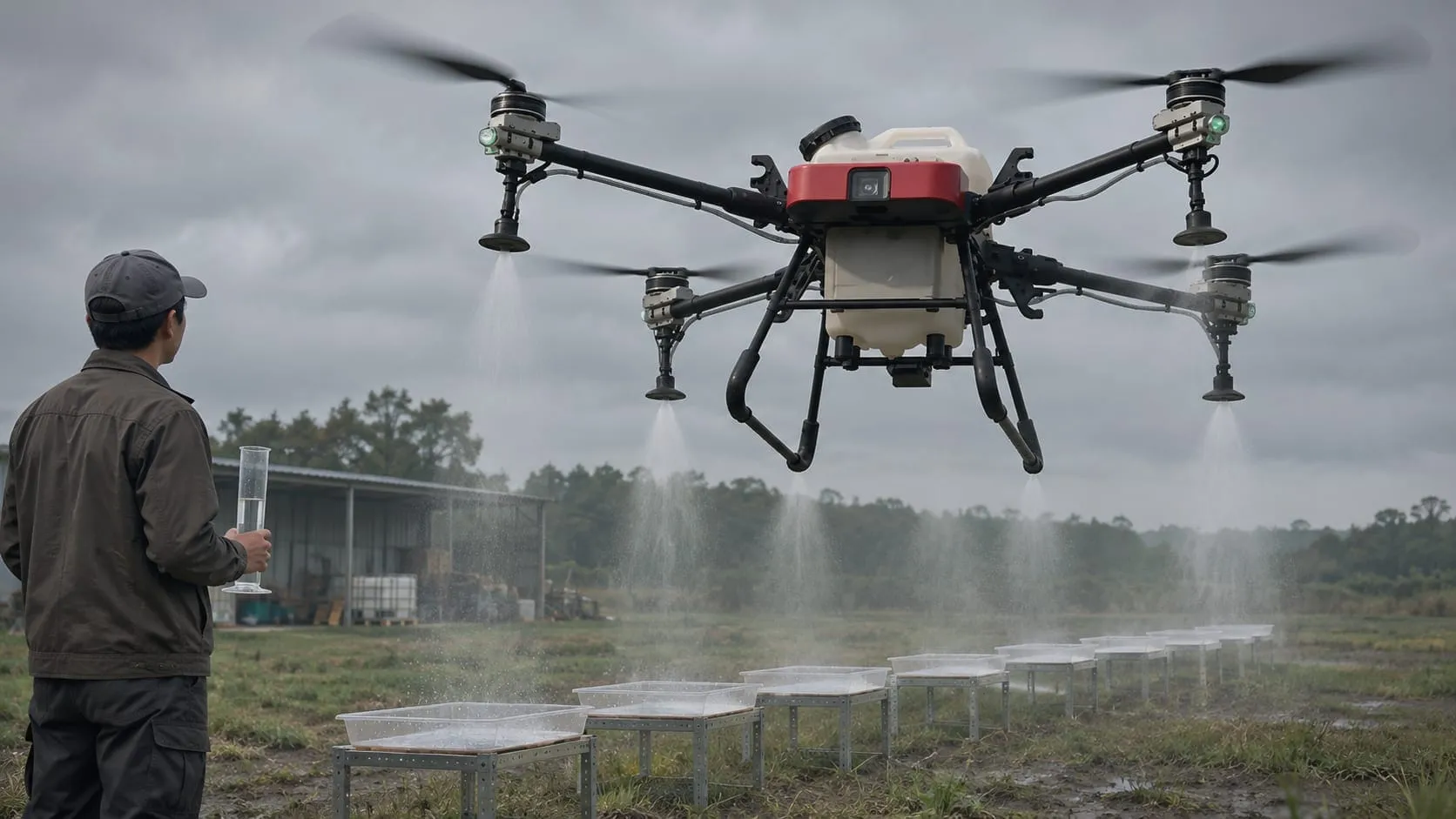
| Drift-sensitive edges | Swath card test | Cards across the swath at your height and speed | Effective swath at least the planned width | Nozzle set-up |
For reference, a rival maker publishes wind resistance of 6 m/s and an operating range of −20 to 50 °C for its 50 kg-class aircraft (DJI T50 specifications). That is the kind of figure a spec sheet should state. If your supplier gives none, ask for it in writing.
How do you check flow calibration before accepting a drone?
Set the flow rate in the app, run the pump on the ground with the nozzles collecting into containers, and weigh or measure the output over 60 seconds. Compare it with the set rate. Ohio State’s fact sheet also suggests checking rotary disc speed with a digital tachometer against a new unit, because worn discs and plugged narrow nozzles change the output.
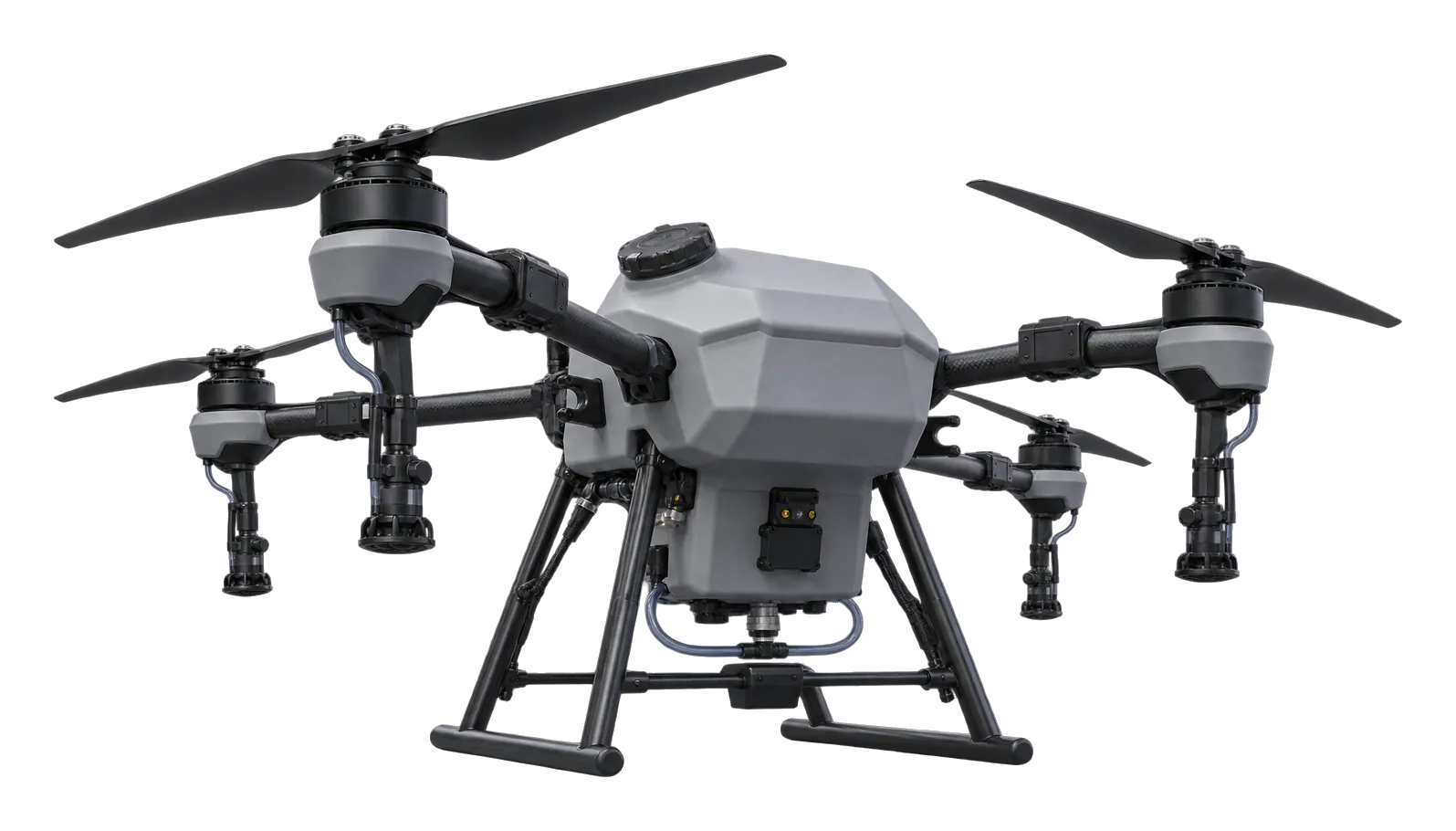
Example (assumptions labelled, not a guarantee). An AS-30 sprays 20 L/ha with a planned 6 m effective swath at 5 m/s. Area rate: 6 × 5 = 30 m²/s, or 10.8 ha/h. Required flow: 20 L/ha × 10.8 ha/h ÷ 60 = 3.6 L/min, well inside the 8 L/min system maximum. The 60-second catch should therefore be about 3.6 L. A catch of 3.3 L is 8 % low, so you recalibrate before acceptance.
Is the swath on the brochure the swath you get?
Not necessarily. Virginia Cooperative Extension describes a card test: paper strips or cards laid across the swath, then the width where deposit stays above 50 % of the peak is the effective swath. The same publication notes that raising the flow rate on one rival aircraft increased droplet size by roughly 100 µm, so change speed rather than flow when you want to alter the dose. Ask the supplier to repeat the test at your forward speed and height, and check the result against the label’s minimum volume per hectare.
What should a heat and rain test show?
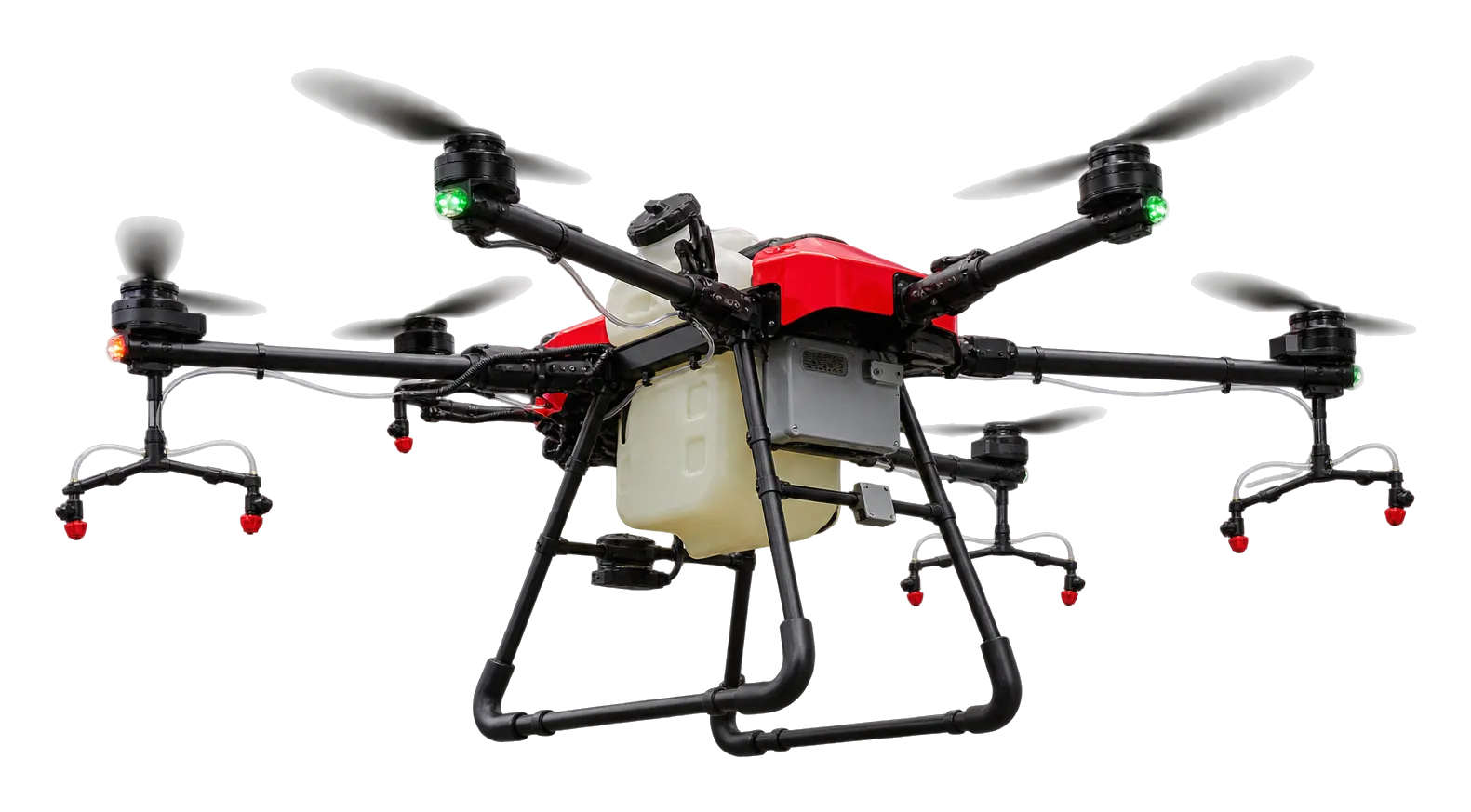
Heat: run five back-to-back sorties with batteries swapped as in a normal day. The AS-50 / AS-65 hovers about 7 minutes at full load, so five sorties take little time; what you watch is battery temperature and any derating. Rain: the AS-30 and AS-50 / AS-65 are listed IP67, which means protected against temporary immersion under defined conditions. It does not mean a pressure-washer jet is safe. Ask which parts the rating covers and what the maker’s wash-down advice is.
How do you test terrain radar and RTK?
For radar, fly a pre-marked slope with the drone in terrain-follow mode and film the height readout against a marker pole. For RTK, plan one route, fly it twice and compare the line positions. Both tests are quick and convincing on video, and they show quickly if a supplier has only fitted the hardware without tuning it.
Which factory records should a supplier share?
Ask for the inspection log for your serial number, the flight-test log, and the parts list with serial numbers on batteries, pumps and the flight controller. One Chinese maker publishes a claim of 17 production inspections and 10 flight tests per unit; whether that is true for any supplier, ask for the log, not the slogan. Purdue Extension also advises asking about spare-parts supply and repair before buying; see our guide to spare parts and wear items.
What can you test by video, and what needs a sample?
| Test | Video call | Needs a sample |
|---|---|---|
| Flow catch test | Yes | No |
| Swath card test | Yes, if cards are filmed with a scale | Better with a sample |
| Heat sorties | Partly | Yes, in your climate |
| Slope radar | Yes | Yes for steep sites |
| Maintenance access, arm folding | Yes | Optional |
Best for hot plains: the heat test on the AS-50 / AS-65 with its 7-minute full-load hover. Best for orchards: the swath card test on the six-rotor AS-30X at 4–9 m width. Best for label-heavy contract spraying: flow calibration first, on any model.
What paperwork should you check?
In the US, check three things before ordering a foreign-built drone: its FCC Covered List status, the Section 232 duty and FAA approval for aircraft of 55 lb or more. Confirm with your customs broker and the FAA; see importing industrial drones from China and FCC rules for drones. China’s revised export rules apply from 18 November 2026: export licensing is checked per model and destination and can add time to the lead time. Battery shipping follows IATA lithium rules.
Next step
Send us your crop, field shape, climate and the label of your main product. We reply with a test list and the pass figures we would agree to, and you can compare it with our agriculture range and the service page.
Q & A
Common questions
01Can I test an agricultural drone before buying from China?
Yes. Most factories can run the tests on a video call and film the results, and many will ship one sample. Send the test list and the pass figures first so the factory knows what it is being measured against.
02What flow accuracy should I accept?
Agree a figure before the test. Many buyers use about ±5 % of the set rate from a 60-second catch test, but this is a suggestion, not a standard. If the label of your product is strict, ask for tighter.
03Does IP67 mean I can wash the drone with a hose?
IP67 is defined for temporary immersion, not for jets from a pressure washer. Rinse gently, keep the nozzle at a distance and follow the maker's maintenance guidance. Ask which parts the rating covers.
04How long should a sample test take?
Plan two to four days: one day for set-up and calibration, one for swath and terrain-follow runs, and a hot-hours day with back-to-back sorties.
05Who pays for the sample?
It is normally the buyer, often credited against the first order. Agree this, the shipping route and the return of any rejected unit in the quotation.
References
- 1Drones for Spraying Pesticides: Opportunities and Challenges — The Ohio State University CFAES
- 2Spray Drones in Agriculture: Technology, Regulation and Field Operations (SPES-819) — Virginia Cooperative Extension
- 3Drone Sprayer Sizing for Agricultural Applications (AEN-174) — University of Kentucky Cooperative Extension
- 4Considerations Before Purchasing a Drone (PPP-154) — Purdue Extension
- 5IEC 60529 Degrees of protection provided by enclosures (IP Code) — IEC
- 6DJI Agras T50 specifications — DJI Agriculture
VEXAFLY Aviation Technology Co., Ltd.. VEXAFLY Aviation Technology Co., Ltd. — industrial drone maker in Nanjing. Our application engineers write and check these pages and configure inspection, cleaning, lift and fire-response systems for project buyers. About VEXAFLY