Agriculture
Agricultural Drone for Hilly Terrain in 2026: Slope, Altitude and Tank Choices
Choosing an agricultural drone for hilly terrain in 2026: slope classes in percent and degrees, altitude, nozzles, take-off spots and a worked orchard example.
- Author
- VEXAFLY Aviation Technology Co., Ltd.
- Scope
- Agriculture
- Published
- Length
- 5 min read · 12 sources
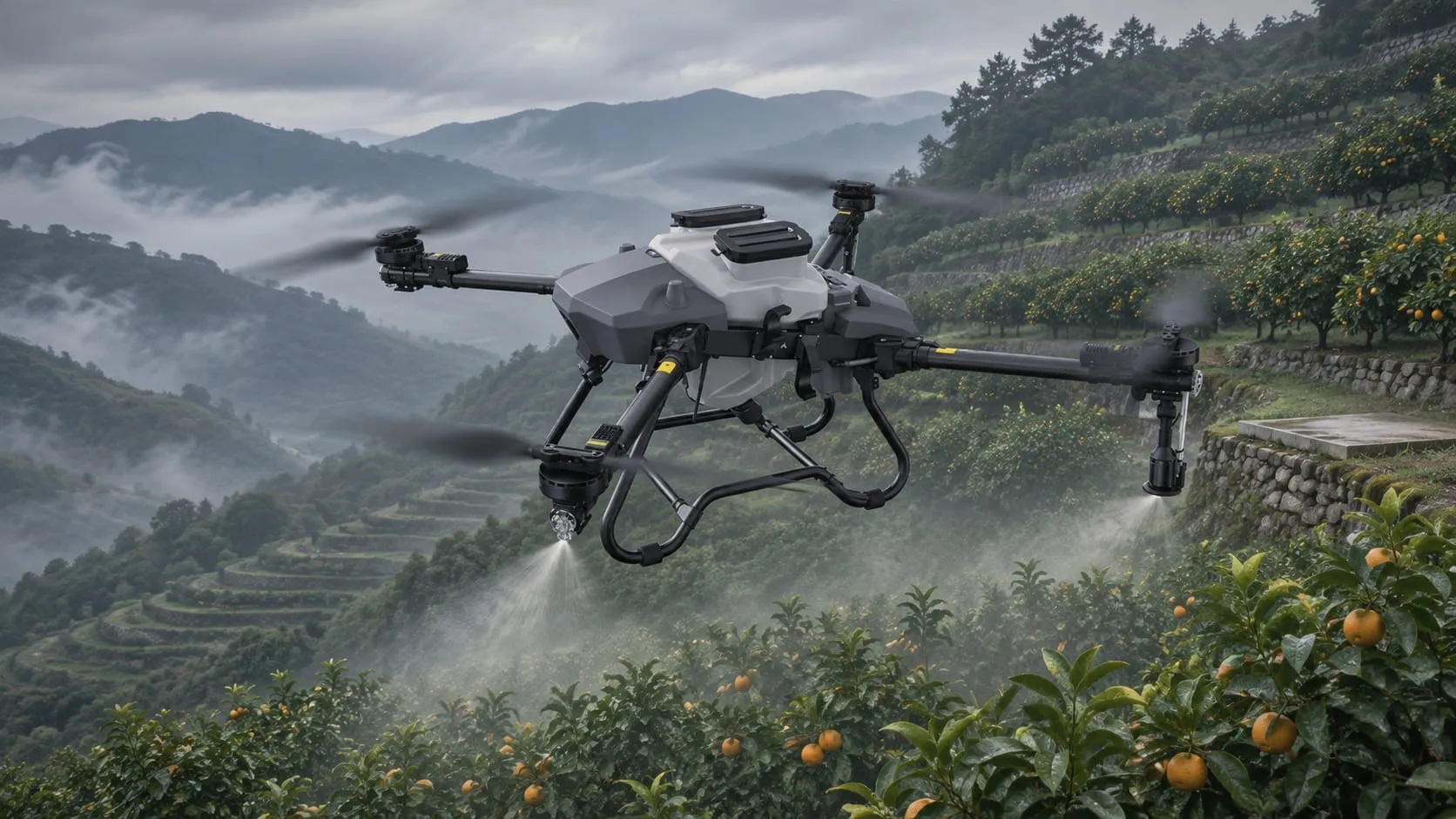
Short answer: an agricultural drone for hilly terrain should be chosen by slope and altitude first and tank size second. Up to about 5 % slope almost any class works; between 5 and 30 % choose a compact or centrifugal-nozzle aircraft that follows the ground; above 30 % you are on terraces or doing spot work. In 2026 ask every maker for the slope limit and the load at your altitude in writing.
Which drone fits which slope?
Slope in percent is rise ÷ run × 100, so 100 % is 45°. Class names are the FAO’s.
| Slope | Degrees | FAO class | What works | Check before buying |
|---|---|---|---|---|
| 0–5 % | up to 2.9° | flat to gently sloping | Any class | Normal rules |
| 5–15 % | 2.9–8.5° | sloping to strongly sloping | Mid-size aircraft with radar terrain following, flown along the contour | Height-hold response on rises |
| 15–30 % | 8.5–16.7° | moderately steep | Compact or centrifugal hill aircraft, short runs | Slope limit in writing; take-off spots |
| 30–60 % | 16.7–31° | steep | Terraces: AS-10 / AS-20, AR-30 | Terrace step height; ferry distance |
| Above 60 % | above 31° | very steep | Spot work with manual checks | Drone spraying often impractical |
How does terrain following work, and where does it stop?
Ohio State states that all current models carry a terrain sensor for uneven ground and that most support RTK. The aircraft holds a set height above the crop: 2.1–3.7 m in Ohio State’s guidance, 2.1–3.0 m typical in Virginia Tech’s.
Published limits are not comparable. EFT lists the Z80’s radar slope ascent as an option, only for terraces under 30° slope and 3 m high (30° is a 58 % slope). EAVISION lists a 90° terrain-following slope for its J150 as a maker figure. Ask each maker: up to what slope, at what speed, with which sensor, over which crop? The AR-30 / AR-50 fly 2.5–3.5 m above the crop; ask us for the terrain-sensing option and its slope limit for your model, confirmed in the quotation.
Does altitude reduce what a drone can carry?
Yes: lift falls with air density, and heat lowers it further.
| Altitude | 0 m | 1,000 m | 1,500 m | 2,000 m | 2,500 m | 3,000 m |
|---|---|---|---|---|---|---|
| Air density, share of sea level | 100 % | 91 % | 86 % | 82 % | 78 % | 74 % |
Standard atmosphere, our calculation from NASA’s model; hot days are lower. DJI publishes a payload reduction of 10 kg per 1,000 m for its own T50; that belongs to that aircraft, not ours. Ask any maker for the load limit at your altitude, and test it. A service ceiling, such as 5,000 m for the AS-92, is not a payload figure.
Small tank or big tank on hills?
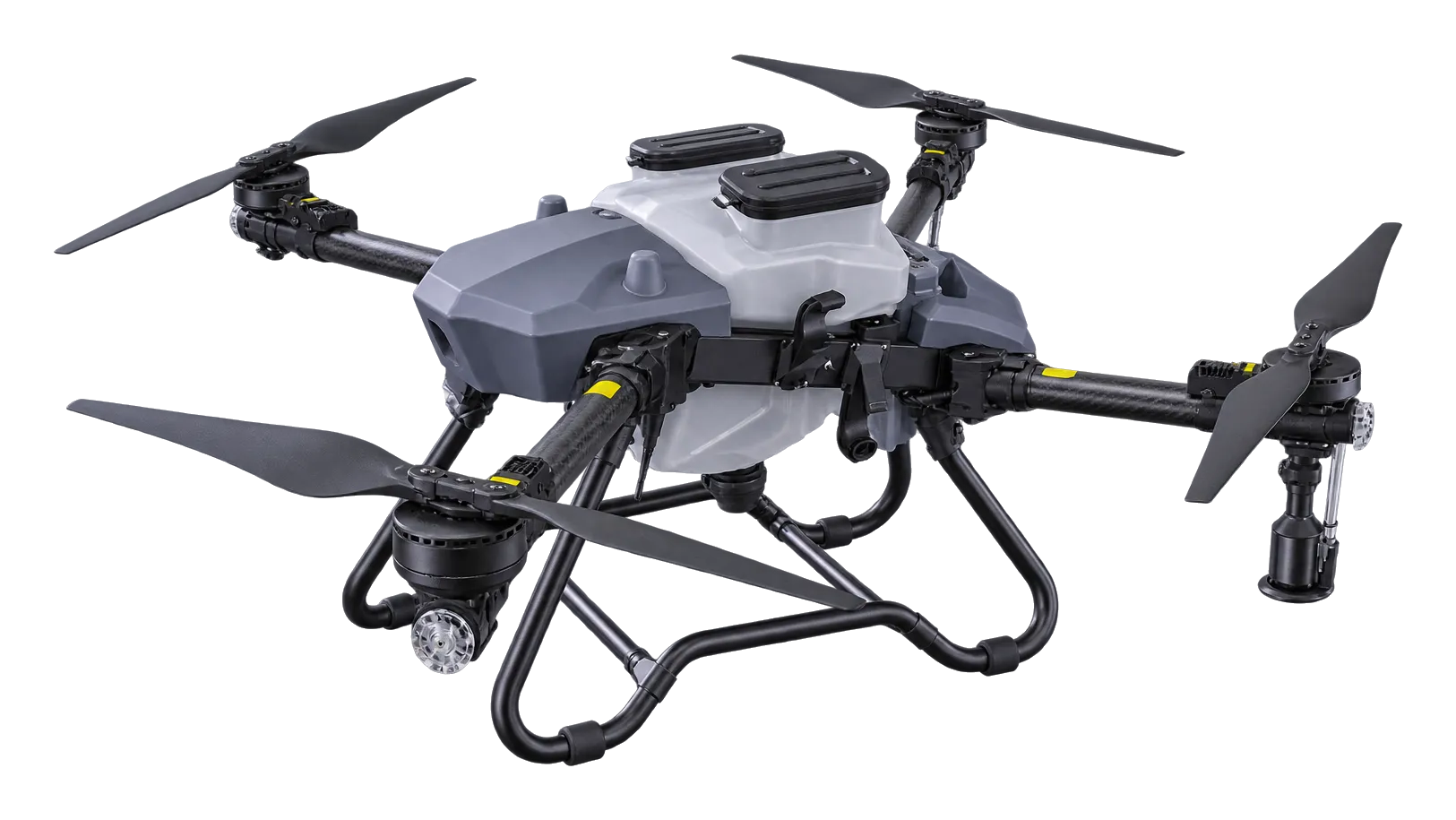
Slopes mean many short runs, so the route to a safe take-off point limits you more than the tank. Small aircraft also land on narrow terraces: the AS-10 folds to 750 mm square at 26 kg take-off weight, the AS-20 to 870 mm at 43 kg. Purdue Extension warns that larger tanks bring larger aircraft and stricter rules.
- Best for terraces and steep tea: the AS-10, 10 L, 26 kg take-off weight.
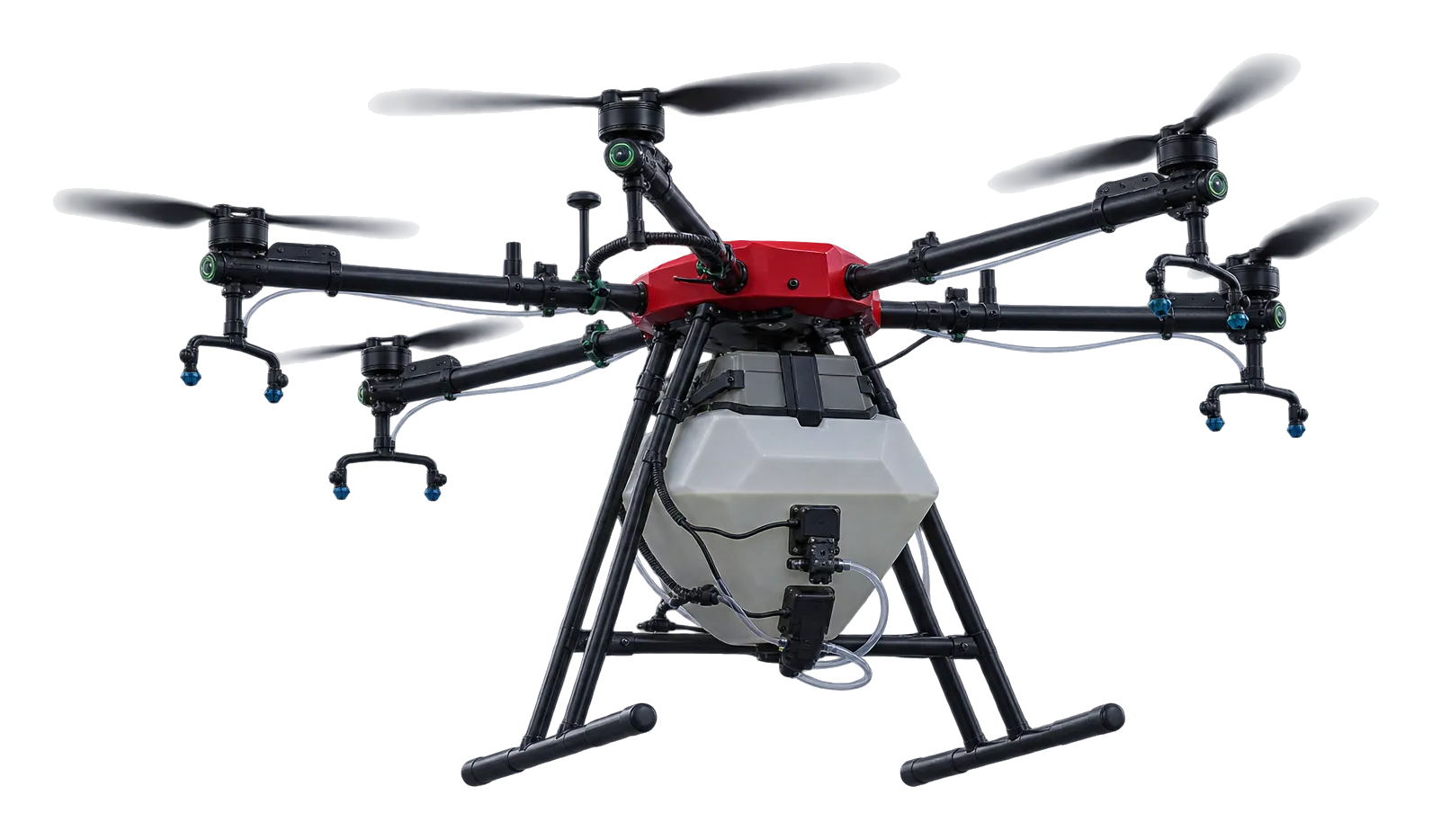
- Best for hillside orchards: the AS-20 or the six-rotor AS-30X, which spreads lift over more motors.
- Best for hilly mixed farms that also spread: the AR-30 / AR-50, 50 / 70 L spreader, 0.5–6 mm granules.
Centrifugal or pressure nozzles on slopes?
Centrifugal nozzles (AR-30 / AR-50, 50–500 µm, 16 L/min) set droplet size by disc speed, so you can go coarser near valley edges without changing tips. High-pressure nozzles (AS-10 / AS-20, 110–400 µm) give a defined pattern. Virginia Tech notes rotary atomisers prefer slightly higher flight and hydraulic nozzles slightly lower. Wind matters more on slopes: Ohio State cautions that spray drones may have problems above about 7 mph (3.1 m/s), 2020 advice, so follow the manual and the label.
Example: a 4 ha hillside orchard at 1,800 m
Example: assumptions are an AR-30, 6 m effective width, 3 m/s, 35 % field efficiency and an assumed label volume of 40 L/ha.
Work rate: 6 × 3 × 0.35 = 6.3 m²/s, about 2.3 ha/h, so 4 ha takes about 1.8 hours of spraying. Liquid needed: 4 × 40 = 160 L. Nominal loads: 160 ÷ 30 L = 5.3, so 6 loads for the AR-30 and 160 ÷ 50 L = 3.2, so 4 loads for the AR-50.
At 1,800 m, standard air density is about 84 % of sea level. As a planning assumption, not a maker figure, cut loads to 84 %: 25 L for the AR-30 and 42 L for the AR-50. The AR-30 then needs 160 ÷ 25 = 6.4, so 7 loads; the AR-50 still needs 4. Confirm the real limit in a test flight.
Where should the pilot stand and take off?
Keep the aircraft in sight for the whole run, take off level with the first pass and plan the loaded leg to climb as little as possible. Put the refill point on a drivable track, not behind a ridge, and check each terrace landing spot for width and step height.
What rules apply?
Aviation and pesticide rules differ by country; check your aviation authority and the label. In the US, check three things before ordering a foreign-built drone: FCC Covered List status, the Section 232 duty (100 % above 25 kg from 3 September 2026) and FAA approval for aircraft of 55 lb or more under Part 137. Every model here is above 25 kg at take-off (the AS-10 is 26 kg). Our guides cover importing from China and FCC certification. Related: tea, coffee, vineyards, drift control, the agricultural range, Colombia and Peru.
Next step
Tell us the slope range, altitude, crop height and plot sizes of your worst field. We reply with a compact aircraft and the load figure at your altitude.
Q & A
Common questions
01Which agricultural drone is best for orchards on hillsides?
A compact aircraft with adjustable droplets and a steady height above the canopy: the AS-20 or six-rotor AS-30X for tree rows, or the AR-30 / AR-50 with centrifugal nozzles. Slope handling and take-off spots matter more than tank size.
02How steep a slope can a spray drone work on?
Published figures differ: EFT lists terraces under 30° and 3 m high for its optional radar; EAVISION lists a 90° terrain-following figure. Ask the maker for the limit for your model, with sensor, speed and crop.
03Is it legal to fly a drone over farmland?
Rules differ by country and pesticide label; check your aviation authority and read the label. In the US the FAA page on dispensing chemicals covers Part 137. We do not promise that any use is permitted.
04How many hectares per hour can I expect on a slope?
Far fewer than on flat land: about 2.3 ha/h in our example (6 m width, 3 m/s, 35 % efficiency) against about 13 ha/h for 12 m at 6 m/s and 50 % on plains.
05Are agricultural drones worth it on small hillside farms?
Often, for access: Purdue Extension notes drones may be the only practical option for small, odd-shaped fields. Below about 397 ha a year, hiring may cost less.
References
- 1Guidelines for soil description, 4th edition (slope gradient classes, Table 7) — FAO
- 2Earth Atmosphere Model (metric units) — NASA Glenn Research Center
- 3Drones for Spraying Pesticides: Opportunities and Challenges — The Ohio State University CFAES
- 4Spray Drones in Agriculture: Technology, Regulation and Field Operations (SPES-819) — Virginia Cooperative Extension
- 5EFT Z80 — EFT
- 6EA-J150 specs — EAVISION
- 7DJI Agras T50 specs — DJI Agriculture
- 8Considerations Before Purchasing a Drone (PPP-154) — Purdue Extension
- 9Dispensing Chemicals and Agricultural Products (Part 137) with UAS — Federal Aviation Administration
- 10Economics of Drone Ownership for Agricultural Spray Applications (G1274) — University of Missouri Extension
- 11Adjusting Imports of Unmanned Aircraft Systems and UAS Components into the United States — The White House
- 12Conditional approval and exemption of certain UAS from the FCC Covered List (DA 26-875) — Federal Communications Commission
VEXAFLY Aviation Technology Co., Ltd.. VEXAFLY Aviation Technology Co., Ltd. — industrial drone maker in Nanjing. Our application engineers write and check these pages and configure inspection, cleaning, lift and fire-response systems for project buyers. About VEXAFLY