Agriculture
Drones for Tea Plantations in 2026: Altitude, Slopes and Export Residue Limits
A drone for tea plantations in 2026: how altitude cuts payload, which aircraft fits terraces and slopes, and what export tea residue limits mean for spraying.
- Author
- VEXAFLY Aviation Technology Co., Ltd.
- Scope
- Agriculture
- Published
- Length
- 5 min read · 5 sources
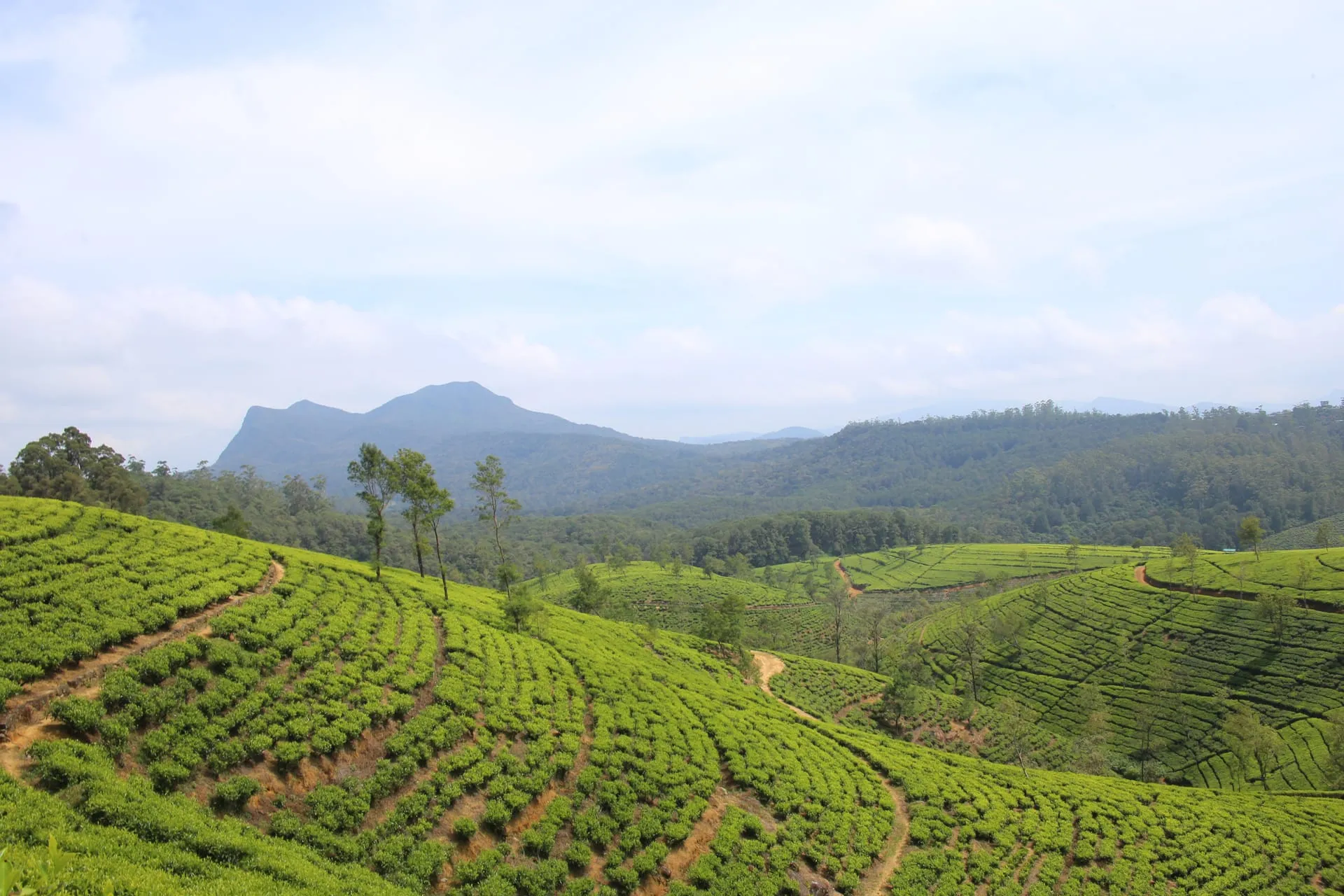
Short answer: in 2026 a drone for tea plantations has to be chosen for altitude first, slope second and task third. Tea gardens in Kenya sit at 1,500–2,700 m, where thin air cuts the load, so a compact 10–20 L aircraft suits terraces and smallholder plots, and the AR-30 / AR-50 suits estates that also spread granular fertiliser. Export tea adds a residue rule: only registered products, label intervals respected.
Which drone suits which tea garden?
Use this matrix first; loads at altitude are planning values to be confirmed in a test flight.
| Garden | Task | Aircraft | Load at altitude |
|---|---|---|---|
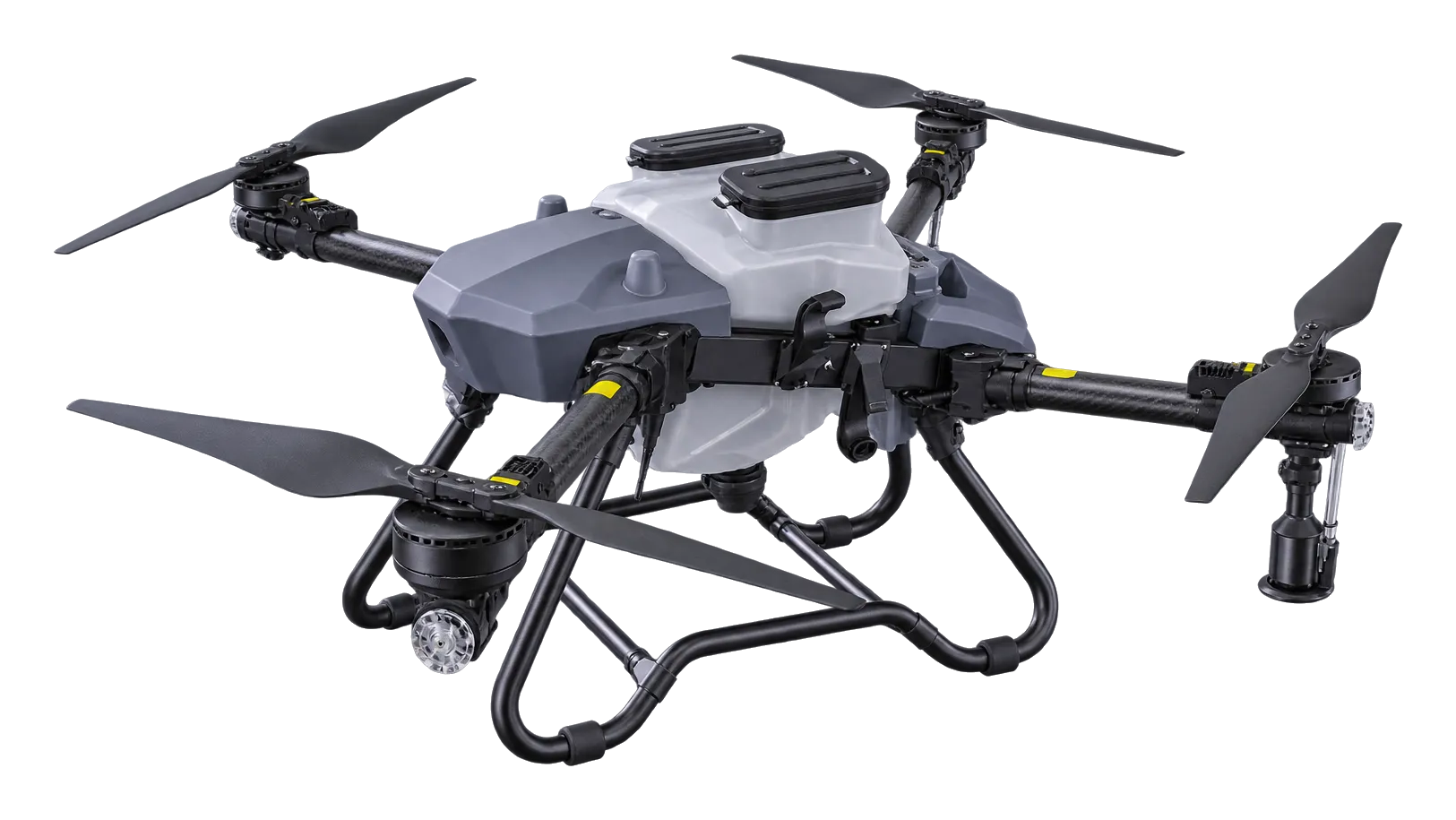
| Narrow terraces or smallholder plots, 1,500–2,000 m | Foliar feed, pest spray | AS-10 (10 L, folds to 750 mm) | Ask us for the limit; start well below tank size |
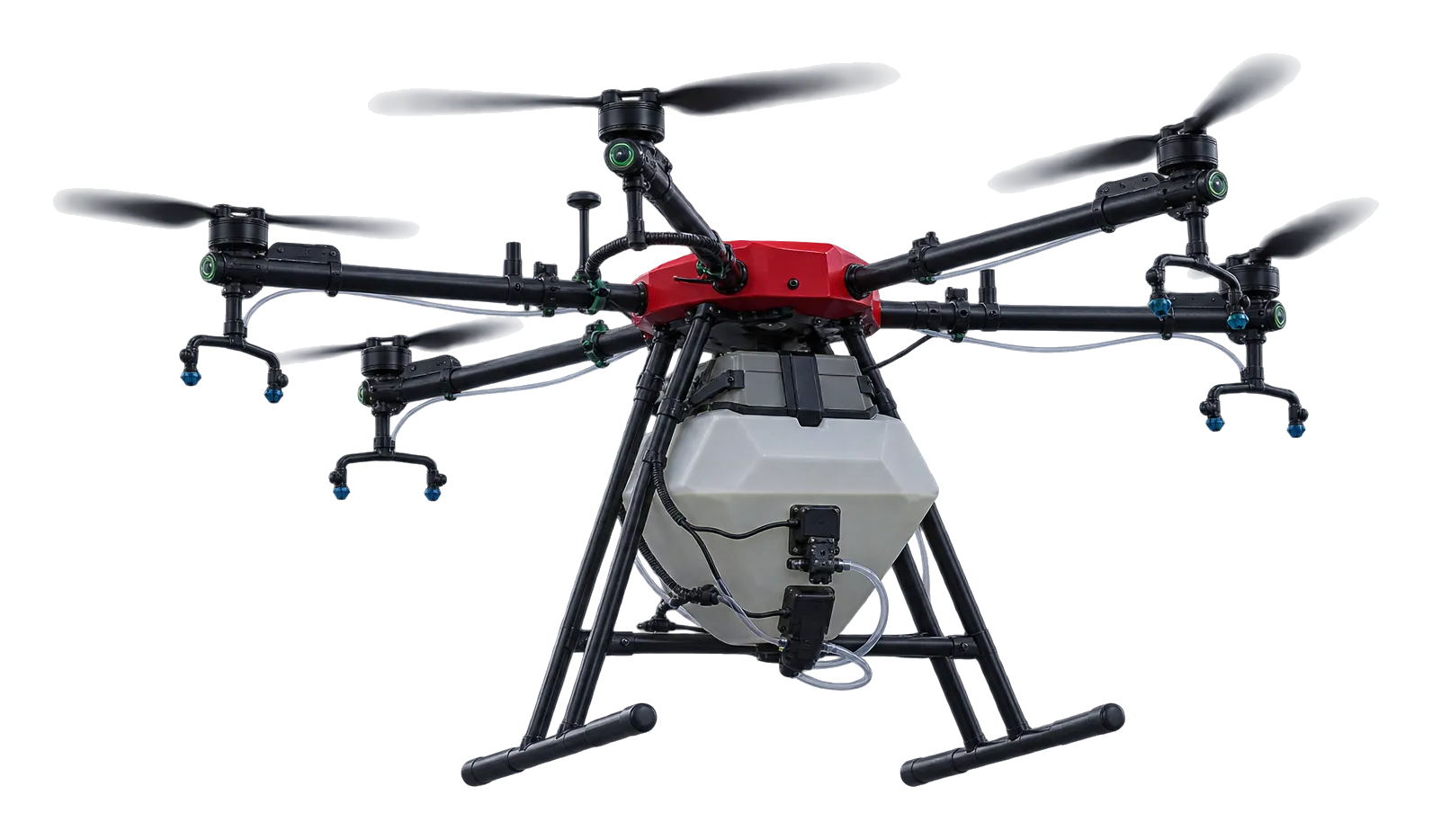
| Medium gardens, spraying only, 1,800–2,500 m | Foliar feed, pest spray | AS-20 (20 L, 3–6 m) | Plan 15 L loads at 2,200 m |
| Estates that spray and spread fertiliser | Spray, granular fertiliser | AR-30 / AR-50 (50 / 70 L spreader) | Plan about 40 L loads at 2,200 m for the AR-50 |
| Very steep banks, dense shade trees | Any | Manual spraying | Drone stops here |
How much does altitude cut the load?
Air density falls with height, and rotors need density to lift. Using the NASA standard-atmosphere model, our calculation gives roughly 91 % of sea-level density at 1,000 m, 86 % at 1,500 m, 82 % at 2,000 m and 78 % at 2,500 m, lower on hot days. For comparison, one maker states that its large aircraft must carry 10 kg less per 1,000 m of altitude. These are not our limits: aircraft differ, and battery output also drops on cold mornings. Ask us for the load limit at your altitude, then fly a test load before you plan the season.
Can spray reach inside a dense tea canopy?
The plucking table is a flat, dense surface. A drone flies above it and relies on droplet size, downwash and height to carry spray into the canopy. The AR-30 / AR-50 flies about 2.5–3.5 m above the crop with centrifugal nozzles producing 50–500 µm droplets; the AS-10 / AS-20 uses high-pressure nozzles at 110–400 µm. Fine droplets penetrate better but drift more; medium droplets drift less but cover the top leaves first. Choose by the label, the target pest and the wind, and check deposition with water-sensitive paper.
What does the work look like in numbers?
Example (assumed inputs, an estimate): a 25 ha hillside garden at 2,200 m needs a foliar feed at an assumed 30 L/ha, so 750 L in total.
| AS-20 | AR-50 | |
|---|---|---|
| Width × speed × efficiency | 4 m × 3 m/s × 35 % | 6 m × 3 m/s × 35 % |
| Area rate | 4.2 m²/s ≈ 1.5 ha/h | 6.3 m²/s ≈ 2.3 ha/h |
| Spraying time for 25 ha | about 16.5 h | about 11 h |
| Planned load at altitude | 15 L → 50 loads | 40 L → 19 loads |
Slopes and a 3 m/s flying speed are cautious. The real load comes from the test flight.
What about residues on export tea?
Importing countries set maximum residue limits (MRLs) by product and crop. The EU sets MRLs for all food and applies a default of 0.01 mg/kg where a pesticide is not listed for the crop (Regulation 396/2005). Practical rules for drone spraying are the same as for any method: use only products registered for tea by your national authority (in Kenya, the Pest Control Products Board), follow the label dose and pre-harvest interval, and fit the application date around the plucking round, usually 7–14 days. Use the EU pesticide database to check a limit before you spray.
Can a drone spread fertiliser on terraces?
Yes. The AR range carries a 50 or 70 L spreader for granules of 0.5–6 mm, with a spread width of 8–12 m. Terrace width and tree lines shape what you can do: on a 6 m terrace you may need to fly lower and make several passes. Weigh one full hopper of your own fertiliser to learn the kilograms per load. See also agricultural drones for hilly terrain and centrifugal vs pressure nozzles.
Which rules apply in Kenya and Sri Lanka?
In Kenya, the Kenya Civil Aviation Authority regulates drones under the Civil Aviation (Unmanned Aircraft Systems) Regulations 2020, with a Remote Operator Certificate for commercial work, and the Pest Control Products Board registers pesticides. In Sri Lanka, the Tea Research Institute is developing guidelines for drone use in tea, and Hatton Plantations, the largest Ceylon black-tea producer, said in 2025 that it is turning to drones and mechanisation because of labour shortage. In every case, check the current rules with the authority; see our Kenya market page.
How does a service business fit a factory catchment?
Tea is picked all year, so a service crew can keep working. Rain in the Kenyan highlands is spread through the year (1,200–1,500 mm), so plan spraying windows around showers and early mornings. Charging at altitude needs a generator or a reliable grid connection, and a second battery set per aircraft keeps the crew spraying while the first set charges. Read our partner programme if you are thinking of offering this as a service.
Best for …
- Best for narrow terraces and smallholder plots: the AS-10, 10 L tank, 26 kg MTOW, folds to 750 mm.
- Best for medium gardens that only spray: the AS-20, 20 L tank, 3–6 m width.
- Best for estates that spray and spread fertiliser: the AR-30 / AR-50, 50 / 70 L spreader, 2.5–3.5 m above crop.
For budgeting: AS-10 / AS-20 are listed at US$2,700–7,000 and AR-30 / AR-50 at US$5,800–14,000, FOB China, before freight and duties.
Next step
Tell us the altitude of your gardens, the slope, the tasks and the products you spray. We come back with the aircraft, a load-at-altitude estimate and what to test first. For the neighbouring crop, read coffee farm drone spraying.
Q & A
Common questions
01Can drones spray tea on steep slopes?
Yes, within limits. Compact aircraft can work hillside gardens and terraces, flown along the contour at a steady height above the bushes. Very steep banks, power lines and tall shade trees are where the drone stops and manual spraying takes over.
02Does altitude reduce drone payload?
Yes. Thinner air gives less lift. By the standard atmosphere, density is about 82 % of sea level at 2,000 m and 78 % at 2,500 m. One maker advises cutting payload by about 10 kg per 1,000 m; we advise asking us for the load limit at your altitude and confirming it in a test flight.
03Will drone spraying affect EU residue limits on my tea?
Residue limits depend on the product, the dose and the interval before harvest, not on the method of application. The EU applies a default limit of 0.01 mg/kg where a pesticide has no specific limit, so use only products registered for tea and follow the label.
04Do I need a KCAA permit to spray tea in Kenya?
Kenya’s Civil Aviation (UAS) Regulations 2020 apply, with remote pilot certification and operator approval for commercial work. Pesticides must also be registered with the Pest Control Products Board. Confirm current requirements with KCAA and PCPB.
05Should a smallholder factory catchment buy or hire?
Hiring or sharing is usually more practical: one trained crew can serve many plots around a factory. Buy only when you can keep an aircraft busy through the season.
References
- 1Tea Growing in Kenya — Tea Board of Kenya
- 2Unmanned Aircraft Systems (Drones) — Kenya Civil Aviation Authority
- 3EU legislation on MRLs — European Commission
- 4Earth Atmosphere Model (metric units) — NASA Glenn Research Center
- 5Largest Ceylon black tea producer embraces mechanisation, drone technology and AI — Daily Mirror (Sri Lanka)
VEXAFLY Aviation Technology Co., Ltd.. VEXAFLY Aviation Technology Co., Ltd. — industrial drone maker in Nanjing. Our application engineers write and check these pages and configure inspection, cleaning, lift and fire-response systems for project buyers. About VEXAFLY