Market · Site conditions
Drones in Colombia 2026: Aerocivil Rules, Steep Coffee Farms and Mountain Power Lines
Drones in Colombia in 2026: Aerocivil’s three certificates, spray drones for steep coffee slopes, banana valleys and mountain power-line transport.
- Author
- VEXAFLY Aviation Technology Co., Ltd.
- Scope
- Market · Site conditions
- Published
- Length
- 4 min read · 5 sources
Short answer: drones in Colombia are governed by Aerocivil’s RAC 100, and heavy industrial aircraft fly in the specific category, which needs three papers: a UA registration certificate, a UAS operator certificate and a pilot certificate of competence. The terrain then picks the aircraft: a light centrifugal spray drone for steep coffee slopes, a larger one for flat banana valleys and an IP67 transport drone for power-line sites in the mountains. In 2026 the practical order is rules first, slope second, altitude third.
Colombia site conditions at a glance
| Condition | Figure | What it means for equipment |
|---|---|---|
| Rule | RAC 100 (Aerocivil), with Resolución 1983 of 27 September 2023 and Resolución 3034 of 27 December 2024 (Aerocivil) | One national framework for open and specific categories |
| Specific category | Flight authorisation needs a UA registration certificate, a UAS operator certificate (specific category) and a pilot certificate of competence, plus a flight request form and a risk analysis (Aerocivil FAQ) | Heavy aircraft need the operator certificate |
| Registration | Commercial or professional-use drones must be registered whatever their weight; the open category starts at 200 g (same FAQ) | Register every aircraft before work |
| Cost | Registration and certification are free; the PUAS theory exam cost COP 60,200 in 2025 (same FAQ) | Budget for training time, not fees |
| Grid | 2024 capacity 21,368 MW: hydro 13,224 MW (62 %), solar 1,392 MW (IRENA) | Hydro dams and mountain lines to inspect and supply |
| Coffee | 199,258 growers from 601 municipalities in 21 departments voted in the 2026 coffee elections (FNC) | Many small farms, so compact aircraft and service providers |
Facts checked on 26 November 2026. We found no sourced coffee or banana area, farm altitude band or transmission-line length, so none is quoted. Two rainy seasons are not sourced either; plan for frequent rain and IP67 airframes.
What are Aerocivil’s three certificates, as a checklist?
- UA registration certificate for every aircraft; commercial or professional drones are registered whatever their weight.
- UAS operator certificate (specific category) for the company that flies.
- Pilot certificate of competence for each remote pilot.
- Flight request form and risk analysis for the operation.
Aerocivil says registration and certification are free; the theory exam fee was COP 60,200 in 2025.
Which spray drone for steep farms: droplet size, swath and height?
| Terrain | Aircraft | Why |
|---|---|---|
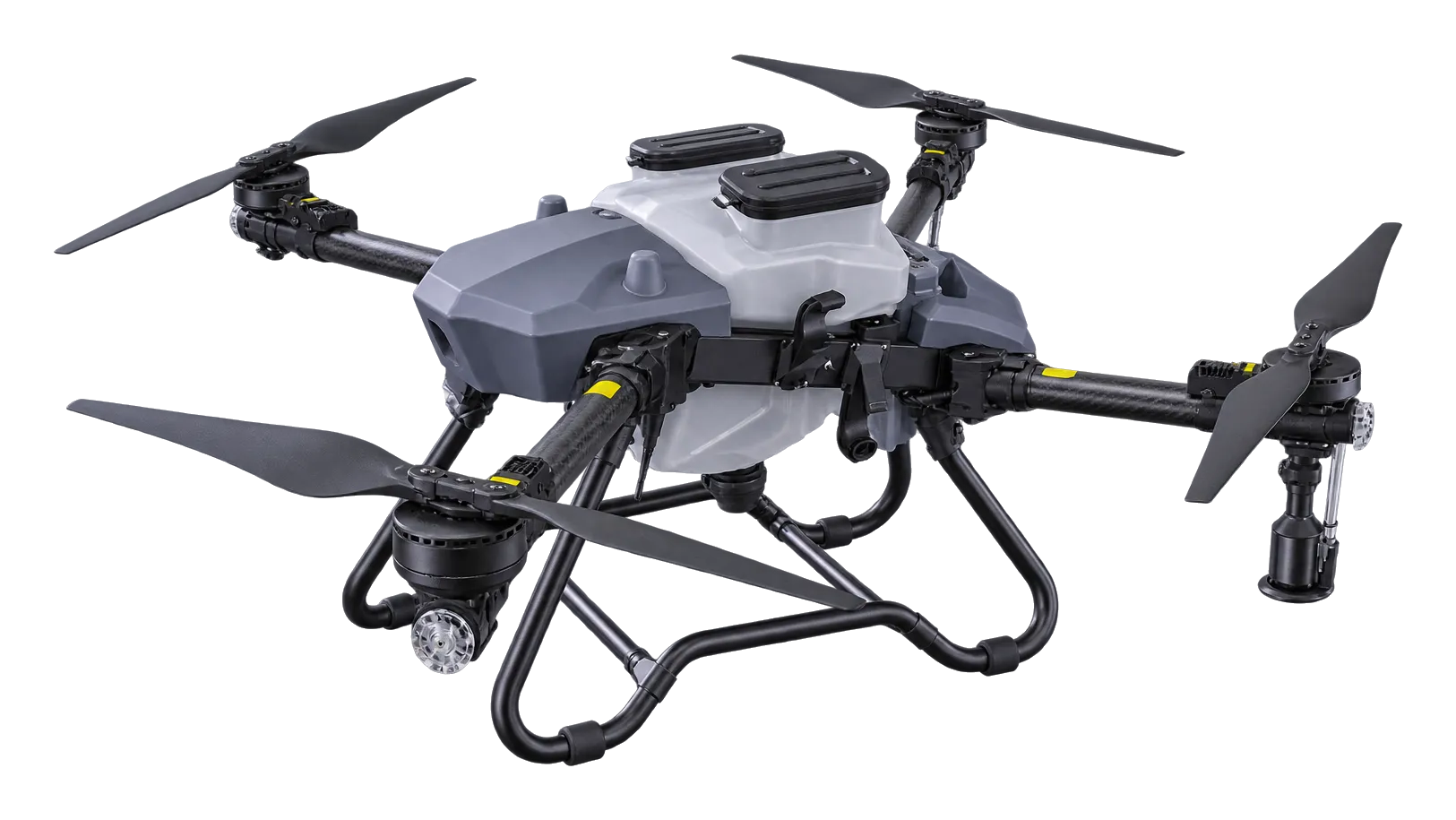
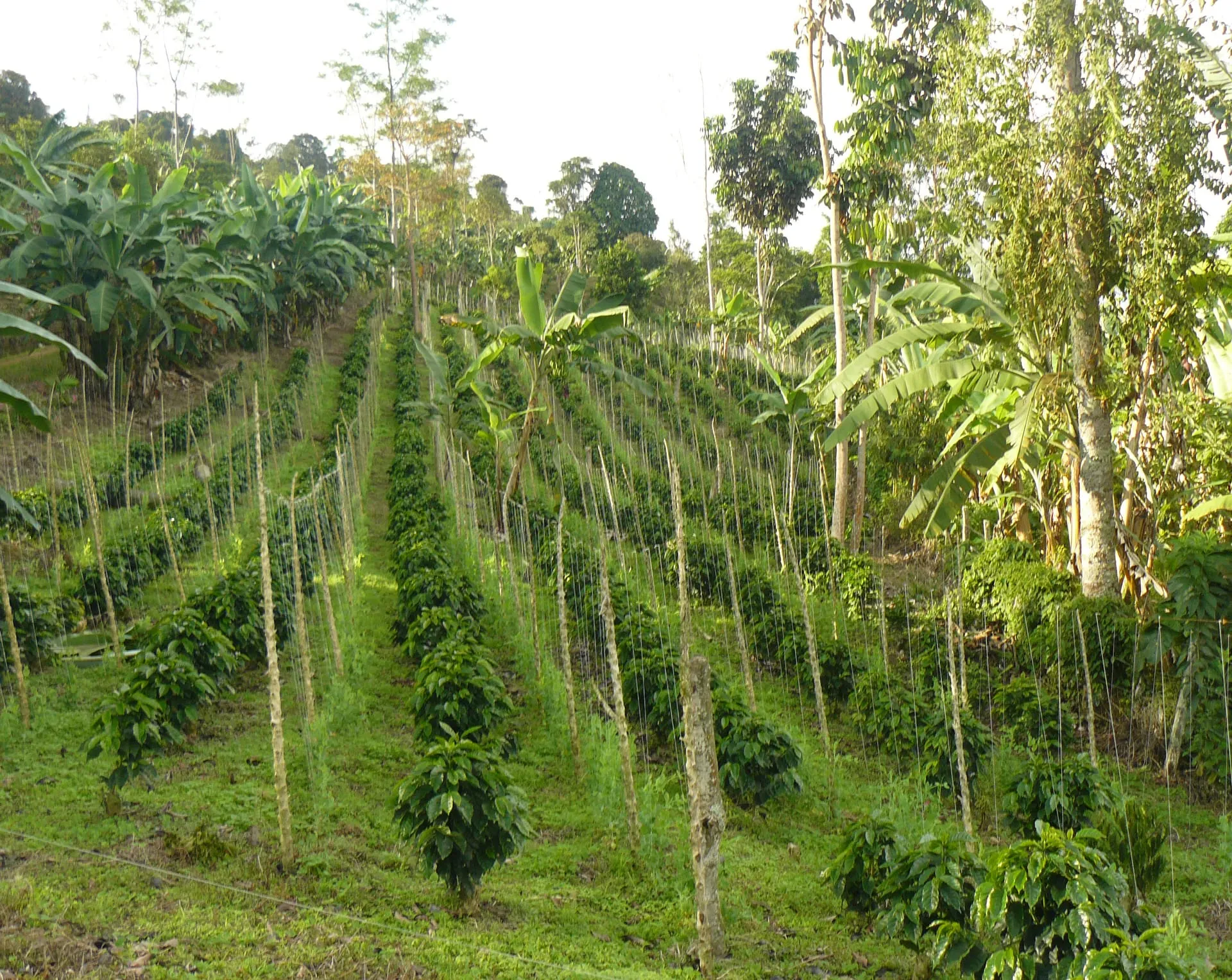
| Coffee on steep slopes and terraces | AR-30: 30 L tank, 70 kg take-off weight (29.8 kg without battery, 40 kg with) | Lightest centrifugal frame; 4–8 m spray width, 50–500 μm droplets |
| Larger mixed farms | AR-50: 50 L tank, 95 kg take-off weight | Same nozzles, more liquid per flight |
| Small plots and orchards | AS-10 / AS-20: 10 L or 20 L, 26 kg or 43 kg | Easy to carry up terraces; 3–6 m swath |
A spinning disc breaks the liquid into droplets, and its speed sets the size, so the same aircraft can go finer for a fungicide or coarser to limit drift. Both AR models fly 2.5–3.5 m above the crop. Tank litres are not payload kilograms. For crop notes read coffee farm drone spraying and agricultural drones for hilly terrain.
- Best for coffee and mixed farms on steep ground: the AR-30, 30 L tank, 70 kg take-off weight and a 50 L spreader option.
- Best for larger farms on gentler slopes: the AR-50, 50 L tank and 70 L spreader, 95 kg take-off weight.
What about banana valleys and flat ground?
Flat valleys favour more litres per flight. An AR-50 or a larger AS model reduces refills; read the banana plantation drone guide. No sourced banana area is quoted here.
Can drones serve mountain power lines and hydro sites?
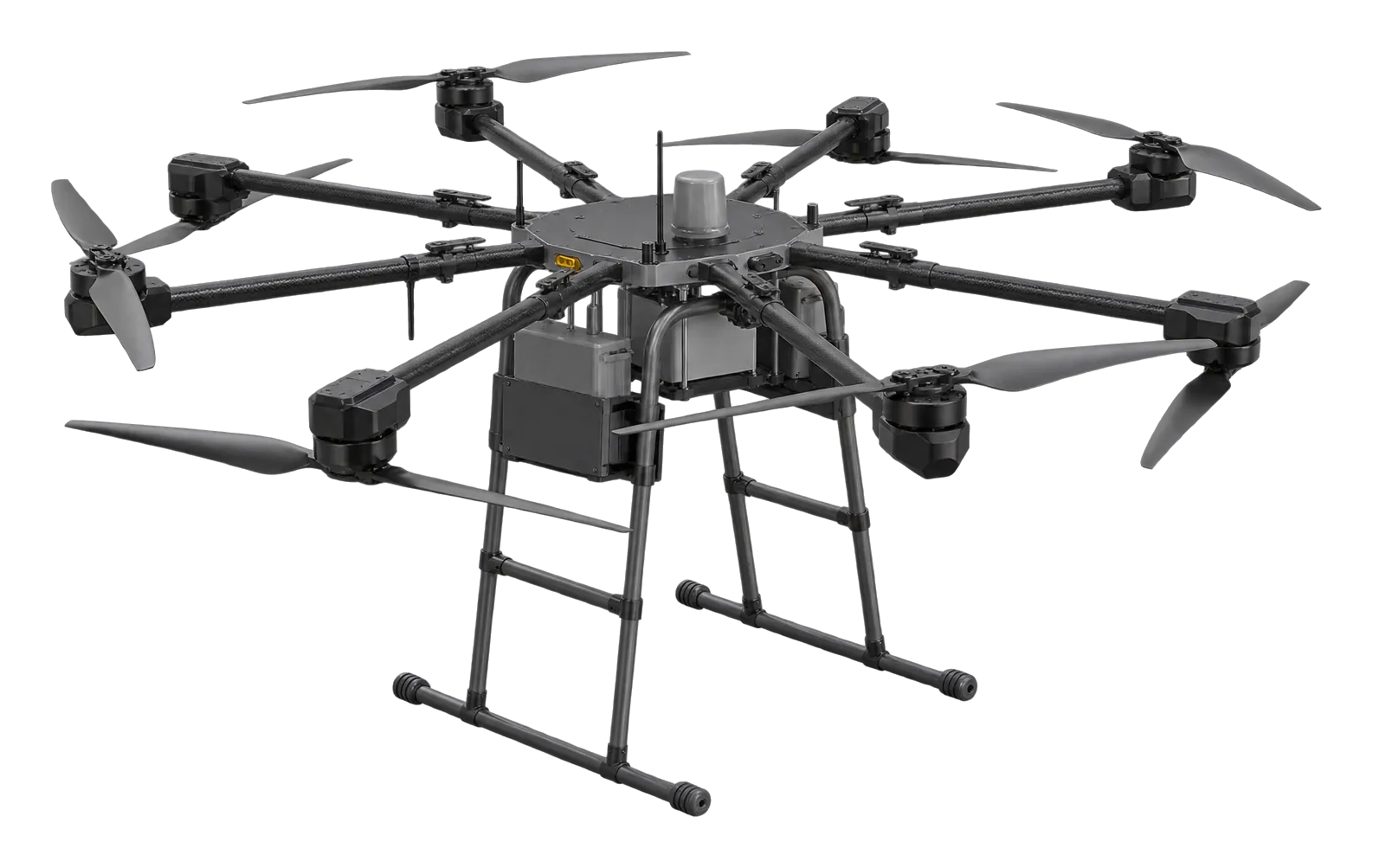
Yes: Colombia’s capacity is 62 % hydro, so lines and dams sit across mountain ranges. An HL-100 with a 100 kg rated payload and IP67 sealing carries tools, insulators and cable drums to tower sites, and an IS-9 (up to 120 min, 3–5 kg payload) inspects lines and dam faces. Flight time and range with load are confirmed for your route in the quotation. Read drone transport for mountain sites.
Example: why choose the lighter aircraft on the steepest blocks?
Example (label: illustrative). At 1,500 m air density is about 1.060 kg/m³ against 1.226 kg/m³ at sea level, (1.226 − 1.060) ÷ 1.226 ≈ 14 % less, using the NASA model. A full AR-30 weighs 70 kg and a full AR-50 weighs 95 kg, so the AR-30 lifts 25 kg less, 25 ÷ 95 ≈ 26 % less mass on every climb. Short slope runs with many climbs favour the lighter aircraft. The quotation sets the real load for your altitude.
How do I import an aircraft into Colombia?
Use a customs broker and keep the product documents, serial numbers and battery shipping papers for the Aerocivil file. Duties and taxes are confirmed by the broker; we supply the product documents your authority asks for. Compare neighbouring rules in Peru, Brazil and Mexico.
Next step
Send the slope, the crop and the take-off altitude. We reply with the aircraft, a load plan and the documents for the Aerocivil file.
Q & A
Common questions
01What does Aerocivil require to fly a commercial drone?
Commercial or professional drones must be registered whatever their weight. For flight authorisation in the specific category Aerocivil asks for a UA registration certificate, a UAS operator certificate and a pilot certificate of competence, plus a flight request form and a risk analysis.
02Do I need an operator certificate for an agricultural drone in Colombia?
Heavy spray aircraft fly in the specific category, where the UAS operator certificate is one of the three papers. Confirm with Aerocivil how your aircraft and operation are classified before ordering.
03Which spray drone works on steep coffee slopes?
A lighter centrifugal aircraft: the AR-30 (30 L tank, 70 kg take-off weight) gives more margin on the steepest blocks than the AR-50 (50 L, 95 kg). Spinning discs make 50–500 μm droplets, and the aircraft flies 2.5–3.5 m above the crop.
04Can drones carry materials to towers in the mountains?
Yes. The HL-100 has a 100 kg rated payload, a 60 kg airframe and IP67 sealing, and carries tools, insulators and cable drums to tower sites. Allow for altitude and for rain.
05How much does registration cost in Colombia?
Aerocivil states that registration and certification are free; the PUAS theory exam cost COP 60,200 in 2025. Check the current fee on the Aerocivil page.
06How much does a 50 L spray drone cost in Colombia?
Our reference price for the AR-30 / AR-50 family is US$5,800–14,000 FOB China, varying by configuration and quantity; final price on quotation. Freight, import duties and taxes are extra and come from your customs broker.
References
- 1Aviación No Tripulada - UAS/Drones — Aeronáutica Civil de Colombia
- 2Preguntas frecuentes: Drones y movilidad urbana aérea — Aeronáutica Civil de Colombia
- 3Renewable energy statistical profile: Colombia — IRENA
- 4Federación Nacional de Cafeteros — Federación Nacional de Cafeteros
- 5Earth Atmosphere Model (metric units) — NASA Glenn Research Center
VEXAFLY Aviation Technology Co., Ltd.. VEXAFLY Aviation Technology Co., Ltd. — industrial drone maker in Nanjing. Our application engineers write and check these pages and configure inspection, cleaning, lift and fire-response systems for project buyers. About VEXAFLY