Heavy lift
Drone Transport for Mountain Construction in 2026: Altitude, Wind and Trips per Day
Drone transport for mountain construction in 2026: altitude derating, valley wind timing, landing zones, drone vs cableway and helicopter, and trips per day.
- Author
- VEXAFLY Aviation Technology Co., Ltd.
- Scope
- Heavy lift
- Published
- Length
- 5 min read · 7 sources
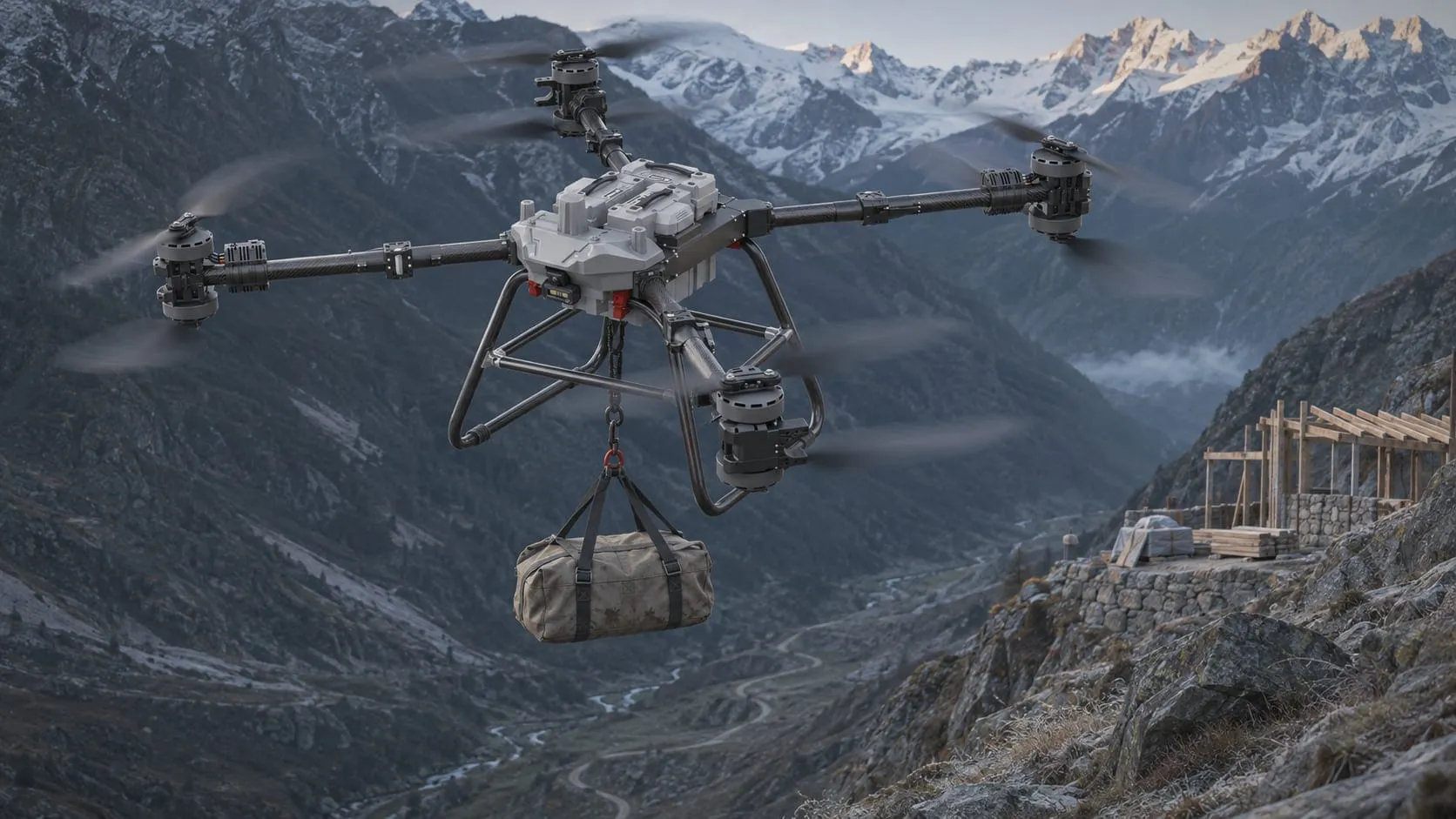
Short answer: drone transport for mountain construction works when pieces are under about 200 kg, routes are a few kilometres and the highest landing zone is known, because altitude and valley wind decide the load and the flying hours. In 2026 the practical plan is an HL-200 class aircraft at a reduced planning load, flying in the morning before up-valley winds build. Above 200 kg a helicopter does the lifting, and drones stand by.
Which drone for your mountain site?
Planning loads are our assumptions for a first plan; the ceilings are first-order estimates from air density (see 100 kg payload drone), not maker data.
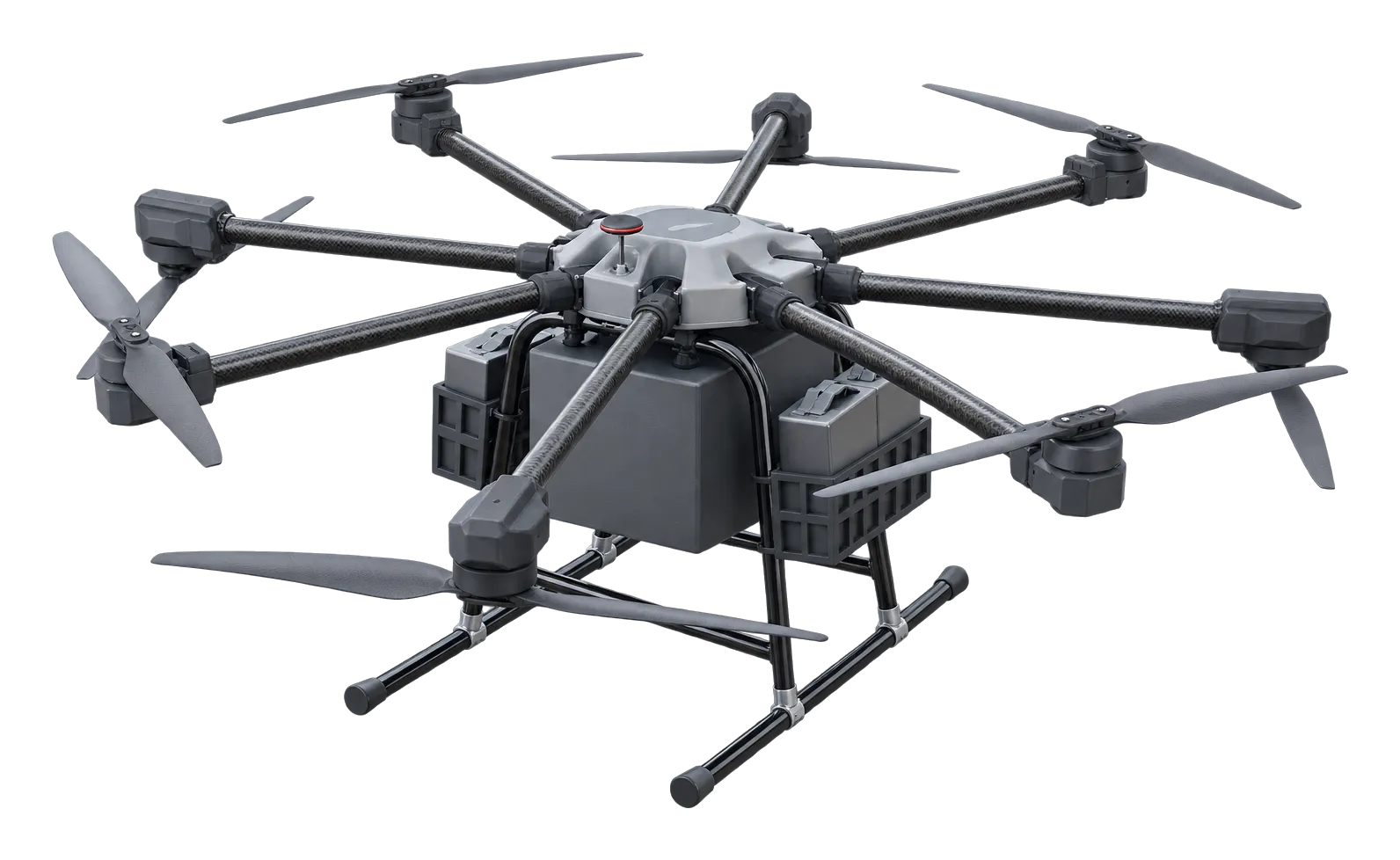
| Highest landing zone | Payload ceiling at the top of the band (HL-150 / HL-200) | Route under 3 km | Route 3–10 km |
|---|---|---|---|
| Below 1,500 m | 116 / 158 kg | HL-200 at about 100 kg | HL-150 or HL-200 at 40–60 kg |
| 1,500–3,000 m | 83 / 114 kg | HL-200 at up to 80 kg | HL-200 at 40–60 kg |
| Above 3,000 m | 65 / 91 kg at 4,000 m | HL-200 at 60 kg or less; get the altitude table | Stage the route, or use a helicopter |
Pieces over 150 kg break the table; see drone vs helicopter. Thin air also costs hover power: read high-altitude heavy-lift drones.
When do valley winds stop the work?
The US interagency fire-weather manual describes the daily cycle. Up-valley wind starts in the middle or late forenoon, reaches its maximum in the early afternoon and continues into the evening. In larger valleys it is ordinarily 10–15 mph (4.5–6.7 m/s). It is turbulent, with eddies at canyon bends and tributary junctions and erratic flow along upper ridges, and downslope flow begins once the slopes fall into shadow. For a drone crew that means a morning window, with the drop zone’s wind checked before every lift. The HL product pages publish no wind limit; ask for the figure for your configuration.
Where do you put the landing zones?
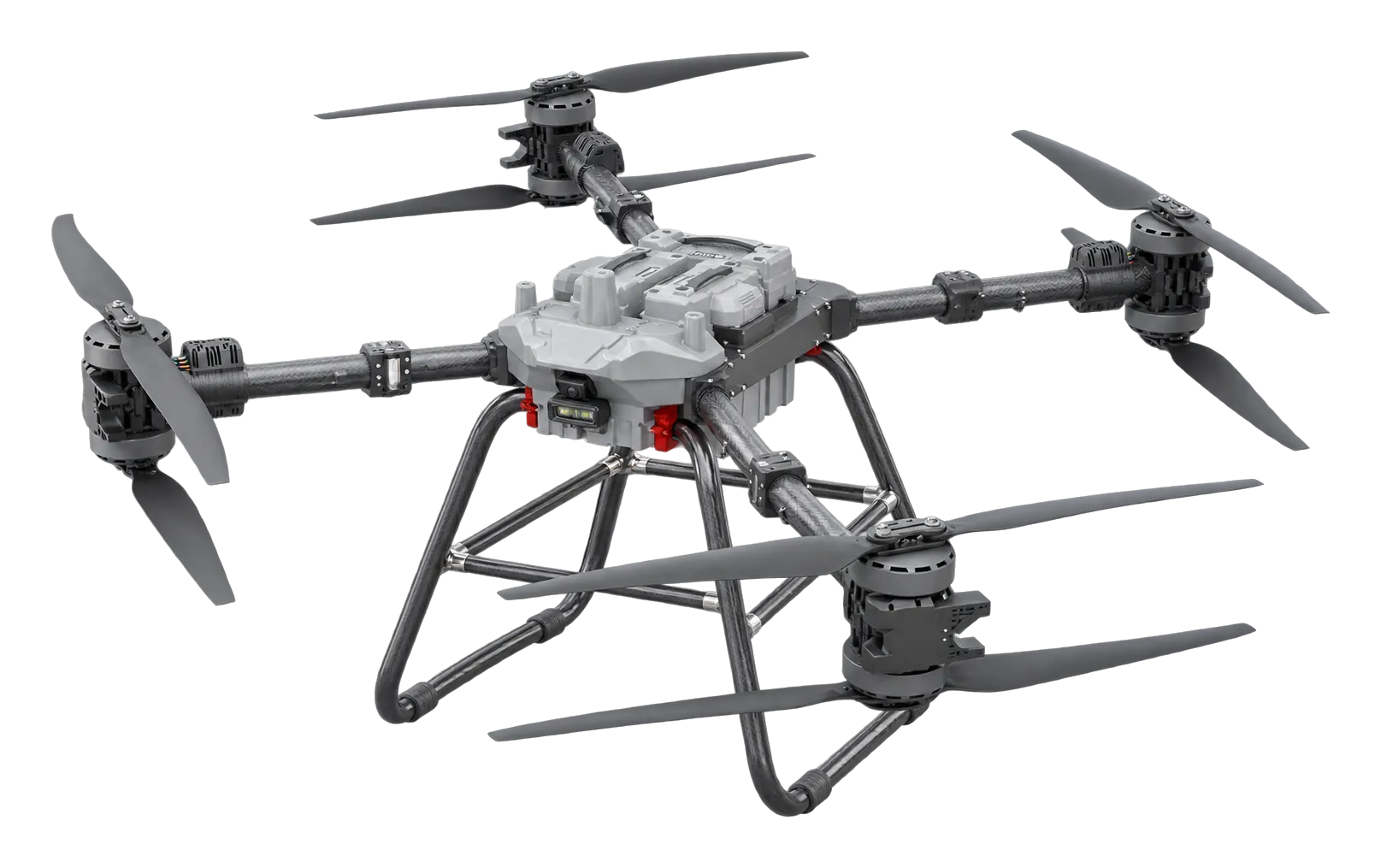
Use a loading pad at the road end and a drop zone at the tower, and plan a secondary zone for an abort, as the Fraser River line-pull plan did. Keep each pad clear beyond the unfolded aircraft: 4,400 × 4,400 mm for the HL-200 and 4,605 × 4,605 mm for the HL-150. Fly loads on a sling or winch so the aircraft never lands at the tower.
Drone, cableway, temporary road or helicopter?
| Method | Best for | Evidence from projects |
|---|---|---|
| Heavy-lift drone | Pieces up to 150–200 kg, no road or cable to build | Yunnan: 16 drones moved 180 t in three days; Ganzhou: about 60 t a day with four drones |
| Cableway | Steady volume on one fixed route | Yunnan: a cableway would have taken about a month to build |
| Temporary road | Heavy plant access | Jinhua: temporary roads and cableways are costly and often damage forest vegetation |
| Helicopter | Pieces over 200 kg | Jinhua: H215 helicopters lifted loads over 200 kg; drones took the rest and stood by when helicopters were grounded |
| Mules and porters | Small loads on existing paths | No published figures we can cite; get local quotes |
How many trips a day can one drone fly?
Example (assumed inputs, brochure speeds): 12 t of foundation materials in pieces under 100 kg, a 2.0 km route with 400 m of climb, landing zone at 1,500 m. An HL-200 is planned at 100 kg per trip. The 1,500 m ceiling is 333 × 0.87 − 132 = 158 kg, so 100 kg leaves margin.
| Step in one cycle | Time |
|---|---|
| Out 2.0 km at about 14.5 m/s | 2.3 min |
| Hover and set-down | 1.0 min (assumed) |
| Back 2.0 km at about 17 m/s | 2.0 min |
| Hook-up and battery swap on the ground | 3.0 min (assumed) |
| Cycle | about 8.3 min, so 7 trips an hour |
Battery per trip is 2.3 ÷ 18 + 1 ÷ 18 + 2.0 ÷ 40 = 23 %, plus an assumed 20 % extra for the climb, which makes 28 %. With a 30 % reserve that is 2 trips per battery set, so 3.5 sets an hour must be charged or swapped. Flying 07:00–11:00, before the up-valley wind peaks, gives 4 h × 7 = 28 trips, or 2.8 t per aircraft per day. The 12 t takes 4–5 days with one aircraft and 2–3 with two.
Cross-check: Yunnan works out to 180 t ÷ (16 drones × 3 days) = 3.75 t per drone per day, Ganzhou to about 15 t, so route and load decide output.
What has been done already?
These are press reports, and the drone models are not always named.
- Xichou, Yunnan (May 2025): 16 heavy-lift drones moved 180 t of steel and concrete for three transmission towers, at altitudes up to 1,650 m, in three days.
- Ganzhou, Jiangxi (220 kV Wanhu line): four drones delivered 400 kg of concrete to a mountaintop in six minutes; tool-transfer time fell from 4 hours to 1 and labour costs by 70 %.
- Jinhua, Zhejiang (May 2026): towers at 250–400 m with no construction roads, some inside water-source protection zones; the target was a construction period shorter by over 20 %.
- Dawu, Hubei (June 2026): two drones hoisted tower components along a route over 90 % deep forest with no access roads.
Best for your slope
- Best for long valley supply runs with 40–80 kg where hover time matters: HL-150, 19.2 km and 32 minutes at 80 kg.
- Best for tower foundations with pieces up to 150 kg: HL-200, 150 kg rated.
- Best for loads above 200 kg: a helicopter.
Next step
Send the altitude of your highest landing zone, the route length and height gain, the heaviest piece and the daily volume through the contact form, and we run the trips-per-day sum with your numbers. Stringing on the same line: power line stringing drones. Mines: mining site drone logistics.
Q & A
Common questions
01What time of day is best to fly loads in a valley?
Morning. Up-valley winds usually start in the middle or late forenoon and peak in the early afternoon, so plan heavy lifting for the first hours of the day and check the wind at the drop zone before each lift.
02How many trips a day can one drone do?
In our example an HL-200 flies about 28 trips of 100 kg in a four-hour morning, 2.8 t. Public reports work out to about 3.75 t per drone per day in Yunnan and about 15 t in Ganzhou, so route and load decide the output.
03Drone, cableway or helicopter?
A drone for pieces up to 150–200 kg and sites without roads; a cableway for steady volume on one line if you can wait for it; a helicopter above 200 kg. Many projects combine two.
04How much load do you lose at 3,000 m?
Air density at 3,000 m is 74 % of sea level. In a first-order estimate that cuts the HL-200 payload ceiling from about 200 kg to about 114 kg. Ask the maker for the altitude table of the exact model.
05Do we need a permit?
In most countries, yes. In the US an aircraft above 55 lb generally needs a Section 44807 exemption; in the EU it falls into the specific category. Some sites add limits of their own, such as water-source protection zones.
References
- 1Aerial Transport Team Powers Green Construction — China Radio International
- 2Fire Weather: 7. Convective Winds — National Wildfire Coordinating Group
- 3Implementation of 'Helicopter-UAV' Collaborative Aerial Hoisting Operations — China Radio International
- 4Chinese Drones Haul 180 Tonnes Up a Mountain — DroneXL
- 5Dawu, Hubei: Heavy-Lift Drones Carry Tower Components Across Deep Mountains — China Radio International
- 6Earth Atmosphere Model, metric units — NASA Glenn Research Center
- 7Big Bar Ferry Line Pull: Heavy Lift Drone Logistics Across the Fraser River — In Flight Robotics
VEXAFLY Aviation Technology Co., Ltd.. VEXAFLY Aviation Technology Co., Ltd. — industrial drone maker in Nanjing. Our application engineers write and check these pages and configure inspection, cleaning, lift and fire-response systems for project buyers. About VEXAFLY