Heavy lift
Heavy Lift Drone vs Helicopter in 2026: When Each One Wins
Heavy lift drone vs helicopter in 2026: payload, trip count, permits, weather and crew compared with real figures, and when a drone, a helicopter or both fit.
- Author
- VEXAFLY Aviation Technology Co., Ltd.
- Scope
- Heavy lift
- Published
- Length
- 4 min read · 7 sources
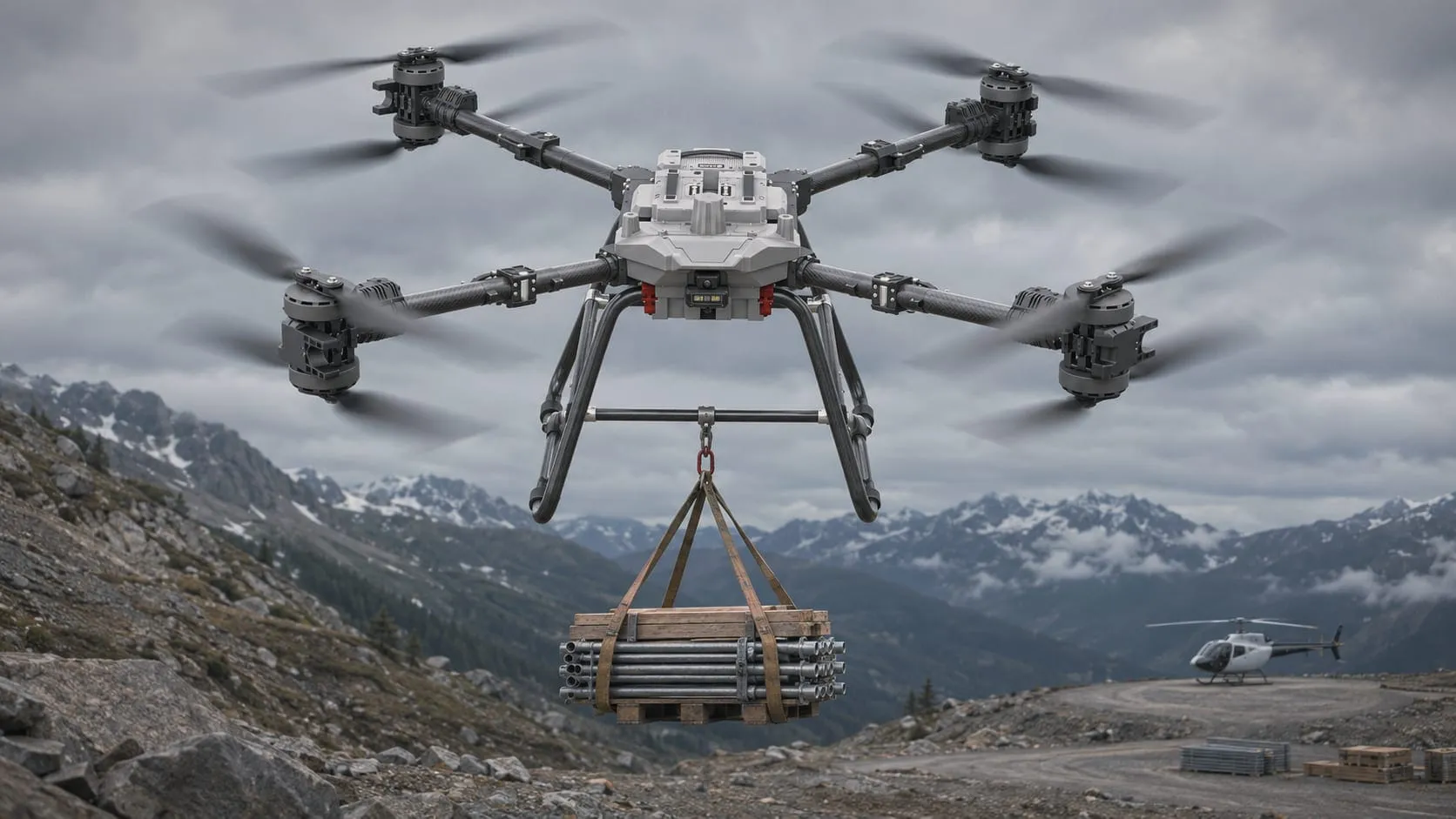
Short answer: in 2026 the choice between a heavy lift drone vs helicopter is mostly a question of weight and distance. A drone such as the HL-200 suits pieces under 150–200 kg, short hops and repeated trips; a light helicopter suits pieces from 200 kg up to its sling limit, long distances and large daily volumes. Many projects use both, split at about 200 kg.
Drone or helicopter for your lift?
Read the table from your heaviest regular piece. The bands are planning guides, not limits.
| Piece weight | Distance under 5 km | 5–15 km | Over 15 km |
|---|---|---|---|
| Under 150 kg | Drone | Drone for light pieces, checked against the load table; otherwise stage the route | Helicopter |
| 150–200 kg | HL-200 at its 150 kg rated load, about 6.5 km one way with a reserve | Helicopter | Helicopter |
| Over 200 kg | Helicopter | Helicopter | Helicopter |
Job length shifts the answer. For a few hours of lifting a helicopter’s mobilisation can dominate the bill; over many days of repeated small loads, the trip count does.
How do payloads compare?
| Aircraft | Payload or maximum sling load | Multiple of the HL-200 rated load | Note |
|---|---|---|---|
| HL-200 | 150 kg rated, 200 kg maximum | 1.0 | 12 km at 150 kg; top speed 72 km/h (20 m/s) |
| Airbus H125 | 1,400 kg | 9.3 | Fast cruise 252 km/h, range 630 km |
| Airbus H135 | 1,200 kg | 8.0 | Maximum cargo sling load |
| Airbus H145 | 1,600 kg (single hook) | 10.7 | Maximum cargo sling load |
| Airbus H215 | 4,500 kg | 30.0 | Maximum cargo sling load |
The Airbus figures come from its civil range brochure and are maxima; fuel, altitude and temperature cut real lift, just as they do for a drone.
How many trips does each need?
Example (assumed quantities): 8 t of material goes to a ridge 1 km away. An H125 at its 1,400 kg maximum needs 8,000 ÷ 1,400 = 5.7, so at least 6 lifts, and more if altitude or heat cut the load. An HL-200 at its 150 kg rated load needs 8,000 ÷ 150 = 53.3, so 54 trips; at a 100 kg planning load it needs 80. On a 1 km hop a drone cycle of about 6 minutes (out and back about 2 minutes, 1 minute hovering, 3 minutes on the ground, all assumed) means 54 × 6 = 324 minutes, about 5.4 hours, or 8 hours for 80 trips.
For cost, use: cost per tonne = (hourly rate × hours on task + mobilisation) ÷ tonnes. Put in your own helicopter quote and your drone crew’s day rate. The drone usually wins when pieces are under 150–200 kg, the distance is short and the helicopter’s mobilisation or minimum charge dominates.
What permits does each need?
In the US, a helicopter doing external-load work needs a Rotorcraft External-Load Operator Certificate under 14 CFR Part 133, which expires after 24 months unless renewed. A drone of 55 lb or more needs a Section 44807 exemption and a COA; see drones over 55 pounds. In the EU the heavy drone falls into the specific category and needs an operational authorisation. Helicopter operators follow the aviation rules of their own state; ask them for the permit and insurance in writing.
How do weather, crew and standby compare?
Dronewatch says most heavy-lift drones are rated to about 12 m/s of wind, with sheet materials harder than compact loads. Its operator quotes about 10 minutes at most with 100 kg and 4–5 minutes on typical missions; our HL-200 table gives 18 minutes at 100 kg, so check the table for your aircraft. A drone crew is small and light. A helicopter brings pilots, a ground crew and a landing site, and the machine must be flown to your site. In Jinhua the drones also acted as the standby when helicopters were grounded.
When does the helicopter still win?
- Over 200 kg: a drone at its limit has no reserve.
- Long distances: an H125’s range is 630 km against about 12 km for an HL-200 at 150 kg.
- Large volume per day: one 1,400 kg lift equals about nine HL-200 trips at the rated load (1,400 ÷ 150 = 9.3).
Makers do claim parity in specific jobs: Infravision says its stringing drones have the pulling capability of a traditional helicopter stringing process without the hazards or environmental impacts. That is a maker claim for line pulling, not for cargo.
Can drones and helicopters work together?
Yes, and the Jinhua project shows how. On a 110 kV line in Zhejiang, drones carried loads under 200 kg (cement, sand and gravel, anchor bolts, tools) and H215 helicopters carried loads over 200 kg (reinforcement cages and concrete materials). The target was a construction period shortened by over 20 %. The split rule, about 200 kg, is simple to copy.
Best for your lift
- Best for pieces under 150 kg over short hops: HL-200, 150 kg rated, with a 12 km total range at 150 kg.
- Best for loads of 200–1,400 kg: a light helicopter of the H125 class, at 1,400 kg maximum sling load.
- Best for mixed projects: a drone plus a helicopter, split at about 200 kg as on the Jinhua line.
Next step
Send your piece weights, distances and job length through the contact form and we work out the trip count for the HL-200. Related reading: drone that can lift 200 kg and mountain site drone transport.
Q & A
Common questions
01Which is better, a drone or a helicopter?
Neither in general. A drone suits pieces under 150–200 kg, short distances and repeated trips; a helicopter suits heavier pieces, long distances and large daily volumes. Many projects use both, split at about 200 kg.
02What is the heaviest thing a drone can lift?
Catalogue multirotors such as the HL-200 list about 200 kg as their maximum payload. Project reports go higher: State Grid Huangshi reports a maximum single payload of 400 kg, without naming the model.
03Are there unmanned helicopters?
Yes. This guide compares crewed helicopters with multirotor heavy-lift drones such as the HL series.
04How much does a helicopter lift cost per hour?
We do not quote helicopter rates, because the public figures we found are type-specific and dated. Use the cost-per-tonne formula in this guide with your own quotes and your drone crew’s day rate.
05What permits does each need in the US?
A helicopter doing external-load work needs a Rotorcraft External-Load Operator Certificate under 14 CFR Part 133, which expires after 24 months unless renewed. A drone of 55 lb or more needs a Section 44807 exemption and a COA. Confirm both with the FAA.
References
- 1Airbus Helicopters civil range brochure — Airbus Helicopters
- 2Implementation of 'Helicopter-UAV' Collaborative Aerial Hoisting Operations — China Radio International
- 314 CFR Part 133 Rotorcraft External-Load Operations — eCFR / FAA
- 4Section 44807: Special Authority for Certain Unmanned Aircraft Systems — Federal Aviation Administration
- 5Drone vs Crane: The Reality of Heavy Lift Drone Operations — Dronewatch Europe
- 6Using Drones for Powerline Stringing — Infravision
- 7"Aerial Transport" Accelerates Power Grid Construction in Huangshi — China Radio International
VEXAFLY Aviation Technology Co., Ltd.. VEXAFLY Aviation Technology Co., Ltd. — industrial drone maker in Nanjing. Our application engineers write and check these pages and configure inspection, cleaning, lift and fire-response systems for project buyers. About VEXAFLY