Heavy lift
High Altitude Heavy Lift Drone in 2026: How Much Payload You Keep at 3,000 m and Above
High altitude heavy lift drone in 2026: density altitude, payload and flight time lost at 3,000 m, public derating data and a morning vs afternoon example.
- Author
- VEXAFLY Aviation Technology Co., Ltd.
- Scope
- Heavy lift
- Published
- Length
- 5 min read · 6 sources
Short answer: a high altitude heavy lift drone loses payload and flight time because thin air gives less lift. In 2026 a sound plan for a 3,000 m site is about 70–75 % of the sea-level rating on a cool morning and less on a warm afternoon, then a maker table and a test hover to confirm. Heat, not only height, sets the density.
Which drone for your altitude and temperature?
Use this matrix as the first filter:
| Site altitude | Cool morning | Hot afternoon | Planning load, HL-200 | Planning load, HL-150 |
|---|---|---|---|---|
| Below 1,500 m | Near sea-level ratings | Slightly lower | Close to 150 kg rated | Close to 120 kg rated |
| 1,500–3,000 m | 80–90 % of sea level | 70–80 % | About 100–120 kg | About 70–90 kg |
| 3,000–4,500 m | 65–75 % | 60–70 % | About 75–85 kg at 3,000 m, less above | About 55–60 kg at 3,000 m |
| Above 4,500 m | Split loads or use a helicopter | Same | Check maker table | Check maker table |
These are our first-order estimates for HL-200 and HL-150, not maker data. The sea-level ratings are 150 kg and 120 kg.
What is density altitude, and why does heat matter?
Air density depends on pressure, temperature and humidity. The US National Weather Service explains that on a hot, muggy day the air becomes thinner, a propeller has less grip, and the service ceiling drops. Density altitude is the altitude at which the standard atmosphere has the same density as your site today.
| Site | Density ratio (sea level = 1) | Ideal hover power factor (1/√σ) |
|---|---|---|
| Sea level, 35 °C | 0.935 | 1.03 |
| 500 m, 45 °C | 0.853 | 1.08 |
| 3,000 m, 5 °C | 0.717 | 1.18 |
| 3,000 m, 20 °C | 0.681 | 1.21 |
| 4,300 m, standard day | 0.648 | 1.24 |
| 5,300 m, standard day | 0.582 | 1.31 |
Densities follow NASA Glenn’s atmosphere model; the power factor is our first-order figure for an ideal rotor.
How much payload do you lose?
Three public data points show how far one rule can mislead:
| Reference | Published effect | Density ratio | Rule “rated × ratio” | Rule “MTOW × ratio − weight with battery” |
|---|---|---|---|---|
| DJI Agras T40, per 1,000 m | −10 kg of 40 kg (−25 %) | about −9 % per 1,000 m | −3.7 kg | −8 kg, close to DJI |
| DJI FlyCart 30 on Everest, 5,300–6,000 m | 15 kg of 30 kg (50 %) | 0.52–0.58 | 16–17 kg, close | negative, too pessimistic |
| Yunnan grid work on a plateau | 70–90 % of rated | about 0.74–0.91 | matches | not applicable |
No single rule fits every aircraft, because the thrust margin above maximum take-off weight differs. Use the maker’s altitude table and a loaded hover test.
Example: planning loads at 3,000 m
Example (estimate, HL-200, 3,000 m substation; the 20 % working margin is our assumption):
| Morning 5 °C (ratio 0.717) | Afternoon 20 °C (ratio 0.681) | |
|---|---|---|
| Rule A: 150 × ratio | 108 kg | 102 kg |
| Rule B: 333 × ratio − 132 | 107 kg | 95 kg |
| Lower figure less 20 % | about 85 kg | about 75 kg |
On the HL-150 at the same site rule A gives 86 and 82 kg of its 120 kg rating and rule B 77 and 68 kg, so plan 55–60 kg. Our sea-level range guide covers the 2,000 m and 4,000 m MTOW table: see 100 kg payload drone.
How much flight time do you lose?
Ideal hover power rises with 1/√density, so the same mass costs 18 % more power at 3,000 m in the morning and 21 % more in the afternoon. Endurance falls to about 0.85 and 0.83 of the sea-level value. The 80 kg row of the HL-200 table (22 minutes) becomes about 18–19 minutes. Cold batteries cut it further.
Batteries and charging at altitude
Cold limits charging. Public specifications show the effect (see the battery guide for the rates); another states its fast-charge window as 15–40 °C and says generator output is affected by altitude. Keep sets warm, charge indoors or in a heated container and size the generator with derating. Our battery and charging guide gives the planner.
Where has heavy lift been done high up?
- Everest, April 2024: 15 kg payloads (rated up to 30 kg) between Base Camp and Camp 1 at 5,300–6,000 m, planned for −15 to 5 °C and wind up to 15 m/s.
- Yunnan plateau, 2024: two drones each rated 230 kg lifted 300 kg of tower steel together; thin air cut usable load to 70–90 % of rated.
- Mountain construction: see mountain site drone transport.
What are the rules in the Andes and Himalaya?
Peru’s drone standard NTC 001-2015 covers aircraft up to 25 kg, so heavier aircraft need individual authorisation: check with DGAC Peru. Chile limits operations in populated areas to aircraft up to 9 kg without special authorisation. See Peru and the other country pages.
Best for …
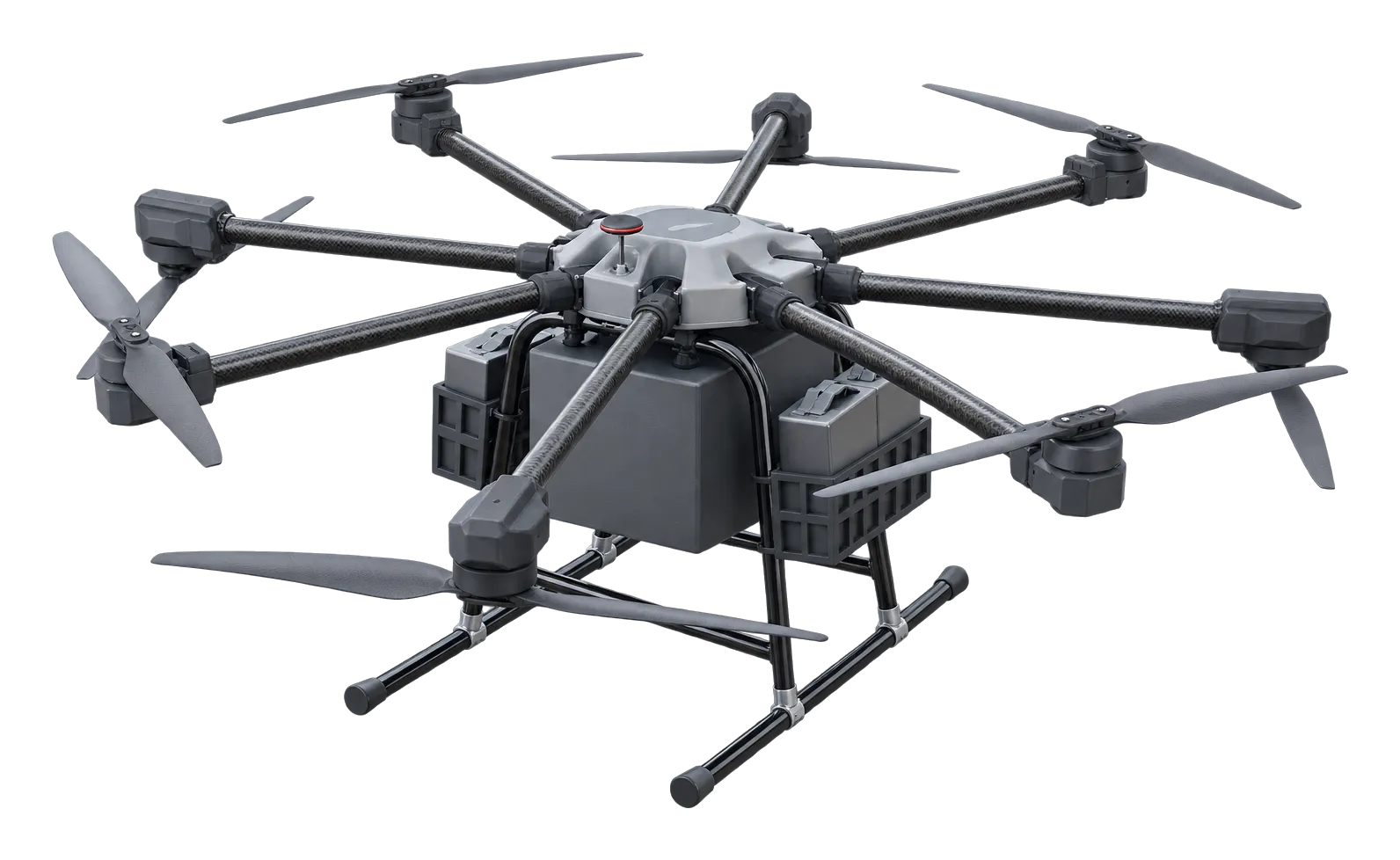
- Best for 3,000 m sites with 60–100 kg pieces: HL-200, 150 kg rated, about 75–85 kg planning load.
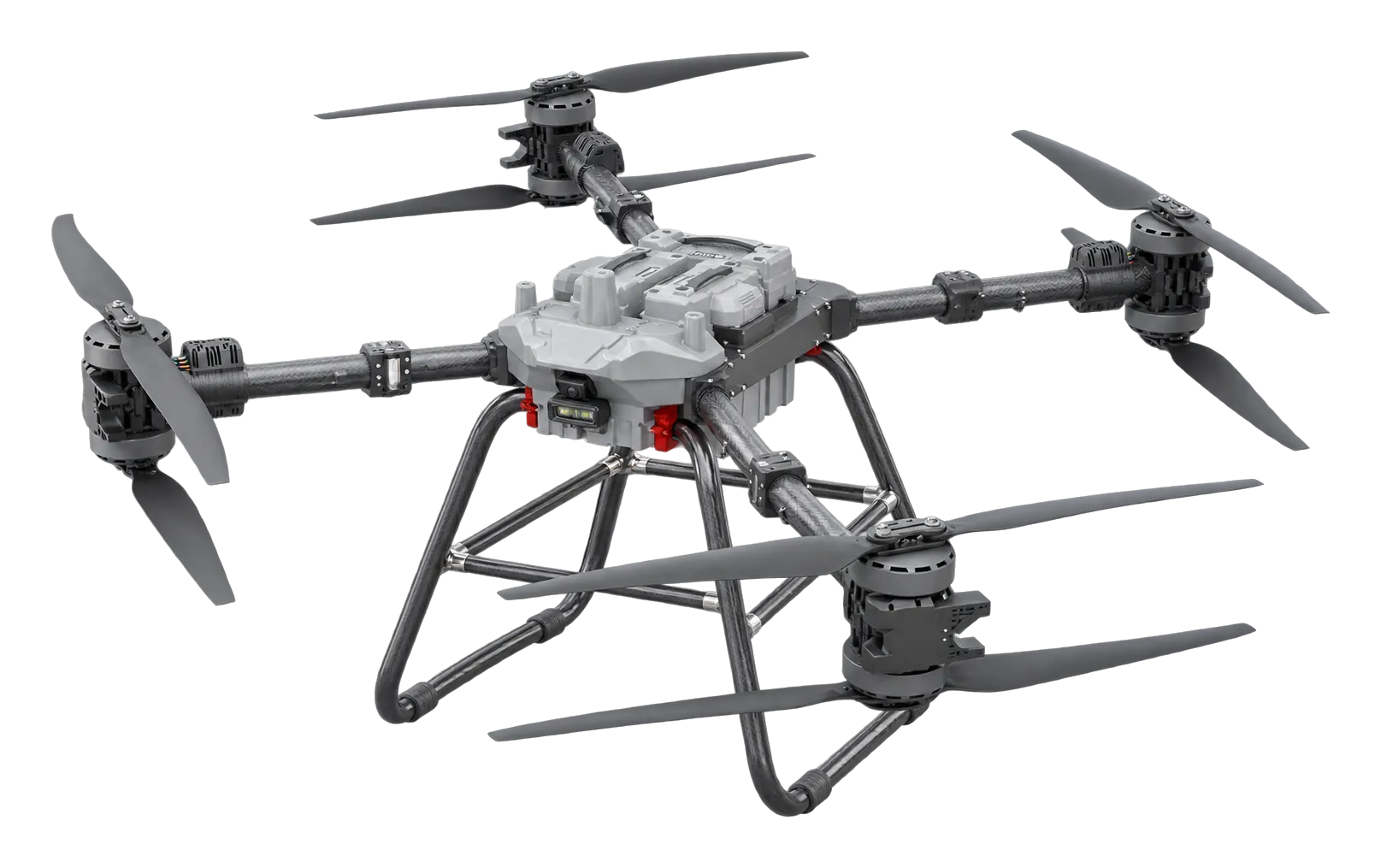
- Best for long supply legs above 2,000 m with light loads: HL-150, about 55–60 kg at 3,000 m.
- Best for loads that stay heavy above 4,000 m: split the load or use a helicopter; see heavy lift drone vs helicopter.
Next step
Send the site altitude, the hottest hour you fly, the heaviest piece and the distance through the contact form; we reply with a load and flight-time plan for the quotation.
Q & A
Common questions
01What type of drone is best for high altitudes?
One with a large thrust margin: a high maximum take-off weight compared with the weight you actually carry. That is why a 333 kg-MTOW aircraft such as the HL-200 keeps more usable load at 3,000 m than a lighter one with the same sea-level rating.
02How much payload do I lose at 3,000 m?
First-order estimates put it at about 25–35 % of the sea-level rating, depending on temperature and the rule used. The real figure comes from the maker's altitude table and a loaded hover test on site.
03What is the highest altitude a cargo drone can fly?
Public specifications for a leading cargo drone list 6,000 m as the maximum flight altitude without payload. Payload capacity falls as take-off height rises, so the useful ceiling with a load is much lower.
04Do batteries work in the cold?
They work but charge slowly and deliver less when cold. Keep sets warm until the flight and charge indoors or in a heated container.
05Can I fly a heavy-lift drone in the Andes or Himalaya?
Technically at many sites, subject to rules. Peru's drone standard NTC 001-2015 covers aircraft up to 25 kg, so heavier aircraft need individual authorisation; check with DGAC Peru. Other countries differ again.
References
- 1Earth Atmosphere Model, metric units — NASA Glenn Research Center
- 2High Density Altitude (Aviation Weather for FAA Air Traffic Controllers) — National Weather Service
- 3DJI Agras T40 specs — DJI
- 4DJI Completes World's First Drone Delivery Tests on Mount Everest — DJI
- 5国内首次采用重载无人机双机联吊运输塔材 (First dual heavy-lift drone tower-steel lift) — China Energy News (People’s Daily)
- 6Pilot's Handbook of Aeronautical Knowledge — Federal Aviation Administration
VEXAFLY Aviation Technology Co., Ltd.. VEXAFLY Aviation Technology Co., Ltd. — industrial drone maker in Nanjing. Our application engineers write and check these pages and configure inspection, cleaning, lift and fire-response systems for project buyers. About VEXAFLY