Heavy lift
Heavy Lift Drone Battery Planning in 2026: Sets per Shift, Charging Power and Generator Size
Heavy lift drone battery planning for 2026: how many sets a shift needs, charger channels, generator kVA, cold charging, cycle life and shipping rules.
- Author
- VEXAFLY Aviation Technology Co., Ltd.
- Scope
- Heavy lift
- Published
- Length
- 5 min read · 6 sources
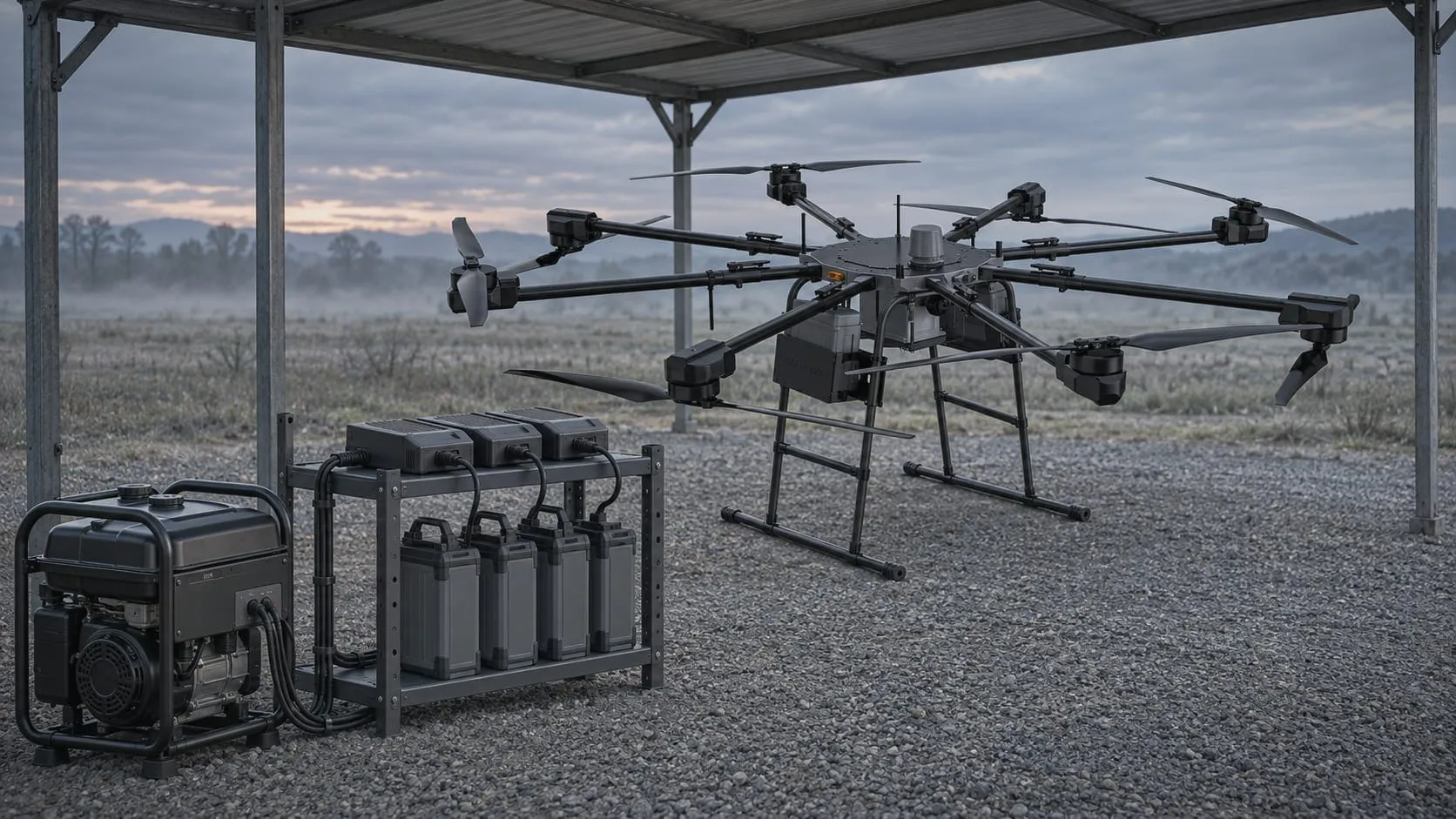
Short answer: for a heavy lift drone battery plan, count sets per shift, not packs. A shift of 80 kg loads over 2.5 km needs about five battery sets, three charger channels and a generator of 55–60 kVA in the example below. The numbers that matter are trips per set, recharge time and charging power; HL battery energy, charge time and cycle life are confirmed in the quotation.
How many battery sets does a shift need?
A crew needs a battery rotation, not just a list of packs. Use this planner, then check it with the example in the next section:
| Job profile | Trips per set | Sets in rotation | Charger channels | Notes |
|---|---|---|---|---|
| Short hops, light load (under 1 km, 20–40 kg) | 4–6 | 3–4 | 1–2 | Many sorties; limit is crew and hook-up time |
| Medium legs, medium load (2–3 km, 60–80 kg) | 2 | 5 | 3 | The worked example |
| Long legs, heavy load (5+ km, 100 kg and above) | 1 | 5–6 | 3–4 | Each trip empties most of a set |
| Remote camp, no mains | Any | As above plus spare | Generator or solar trailer | Size power first |
For reference, a grid operator in Yunnan reports a 200 kg-class drone flying 150 sorties a day over eight hours, on hops of about 300 m. Short hops multiply trips, which is why HL-100 users with large set rotations suit them.
Example: one HL-200 shift at 80 kg
Example (estimate from the HL-200 brochure table; ground time, charge time and reserve are assumptions): 80 kg loads, 2.5 km each way, 1 minute of hover at the drop, 30 % reserve.
| Step | Calculation | Result |
|---|---|---|
| Outbound | 2.5 km at 14.1 m/s = 3.0 min, of 22 min | 13.4 % |
| Hover | 1 min of 22 min | 4.5 % |
| Return (20 kg row as empty-leg proxy) | 2.5 km at 17.1 m/s = 2.4 min, of 40 min | 6.1 % |
| One trip | 24 % | |
| Trips per set | 2 trips = 48 %; 3 trips would be 72 % | 2 |
| Cycle time | 6.4 min flying + 3 min hook-up and swap | 9.4 min, 6.4 trips per hour |
| Sets used | 6.4 ÷ 2 | 3.2 sets per hour |
| One shift | 8 h at 6.4 trips | about 51 trips, 4.1 t |
| Charging | 45 min per set per channel (assumed) = 1.33 sets per hour | 3 channels |
| Sets in rotation | 1 flying + 3 charging + 1 cooling or spare | 5 sets, about 220 kg |
| Generator | 3 × 12 kW = 36 kW ÷ 0.8 = 45 kVA, plus 20 % | 55–60 kVA |
| Wear | 25 set-cycles a day over 5 sets | about 5 cycles per set per day, 1,000 in 200 days |
The 12 kW channel is a public DJI charger rating used as a stand-in, and the 45-minute charge is an assumption. Ask for the actual HL charger power and time.
How much charging power and what generator?
A generator is rated in kVA, a charger in kW. The relation is kW = kVA × power factor, and a factor of 0.8 is a common assumption: 100 kVA is 80 kW. High ambient temperatures may require derating, and DJI states that its generator output is affected by altitude and fuel quality. Public reference points from another maker:
| Item | Published figure | Source |
|---|---|---|
| FlyCart 100 battery | 14.7 kg, 41 Ah, 52 V (about 2.1 kWh) | DJI specs |
| FlyCart 100 charger | 12,000 W on three-phase 380 V; 3,000 W on single-phase 220 V; 30 % to 95 % in 9 min at 15–40 °C | DJI specs |
| FlyCart 100 generator | 11.5 kW DC, 30 L tank, 87 kg | DJI specs |
| FlyCart 30 battery | 38 Ah, 52.2 V, about 1.98 kWh, 11.3 kg | DJI specs |
Fuel check using DJI’s generator figure of 500 mL per kWh: two 2.13 kWh packs charged from 30 % to 95 % need about 2.8 kWh, roughly 1.4 L of petrol, ignoring charger losses.
Grid, generator or battery trailer?
A European heavy-lift operator names batteries as the biggest limitation, prefers charging from the grid when it exists and, in remote places, battery trailers with solar panels, with generators as an option once noise and emissions are considered. Our order is the same: grid, then a trailer, then a generator in a sound-treated enclosure.
How do cold and heat change charging?
Cells charge slowly when cold. DJI’s FlyCart 30 specification allows 1.0C at 5–15 °C and 2.5C at 15–45 °C, with self-heating below 10 °C. In heat, keep sets shaded and let them cool before charging. On a high site, thin air also shortens flights: see the high altitude guide.
How long does a heavy-lift battery last?
We publish no cycle life for the HL aircraft. Ask for the rated number of cycles, the capacity left at the end of that rating and the warranty terms in writing. Retire weak packs as a set rather than mixing old and new. Buy the approved pack configuration from the maker, not a pack with the same capacity that has a different connector.
How do you ship and store batteries?
By air, UN3480 lithium-ion batteries above 100 Wh are forbidden on passenger aircraft; on cargo aircraft the limit is 35 kg net per package, at a state of charge of no more than 30 %, with Class 9 labels and UN-spec packaging. A set of about 44 kg cannot go as one package, so ask how it is split or send it by sea. Each cell type must pass UN 38.3 testing. Read our battery shipping guide and confirm with your forwarder.
Best for …
- Best for short hops with many sorties: HL-100 with a large set rotation, 100 kg rated.
- Best for 80–100 kg over 2–3 km: HL-200, two trips per set at 80 kg in the example.
- Best for remote camps: a generator or solar trailer of at least 45 kVA per three 12 kW channels.
Next step
Send your load, the trip length and the power available on site (phases, kVA) through the contact form. We return a battery-set and charger plan; the aircraft side is in heavy lift drone for sale.
Q & A
Common questions
01How many battery sets does a heavy-lift drone need per shift?
Count the trips one set can fly, the time a set needs to recharge and the time per trip. In our HL-200 example at 80 kg and 2.5 km, one set flies two trips and a shift needs five sets in rotation. Short hops with light loads need fewer.
02What generator do I need to charge on site?
Add the charger channels in kW, divide by a power factor of 0.8 for kVA, and add a margin of about 20 %. Three 12 kW channels (36 kW) give 45 kVA before the margin, so a 55–60 kVA set. Heat and altitude reduce output, so size up.
03Can I charge from single-phase power?
Often at a much lower rate. One public cargo-drone charger delivers 12,000 W on three-phase 380 V but only 3,000 W on single-phase 220 V. Check the charger input options in the quotation.
04How long do heavy-lift batteries last?
We do not publish a cycle life for the HL range, so ask for rated cycles and the capacity left at end of life. At five cycles per set per day, 200 working days is about 1,000 cycles, so the rating matters.
05Can I send heavy-lift batteries by air?
Lithium-ion batteries over 100 Wh are forbidden on passenger aircraft and, on cargo aircraft, are limited to 35 kg net per package at no more than 30 % charge. A 44 kg set must be split or go by sea; confirm with your forwarder.
References
- 1DJI FlyCart 100 specs — DJI
- 2DJI FlyCart 30 specs — DJI
- 3Interactive Guide to Shipping Lithium Batteries (2026) — FAA Office of Hazardous Materials Safety
- 4How to size a generator — Atlas Copco
- 549 CFR 173.185 Lithium cells and batteries — eCFR
- 6Drone vs Crane: The Reality of Heavy Lift Drone Operations — Dronewatch Europe
VEXAFLY Aviation Technology Co., Ltd.. VEXAFLY Aviation Technology Co., Ltd. — industrial drone maker in Nanjing. Our application engineers write and check these pages and configure inspection, cleaning, lift and fire-response systems for project buyers. About VEXAFLY