Cleaning
Drone Solar Panel Cleaning Business in 2026: Customers, Equipment, Water and Approvals
Drone solar panel cleaning business in 2026: customer types, equipment, water logistics and South African (SACAA) approvals, with a note on Australia.
- Author
- VEXAFLY Aviation Technology Co., Ltd.
- Scope
- Cleaning
- Published
- Length
- 3 min read · 8 sources
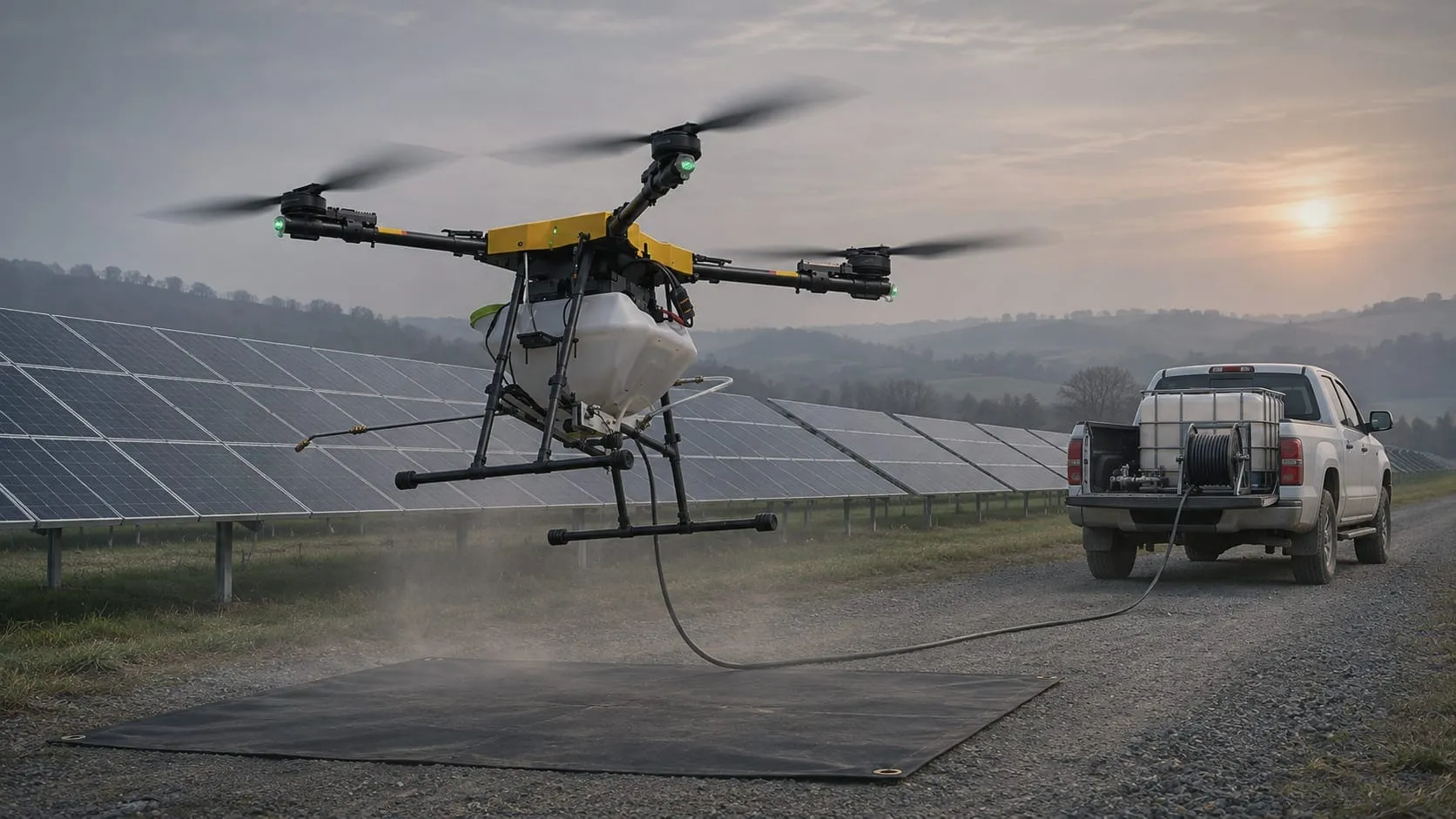
Short answer: in 2026 a drone solar panel cleaning business is worth running where customers cannot clean their panels safely and you control water cost and travel. Chase malls, warehouses, farms, carports and homes with the right aircraft for each, hold every approval your authority requires (in South Africa, five under SACAA Part 101) and price jobs from a measured test clean, not from guesswork.
Which customers should you chase?
| Customer | Array | Aircraft | Water a wash (0.5 L/m², assumption) | Why |
|---|---|---|---|---|
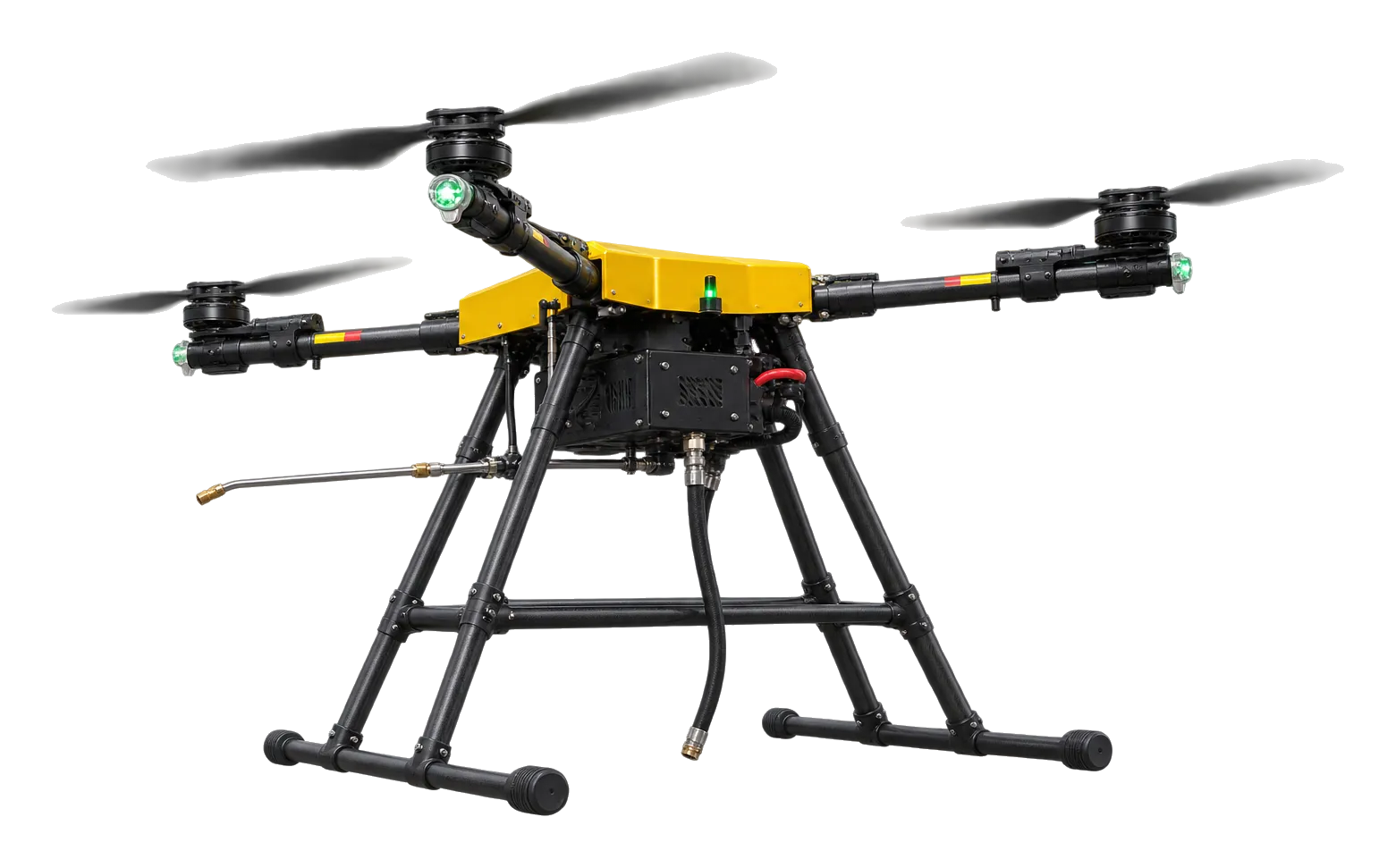
| Household | 6 kW: 11 modules, about 29 m² | CW-30T | 14 L | 30 L tank, no hose over the garden |
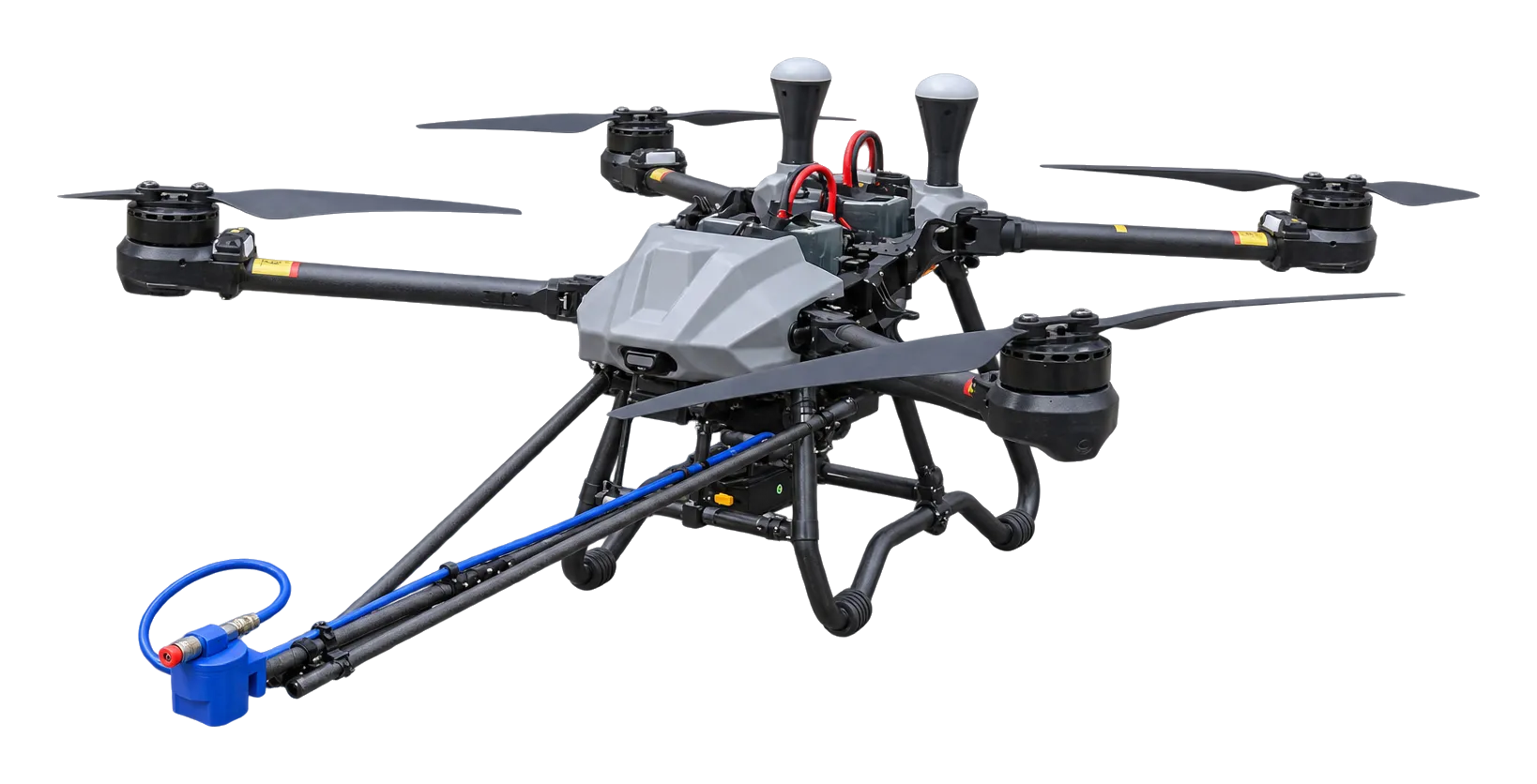
| Mall, warehouse, farm roof | 500 kW in the example below | CW-30P, hose-fed | About 1,180 L | 32 L/min pump, tether |
| Carport over parking | Area-dependent | CW-65 or CW-30P on a tether | Area × 0.5 L/m² | No walkway above the cars; cordon below |
| Utility ground plant | Tens of MW in rows | Crews, tractors, robots | Not drone work | A drone for patches only |
Is a solar panel cleaning business profitable?
It depends on the mix. Use this formula and fill it with your own numbers: monthly profit = jobs × (price − water − chemicals − fuel and travel) − crew time − insurance − depreciation of aircraft and pump. To find the break-even, divide the fixed monthly costs by the margin on one job; the arithmetic is in our rent or buy guide. The value you sell is energy: the IEA puts average global soiling loss at 4–7 %, so show each customer a before and after reading.
What approvals does SACAA require?
Part 101 applies to commercial operations and needs five items:
- ASL, the Air Service Licence.
- UASOC, the operating certificate.
- RLA, the RPAS Letter of Approval for the aircraft.
- RPL, the pilot licence, earned through a SACAA-approved training organisation.
- C of R, the certificate of registration.
Ask SACAA how an aircraft of 60 kg (CW-30) or 111 kg (CW-65) take-off weight is classed before you order. Market conditions and more detail are in our South Africa guide.
How much water do you haul?
Example (assumptions, not a quotation): a 500 kW mall roof of 550 W modules at 2.6 m² each, 0.5 L/m² from a test clean.
| Step | Arithmetic | Result |
|---|---|---|
| Modules | 500,000 ÷ 550 | 909 |
| Glass area | 909 × 2.6 | about 2,360 m² |
| Water a wash | 2,360 × 0.5 | 1,180 L, or 1.2 IBC tanks of 1,000 L |
| Pump time | 1,180 ÷ 32 L/min | 37 min |
| Quarterly contract | 4 × 1,180 | 4,720 L a year |
A single 1,000 L IBC lasts 1,000 ÷ 32 = 31 minutes of continuous spray, so plan a refill route.
What do the module makers allow?
Trina’s Vertex manual allows compressed-water cleaning up to 4 MPa with pH 6–8 water and no cleaning above Beaufort 4; First Solar allows at most 35 bar and pH 6.5–8.5, dusk to dawn. The CW-30P pump is rated 28 MPa, so set the nozzle pressure to the maker’s limit. One drone solar agent is alkaline at pH 11 ± 1, so check any product against the module maker. Some environmental authorisations also limit runoff from solar sites.
What contracts keep the drone busy?
In practice, recurring work: quarterly or half-yearly maintenance washes, a short performance report per visit, and call-outs after dust storms. Recurring work keeps the crew busy and makes the water route repeatable.
What changes in Australia?
The Clean Energy Regulator counted 4 million small-scale renewable systems by December 2024, a large home and business base. An Australian drone-cleaning service says operators need a CASA remote pilot licence and an operator’s certificate; open the CASA pages to confirm before you rely on that. See our Australia guide.
- Best for households: CW-30T, 30 L, no hose over gardens.
- Best for malls, warehouses and farms: CW-30P hose-fed, 32 L/min, the bulk of the 8.3 GW.
- Best for carports over parking: CW-65 or CW-30P on a tether, cordon below, 3–6 m spray.
Next step
Send your first sites, module types and water access, and read the solar panel cleaning price guide and robot versus drone guide. If you plan a service network, see the partner programme.
Q & A
Common questions
01Is a solar panel cleaning business profitable?
It can be, but it depends on customer mix, water access and travel. Profit is the margin on each job times the number of jobs, less fixed costs such as insurance and depreciation. Test one site and price from the measured water and time, not from a guess.
02Can you clean solar panels with a drone?
Yes. A drone sprays and rinses from above without anyone on the array. It does not brush, so cured cement or lichen needs hand work first, and open ground rows are usually better served by crews, tractors or robots.
03Who sells solar panel cleaning drones in South Africa?
We supply the CW-30 and CW-65 factory-direct, FOB China, from one unit. Ask about landed cost, SACAA classification of the aircraft and our partner programme for service operators.
04Do I need a licence to start in South Africa?
Commercial operations need an Air Service Licence, an operating certificate, a letter of approval for the aircraft, a pilot licence and a certificate of registration. Confirm the current requirements with SACAA before you buy.
05How can I clean my own solar panels?
Ask your module maker’s cleaning guideline first: pressure, water quality and timing are limited. For a roof you cannot reach safely, a service using a drone avoids walking on the array.
References
- 1Unmanned Aircraft Systems — South African Civil Aviation Authority
- 2Capacity of rooftop solar installed in South Africa has passed 8 GW mark — Engineering News
- 3Understanding, Measuring, and Mitigating Soiling Losses in PV Power Systems (fact sheet) — IEA PVPS
- 4Drone cleaning where crews can’t reach safely — RenewChem
- 5Vertex Series User Manual — Trina Solar
- 6PV Module Cleaning Guidelines — First Solar
- 7Australia reaches 4 million small-scale renewable energy installations — Clean Energy Regulator
- 8How to become a drone cleaning service provider — WashDrones
VEXAFLY Aviation Technology Co., Ltd.. VEXAFLY Aviation Technology Co., Ltd. — industrial drone maker in Nanjing. Our application engineers write and check these pages and configure inspection, cleaning, lift and fire-response systems for project buyers. About VEXAFLY