Cleaning
Cleaning Drone Specifications in 2026: An RFQ Template and How to Read Each Figure
Cleaning drone specifications in 2026: an RFQ template with CW-30P and CW-65 values, how each figure is measured, IP and wind codes and acceptance tests.
- Author
- VEXAFLY Aviation Technology Co., Ltd.
- Scope
- Cleaning
- Published
- Length
- 5 min read · 7 sources
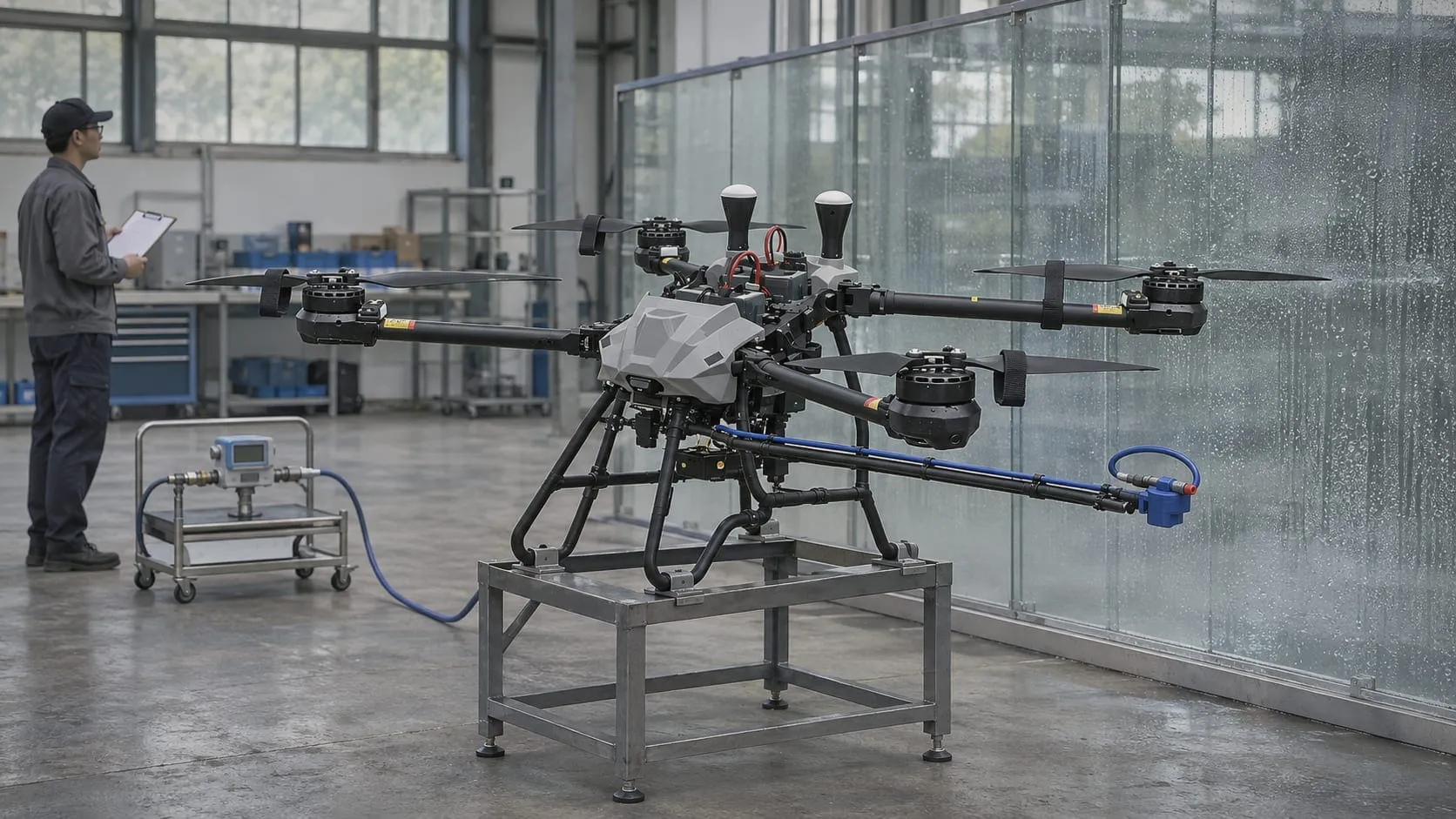
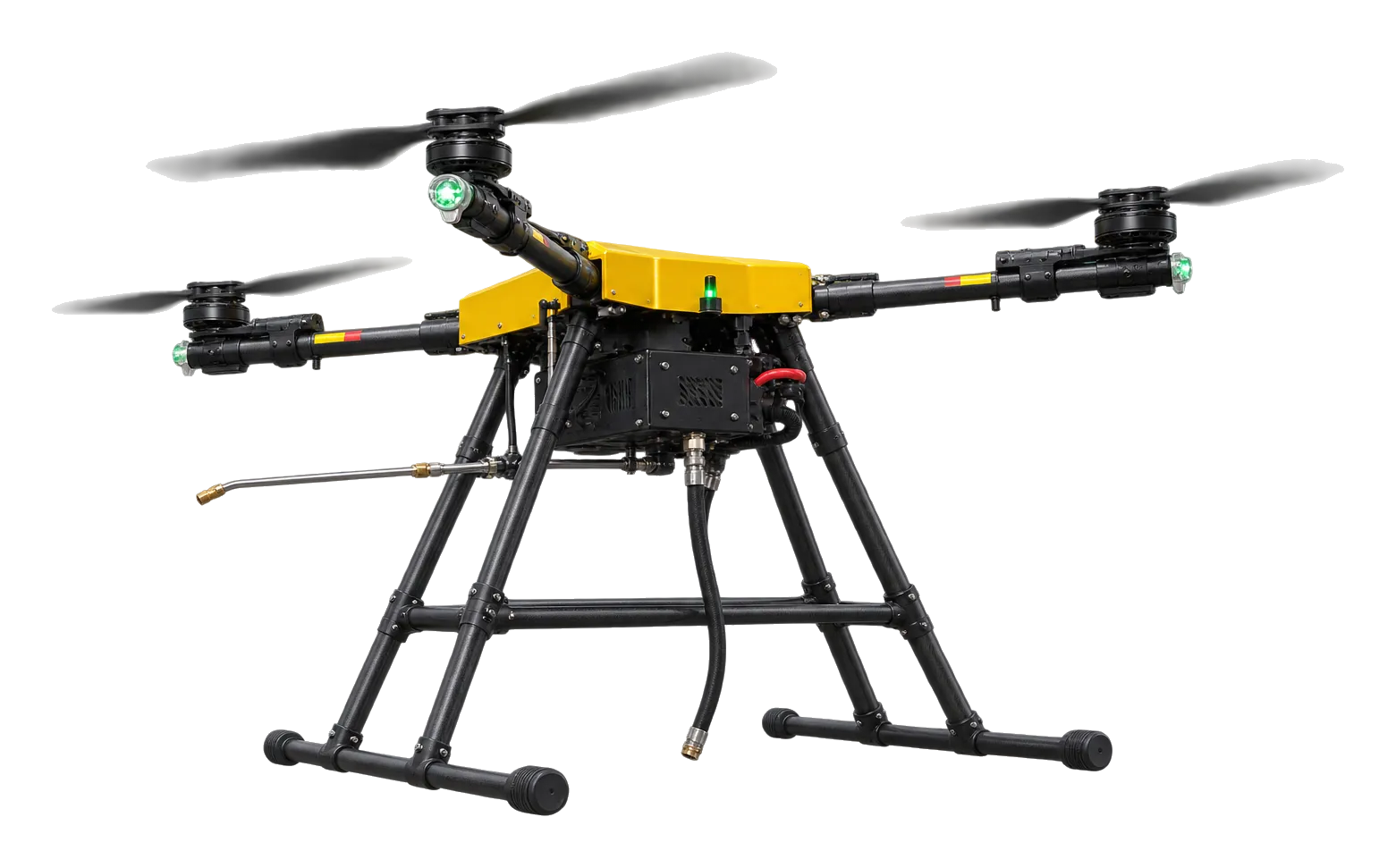
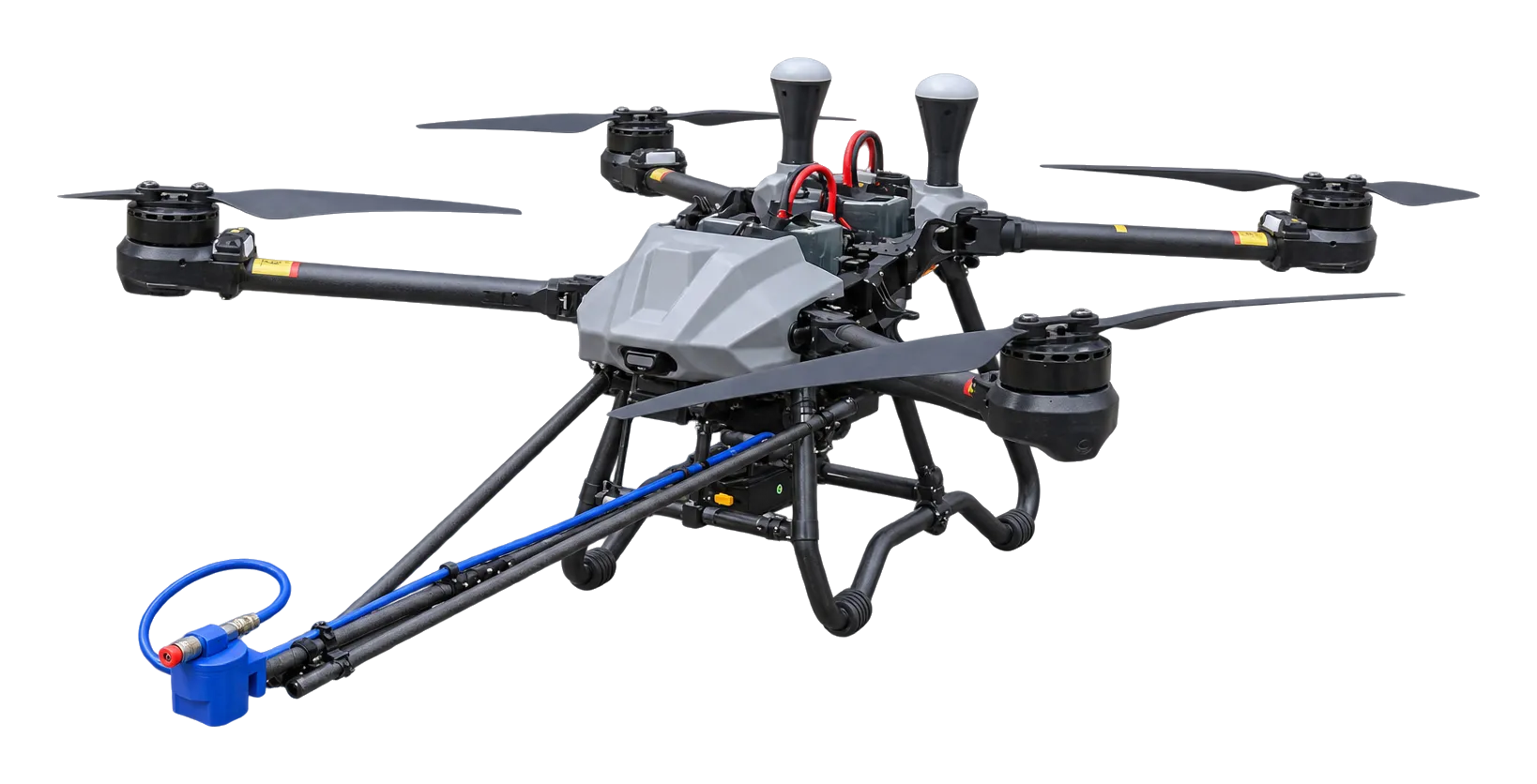
Short answer: in 2026 a useful set of cleaning drone specifications gives each figure with its measurement basis: working height with a named hose, pump and nozzle pressure separately, flight time hovering or spraying, weight with and without water, a wind rating in m/s and an IP test report. The table below fills in the CW-30P and CW-65 reference values from the maker’s brochure.
What should a cleaning-drone spec sheet contain?
| Parameter | Define it as | Verify by | CW-30P | CW-65 |
|---|---|---|---|---|
| Working height | Height at which rated flow still reaches the lance, hose named | Test at full height | ≤ 50 m | ≤ 100 m (max flight altitude) |
| Pump pressure | Maximum at the pump outlet | Gauge at the pump | 28 MPa (4,061 psi) | 5.5 or 13 kW ground unit; ask for the figure |
| Flow | L/min at the pump and at the nozzle | Flow meter | 32 L/min (8.45 US gpm), a separate maximum | Ask for the figure |
| Spray distance | Distance at which the jet cleans, still air | Test panel | 6–10 m (CW-30T: 3–5 m) | 3–6 m |
| Flight time | Battery type; hovering or spraying; tether | Timed spray test | 8–15 min standard, 20–30 extended, tethered unlimited | 7–28 min standard, 20–40 customised, tether no limit |
| Weight | Empty, with battery, maximum take-off | Scale | 21 kg body; 60 kg maximum | 33.4 kg; 55.8 kg with battery; 111 kg maximum |
| Wind rating | Beaufort level and m/s | Maker’s test report | Level 6 | Level 7 |
| IP rating | IEC 60529 code and the report | Report | IP67 | IP67 |
| Lance | Angles and length | Demonstration | Horizontal, 45°, 90° | 1.06 m; 45°, 90°, 180° |
The CW-30 data sheet says wind level 6 and the catalogue says 7. We plan with 6, and a good RFQ asks the supplier to state which document each figure comes from.
What limits working height?
Three things: hose weight, the pressure lost over the height, and the rules. The CW-65 figure is a maximum flight altitude of 100 m, not a promise of nozzle pressure at that height. Ask the supplier to name the hose bore, length and pump setting behind the number. For site set-up see our pump and hose guide.
Pump pressure or nozzle pressure?
Published figures are separate maxima. One US maker lists 4,500 PSI as a maximum and, separately, 12 GPM at 300 PSI for soft wash; another lists up to 6,300 PSI at 6 GPM or 15 GPM at 1,000 PSI (trade press, 2026). Our CW-30P pump lists 28 MPa and 32 L/min; they are never reached at the same time. Ask for the pressure and flow at the nozzle at working height.
Flight time: hover, spray or tether?
Our brochure ranges are in the table. Ask whether the figure was measured hovering or spraying with the hose attached. A tether removes the battery limit, so power and hose become the limit: see the tethered versus tank guide.
How much does the water in the hose weigh?
Example (assumption: a 1/2-inch, 12.7 mm inner-diameter hose, fully hanging from the aircraft):
| Step | Arithmetic | Result |
|---|---|---|
| Cross-section | π × 0.635 cm × 0.635 cm | 1.27 cm² |
| Water per metre | 1.27 cm² × 100 cm = 127 cm³ | 0.127 kg |
| At 50 m | 50 × 0.127 | 6.3 kg, 10.5 % of the CW-30’s 60 kg |
| At 100 m | 100 × 0.127 | 12.7 kg, 11.4 % of the CW-65’s 111 kg |
This is before the hose wall, which is why “maximum working height” must name the hose.
What do wind ratings and IP codes mean?
Beaufort level 6 is 22–27 knots, 11–14 m/s; level 7 is 28–33 knots, 14–17 m/s. In an IP code the first digit covers solids and the second covers water. Digits 5 and 6 are nozzle-jet tests and 7 is temporary immersion between 0.15 m and 1 m, so IP67 is dust-tight plus immersion. Each digit is its own test, so ask which test reports exist for jets rather than assuming.
Which weight class does it fall in?
In the US, Part 107 covers aircraft under 55 lb (25 kg) at take-off. The CW-30 is 60 kg (132 lb) at maximum take-off weight, and the CW-65 is 55.8 kg (123 lb) with its battery and 111 kg (245 lb) at maximum, so both need a Section 44807 route. In the EU, aircraft of 25 kg or more are in the specific category. Tank litres are not payload kilograms: the CW-65 has 111 − 55.8 = 55.2 kg of headroom, so a full 62 L tank, which is 62 kg of water, would exceed it. For a US site, three checks come before an order: the exact model’s FCC Covered List status, the Section 232 duty and FAA approval at 55 lb or more. Your customs broker and the FAA confirm them; see our import guide and FCC guide.
Which acceptance tests before you pay the balance?
- Weigh the aircraft with battery, lance and hose water.
- Spray at full working height and read the pressure at the nozzle.
- Time a flight with the hose attached, on battery and on tether.
- Ask for the wind test report and the IP test reports, including jets.
- Spray a test panel for distance and pattern at each lance angle.
- Check the manual, firmware version and the spare-parts list.
Use the pre-shipment inspection guide for the full routine.
- Best for up to 50 m on a budget: CW-30P, 32 L/min pump, IP67.
- Best for 50–100 m towers: CW-65, 111 kg maximum take-off weight, level 7.
- Best for sites without a hose route: CW-30T, 30 L tank.
Next step
Paste the table into your tender and fill the last two columns with our quotation. For a changed lance or hose length ask about OEM and ODM options.
Q & A
Common questions
01What is a cleaning drone?
A drone with a spray lance that washes glass, facades, roofs, solar panels or insulators, fed by hose from a ground pump or carrying a tank. It sprays and rinses; it does not scrub.
02What are drone specifications?
The measured figures for an aircraft: size, weight, flight time, wind and ingress ratings, plus working height, pump pressure and flow for cleaning drones.
03Why does the CW-30 list wind level 6 and 7?
The data sheet gives level 6 and the catalogue level 7. We plan with the lower figure and confirm it in the quotation.
04What flight time should I expect?
Trade press puts typical cleaning-drone flight time at 15–25 minutes a battery. Ours is 8–15 min (CW-30 standard) and 7–28 min (CW-65 standard); a tether removes the battery limit.
05Is the tank size the payload?
No. Litres and kilograms differ. The CW-65 has a 62 L tank, but it weighs 55.8 kg with its battery against a 111 kg maximum take-off weight, so the fill level is set on the quotation.
References
- 1IEC 60529 Degrees of protection provided by enclosures (IP Code) — IEC
- 2ANSI/IEC 60529-2020 contents and scope — NEMA
- 3Beaufort wind force scale — Met Office
- 4Section 44807: Special Authority for Certain Unmanned Aircraft Systems — FAA
- 5Civil Drones — Specific Category — EASA
- 6Sherpa Cleaning Drone — Lucid Bots
- 7The Best Cleaning Drones on the Market Today: A Complete Buyer’s Guide — Commercial UAV News
VEXAFLY Aviation Technology Co., Ltd.. VEXAFLY Aviation Technology Co., Ltd. — industrial drone maker in Nanjing. Our application engineers write and check these pages and configure inspection, cleaning, lift and fire-response systems for project buyers. About VEXAFLY