Cleaning
Drone Soft Washing in 2026: Which Surfaces, What Pressure, How Long to Dwell
Drone soft washing in 2026: which surfaces take soft wash or pressure wash, the pressure bands in psi and MPa, dwell timing, chemicals and runoff rules.
- Author
- VEXAFLY Aviation Technology Co., Ltd.
- Scope
- Cleaning
- Published
- Length
- 4 min read · 8 sources
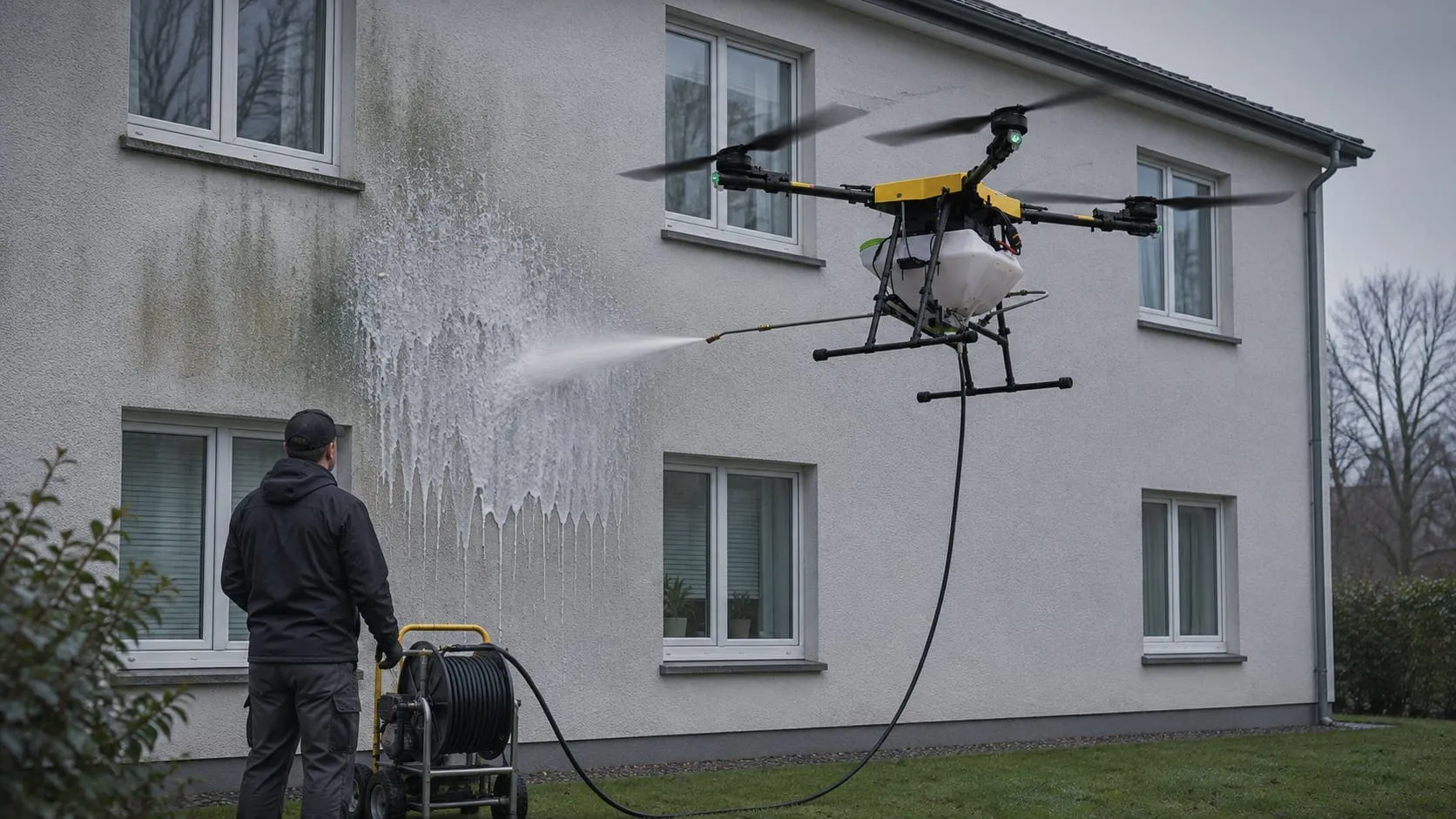
Short answer: in 2026, drone soft washing means spraying a cleaning mix at low pressure, letting it dwell and rinsing, and it suits shingle roofs, painted walls, historic masonry and glass. Trade sources put soft wash under about 600 psi, and the US National Park Service starts masonry at 100 psi or less. The CW-30T works at 116–261 psi; the CW-30P pump is rated 28 MPa (4,061 psi) and is pressure-wash class.
Soft wash or pressure wash: which surface gets which?
| Surface | Method | Pressure band | Source |
|---|---|---|---|
| Asphalt shingle roof | Soft wash: 50:50 bleach and water, 15–20 min dwell, low-pressure rinse | Low; no power washer | ARMA |
| Historic masonry and stone | Water first, then the mildest cleaner that works; test patch; pH strips after the rinse | Start at 100 psi or less; generally no higher than 300–400 psi | National Park Service |
| Painted wall, render, cladding | Soft wash with a mild detergent; test one bay first | Soft-wash band, under about 600 psi | Commercial UAV News (band) |
| Glass | Mild glass agent, short dwell, rinse; see our detergent guide | Soft-wash band | See the guide |
| Solar modules | Water first; the module maker sets the limit | Trina 4 MPa, First Solar 35 bar | Module makers |
| Sound concrete, steel | Pressure wash is possible; test first | 1,500–4,000 psi class | Commercial UAV News (band) |
What pressure counts as “soft”?
| Reference | psi | MPa |
|---|---|---|
| National Park Service: where to start on masonry | 100 or less | 0.7 or less |
| National Park Service: generally no higher | 300–400 | 2.1–2.8 |
| Soft wash, trade press | Typically under 600 | Under 4.1 |
| CW-30T nozzle | 116–261 | 0.8–1.8 |
| One US maker’s soft-wash flow: up to 12 US gpm at 300 psi | 300 | 2.1 |
| Pressure wash, trade press | 1,500–4,000 | 10.3–27.6 |
| CW-30P pump maximum | 4,061 | 28 |
The CW-30P pump also lists 32 L/min (8.45 US gpm). Pressure and flow are separate maxima, never reached at once. For any module, wall or roof, set the nozzle pressure to the surface maker’s limit.
How long must the chemistry dwell, and how do you plan the sorties?
Dwell comes from the product label; the shingle makers’ association uses 15–20 minutes and says not to let the mix dry. Because a battery lasts 8–15 minutes, you can use the dwell: apply one bay, apply the next, then rinse the first.
Example (assumptions, not a quotation): a three-storey painted facade split into three bays, 10 minutes of spraying per CW-30T sortie, 5 minutes to swap batteries and refill.
| Sortie | Minutes | Job |
|---|---|---|
| 1 | 0–10 | Apply to bay A |
| Swap | 10–15 | Battery and tank |
| 2 | 15–25 | Apply to bay B |
| Swap | 25–30 | Battery and tank |
| 3 | 30–40 | Rinse bay A (20 min after its last spray) |
Bay A sits at the top of the 15–20 minute window. If the label or the sun gives less time, split the wall into two bays instead of three.
Does rotor downwash change the result?
Yes. The rotors push air down, and at a wall that air spreads and can carry fine mist sideways. Low pressure makes coarser droplets, which drift less, but it does not remove overspray. Keep the aircraft upwind, shield cars and air intakes, and test one bay before the whole wall. This is practice, not a measured figure.
Which chemicals can go through a drone?
- Read the safety data sheet and the label dilution.
- Send us the product before quoting: we check it against the pump and hose materials.
- Never mix bleach with ammonia or acids: it releases chlorine or chloramine gas.
- Test a bay, then check the pH with strips after the rinse.
- Keep a record of product, ratio, batch and weather.
Do you need approval to spray chemicals?
In the US, Part 107.36 bars carrying hazardous material, and dispensing chemicals falls under Part 137 with separate tracks below and above 55 lb. The CW-30 has a 60 kg (132 lb) maximum take-off weight and the CW-65 111 kg, so see our over-55-pounds guide. Some operators read algaecide mixes as Part 137 products: ask the FAA or an aviation lawyer. In the EU, flights that drop material are specific-category operations.
Where does the runoff go?
Control, contain and capture: San Diego bars polluted wash water from storm drains, with penalties up to US$10,000 per day per incident, and suggests biodegradable, phosphate-free products and wet-vacuum recovery. For roofs, see our roof cleaning guide.
Tank, hose or tether for soft washing?
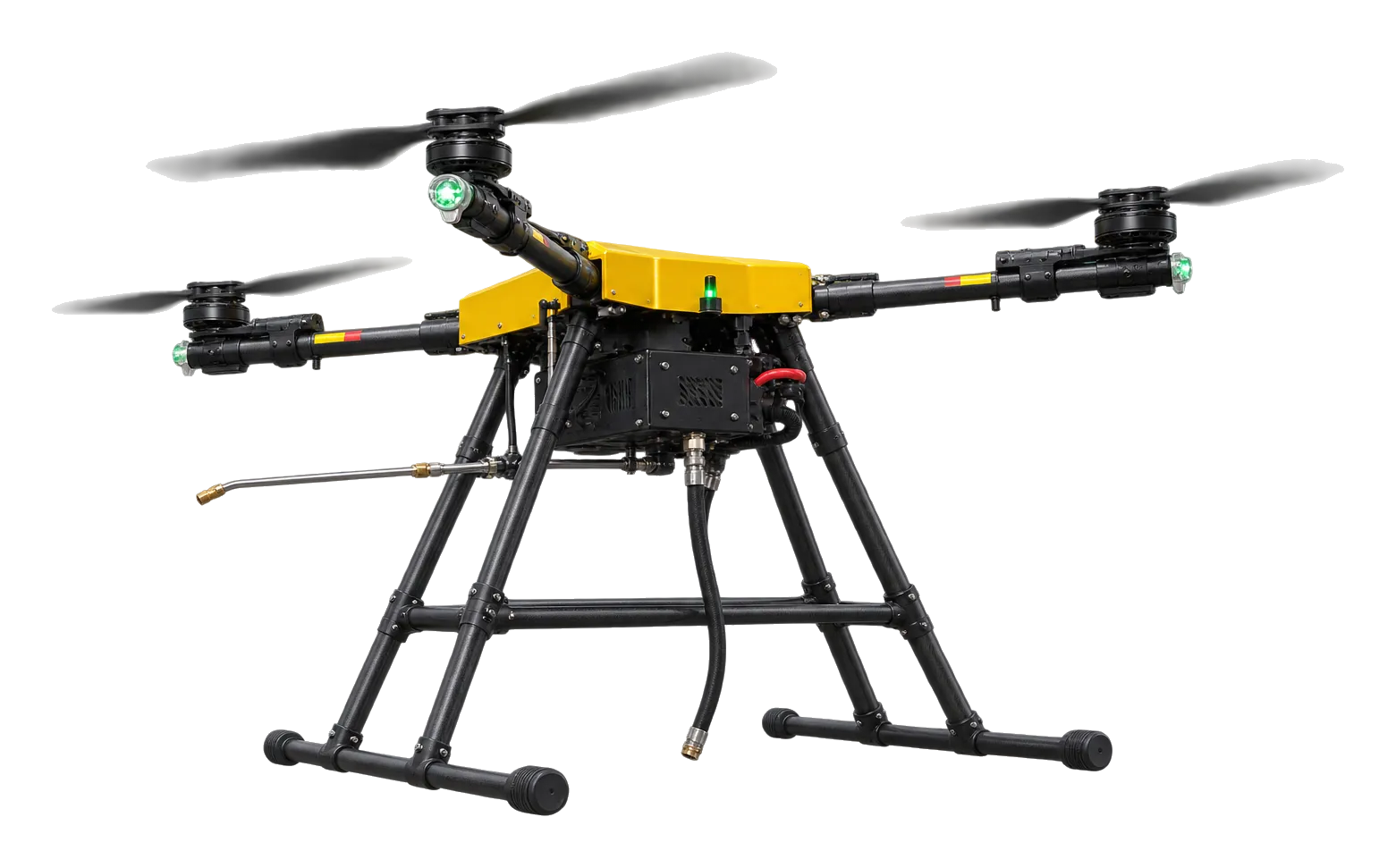
- Best for soft wash on mid-rise walls: CW-30T, 116–261 psi, 30 L, 3–5 m throw.
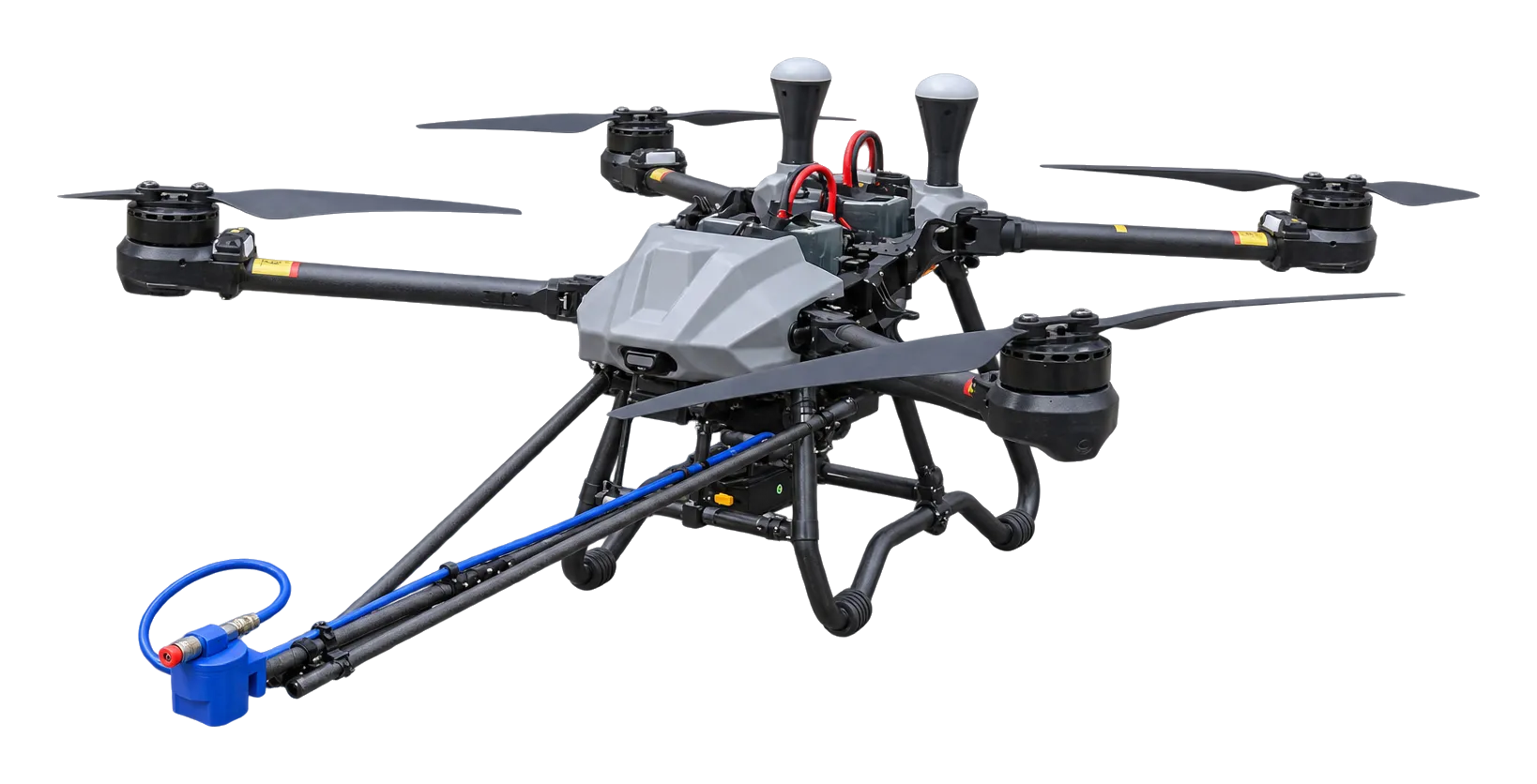
- Best for concrete and pressure work: CW-30P, 28 MPa pump, 6–10 m throw, hose-fed.
- Best for long soft-wash days on one building: CW-65 on a tether, no flight-time limit, 3–6 m spray range.
Next step
Tell us the surfaces, the product and the building height. For window-height work read the window cleaning safety guide next, then ask for a quotation at contact.
Q & A
Common questions
01Is soft washing worth it?
For roofs, painted walls, render and historic stone, yes: low pressure protects the surface and the chemistry does the cleaning. For sound concrete or steel, a pressure wash may fit better. The surface and the maker’s guidance decide.
02Do window washing drones exist?
Yes. Hose-fed and tank cleaning drones wash glass facades from the outside. See our selection guide for facade cleaning drones for height and water supply.
03What is drone propwash?
It is the downward air from the rotors. Near a wall it spreads and can carry fine mist sideways. Coarse, low-pressure droplets drift less than a fine mist, so soft washing helps; test a bay and spray from the upwind side.
04What does a drone soft-wash service charge?
That depends on roof or wall area, access and the product, and we publish no service rate. For equipment, reference FOB China prices run US$4,500–10,600 for the CW-30 range and US$11,300–16,000 for the CW-65, with pump, freight and training extra.
05Can I spray bleach through a drone?
Only if the pump, hose and seals are compatible and the product’s safety data sheet allows it. Send us the agent before quoting. Never mix bleach with ammonia or acids.
06Do I need FAA approval to spray chemicals?
In the US, dispensing chemicals falls under Part 137, with separate tracks below and above 55 lb. Ask the FAA or an aviation lawyer how your mix is classed. In the EU, spraying is a specific-category operation.
References
- 1Preservation Brief 1: Cleaning and Water-Repellent Treatments for Historic Masonry Buildings — US National Park Service
- 2Algae & Moss Prevention and Cleaning for Asphalt Roofing Systems — Asphalt Roofing Manufacturers Association
- 3Dispensing Chemicals and Agricultural Products (Part 137) with UAS — FAA
- 4The Best Cleaning Drones on the Market Today: A Complete Buyer’s Guide — Commercial UAV News
- 5Sherpa Cleaning Drone — Lucid Bots
- 6Pressure Washing fact sheet — City of San Diego
- 7Vertex Series User Manual — Trina Solar
- 8PV Module Cleaning Guidelines — First Solar
VEXAFLY Aviation Technology Co., Ltd.. VEXAFLY Aviation Technology Co., Ltd. — industrial drone maker in Nanjing. Our application engineers write and check these pages and configure inspection, cleaning, lift and fire-response systems for project buyers. About VEXAFLY