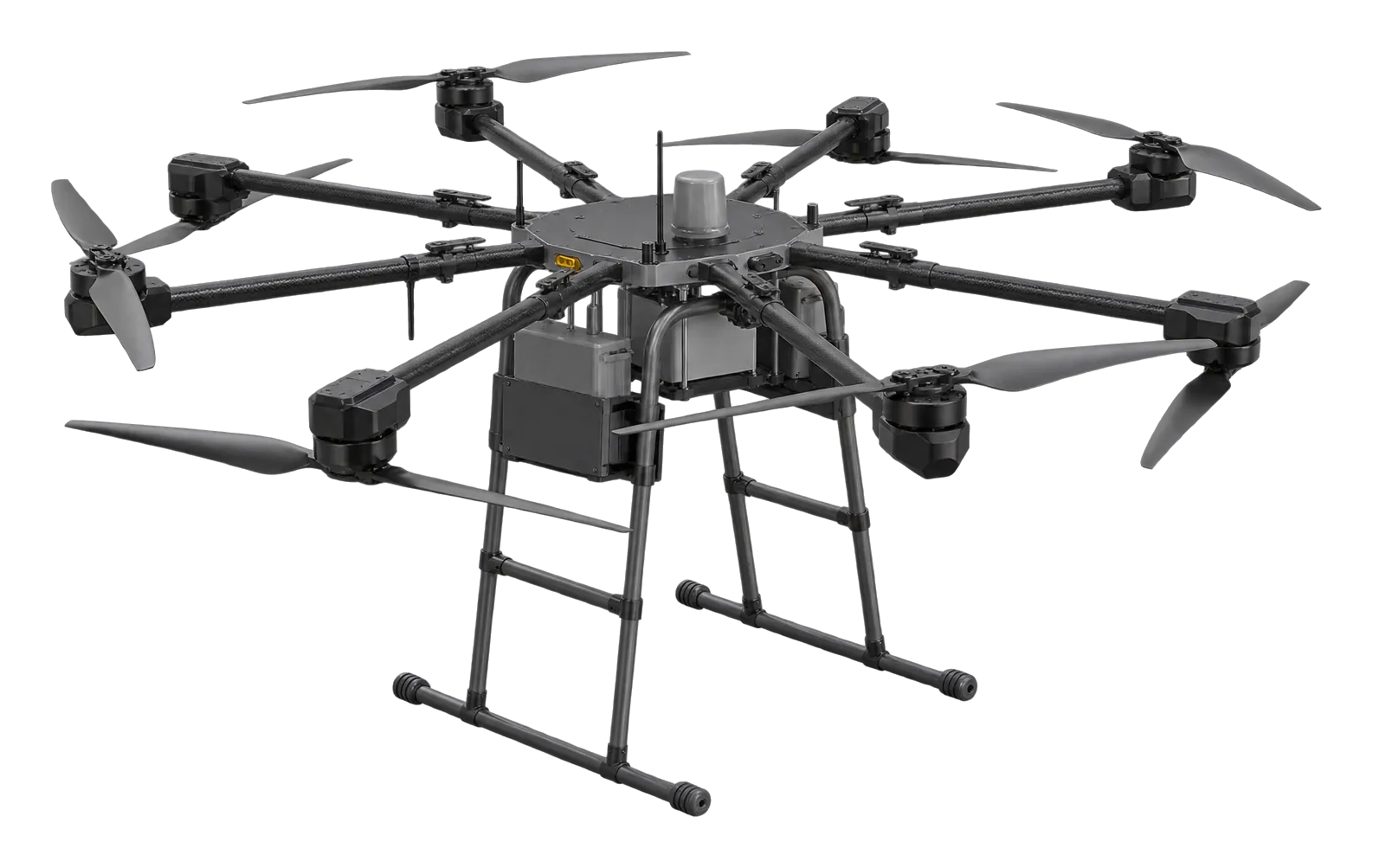
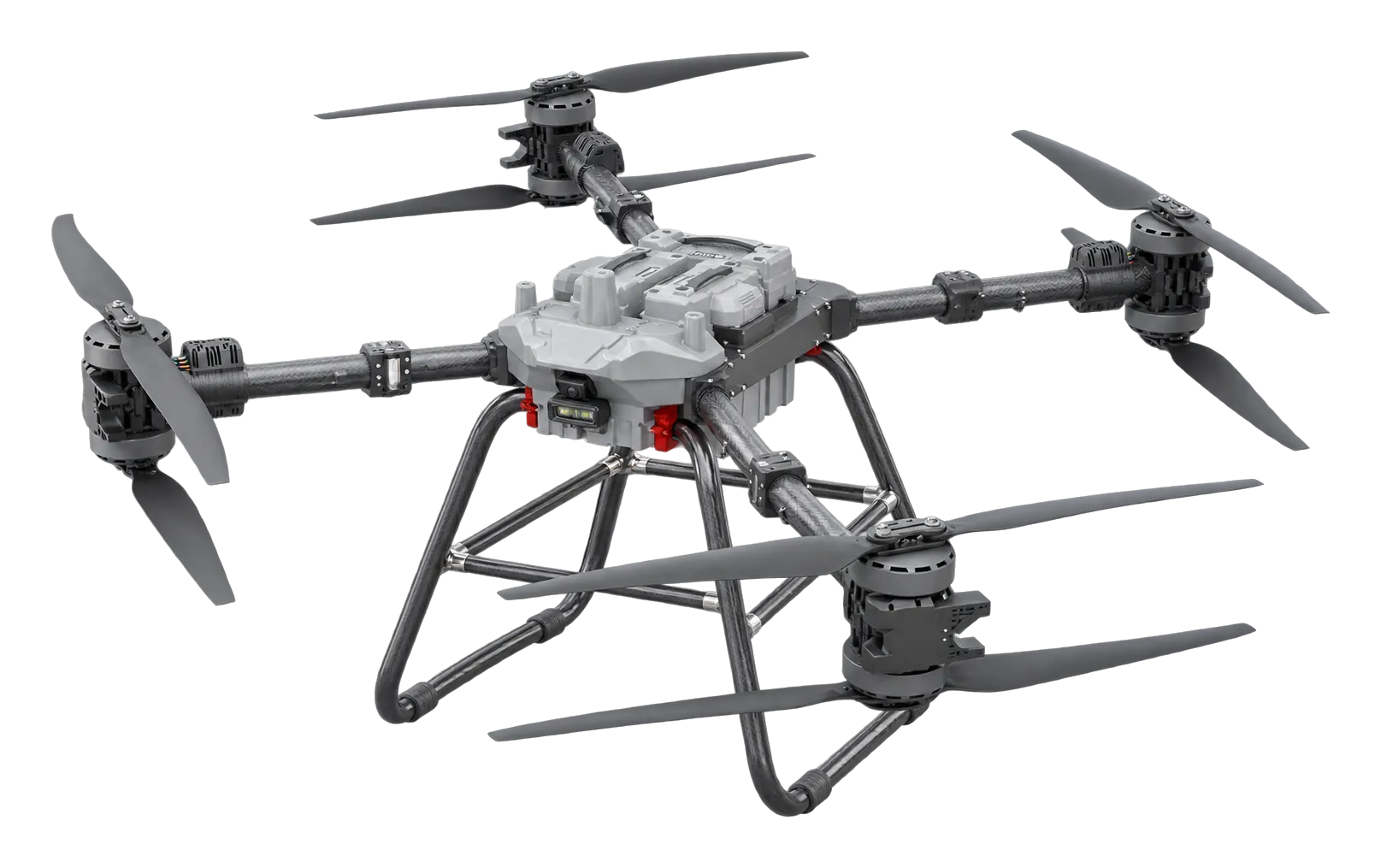
Heavy lift
Drone Sling Load in 2026: Hook, Winch or Cargo Box, and How Long the Rope Should Be
Drone sling load in 2026: hook vs winch vs cargo box, rope length and swing, release methods and a load-securing checklist for heavy-lift drones.
- Author
- VEXAFLY Aviation Technology Co., Ltd.
- Scope
- Heavy lift
- Published
- Length
- 5 min read · 6 sources
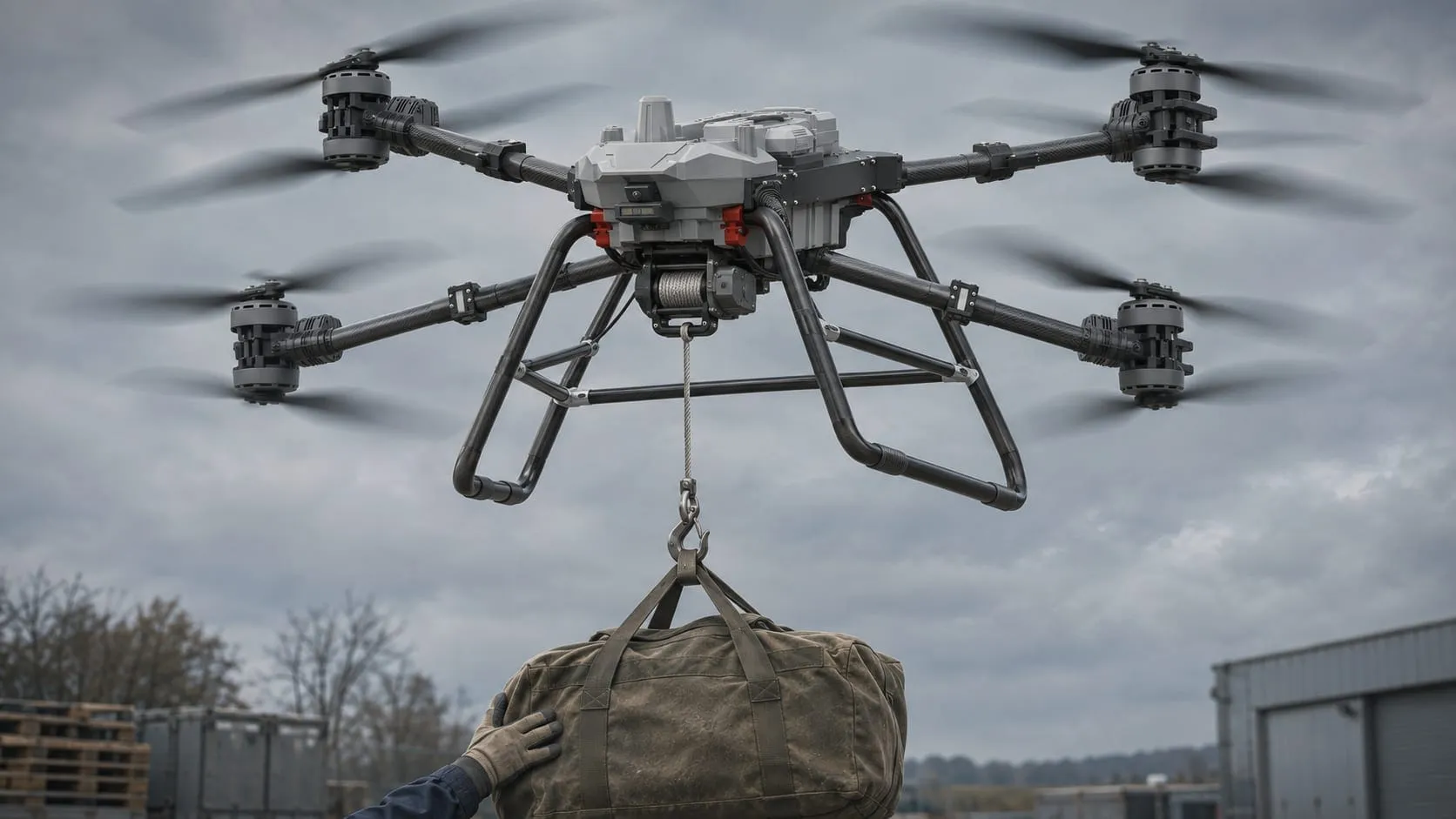
Short answer: a drone sling load is a hanging load on a line, and the right way to carry it depends on where it lands. In 2026 the working rule is: hook and sling for open ground, a winch to lower loads onto roofs, decks or between trees, and a cargo frame for many small items. Keep the rope as short as the site allows, because swing adds force on the hook.
Hook, winch or cargo box: which one for your drop?
Pages that rank for this topic are research news, a forum thread and a patent list. None compares carrying methods. Start with the drop zone:
| Drop zone | Load type | Method | Who is at the drop | HL set-up |
|---|---|---|---|---|
| Open ground, road, pad | Compact, heavy, one piece | Hook and sling | Receiver unhooks | HL-200 hook and sling, 150 kg rated |
| Roof, deck, scaffold | Medium load, nobody can stand under | Winch lowering | Receiver at the landing point | Winch rating on quotation |
| Between trees or on a slope | Awkward load, no landing space | Long line or winch | Spotter nearby | Rope length set by canopy |
| Many small items to one site | Boxes, tools, bags | Cargo frame | Receiver empties frame | HL-100 cargo frame |
| Any, load must be watched | Fragile, high value | Camera on the load | Pilot sees the hook | HL-100 camera pod, HL-200 FPV camera |
Hook and winch ratings for the HL range are not published; they are confirmed in the quotation. As a public reference, DJI lists a 20 m winch cable on its FlyCart 30 with a maximum retraction speed of 0.8 m/s, swing control, cable-cut protection and touchdown release.
How long should the sling be?
A load on a rope is a pendulum. Its swing period depends on rope length only, T = 2π√(L/g), not on the weight of the load. Sideways offset depends on how hard the aircraft brakes:
| Rope length | Swing period | Offset at 1.5 m/s² braking (8.7°) | Offset at 3 m/s² braking (17°) |
|---|---|---|---|
| 5 m | 4.5 s | 0.8 m | 1.5 m |
| 10 m | 6.3 s | 1.5 m | 2.9 m |
| 15 m | 7.8 s | 2.3 m | 4.4 m |
| 20 m | 9.0 s | 3.0 m | 5.8 m |
| 30 m | 11.0 s | 4.5 m | 8.8 m |
Longer ropes keep the load further from rotor wash and tree tops, but swing slowly and wide. A maker’s public recommendation for a 100 kg-class cargo drone is 10–15 m of cable. Choose the shortest rope that clears the canopy and the people below.
Why do slung loads swing and spin?
FAA helicopter guidance (AC 133-1B) notes that low-density light loads tend to shift aft and become unstable: they may flutter, oscillate or rotate, and reducing forward speed usually steadies them. Crews report the same on drones: a load that flies steady at cruise starts to swing when the aircraft slows for the approach. A European heavy-lift operator describes the correction as moving with the swing rather than steering against it, and assesses flexible or asymmetrical loads such as cables and hoses one by one. A swivel between hook and load stops spin from twisting the line.
How much extra force does a swinging load put on the hook?
Example (physics estimate, not maker data): a 90 kg pallet hangs on a 15 m sling. The aircraft brakes at 3 m/s², so the line swings out to 17°. At the bottom of the swing the line tension is m·g·(3 − 2 cos θ), which is 1.09 times the static weight, about 98 kg-force. A 30° swing gives 1.27 times, about 114 kg-force, above the 100 kg rating of an HL-100. Braking gently at about 1 m/s² gives a 5.8° swing and a 1.5 m offset on 15 m of rope. The lesson: plan soft stops, and rate the hook for the swing, not for the pallet.
How are loads released?
- Electric release from the controller, ideally needing a deliberate two-step action. Helicopter practice requires a quick-release that needs two distinct movements.
- Winch with cable-cut: if the load snags, the line is cut so the aircraft is not pulled down.
- Touchdown release: the hook opens when the load is set down and the line goes slack.
- Manual hook at the drop, when a person safely receives the load.
When a hook and ring are briefly unloaded at touchdown, the ring can flip over the hook tip and rest on the spring keeper, a known hazard described in AC 133-1B. Check the hook closes with load before every lift.
Load-securing checklist
- Weigh the load; do not trust the label.
- Use rigging that is rated and marked with its safe working load, and never load it above that (OSHA 1926.251).
- Inspect slings and gear before each shift; remove defective items. No hooks made from bolts or rods.
- Put loose items in nets or bags and close them; no open crates.
- Add a swivel for loads that spin and a tag with the sling’s rated load.
- Watch the load: HL-100 has a camera pod, HL-200 an FPV camera.
- Name one person at the drop with a stop signal, and keep everyone else clear of the line of travel.
- Rope length chosen from the pendulum table, not by feel.
Best for …
- Best for compact loads to open ground: hook and sling on the HL-200, 150 kg rated.
- Best for drops onto roofs, decks or between trees without landing: winch-type lowering; ask us for its rating.
- Best for many small items per trip: HL-100 with the cargo frame, 100 kg rated.
Next step
Tell us the heaviest item, the drop surface and the rope length you expect through the contact form. We reply with a rigging suggestion. Related field work: construction site delivery and power line stringing.
Q & A
Common questions
01What drone can carry a 30 kg payload?
Several. DJI lists the FlyCart 30 at 30 kg on a winch with two batteries and 40 kg with one. For heavier or bulkier loads, our HL-100 is rated 100 kg and the HL-200 150 kg, both with hook and sling release.
02How long should the rope be?
As short as clears trees, people and rotor wash. A maker's public recommendation for a lifting system on a 100 kg-class aircraft is 10–15 m of cable. Every extra metre adds swing time and sideways offset.
03Why does my load spin in flight?
Light, low-density loads move aft and can flutter, oscillate or rotate, according to FAA helicopter guidance. Slow down, add a swivel between hook and load, and fit a stabilising fin or heavier compact package where possible.
04Can the drone release the load automatically?
Release can be electric from the controller, by touchdown release on a winch, or manual at the drop. Release type and rating for each HL aircraft are confirmed in the quotation; we only state hook and sling release.
05What happens if the load snags?
A quick-release that needs two distinct movements, and a way to jettison fast, are the rules in helicopter practice. Plan the drop zone so the released line cannot catch on trees, wires or roofs, and keep people out of the line of travel.
06Is approval needed for flying a hanging load?
Usually, and the load method is part of the application. Describe the hook, rope length and release in your operations manual. For a US operation, an aircraft of 55 lb or more is handled through the FAA; elsewhere ask your aviation authority.
References
- 1AC 133-1B Rotorcraft External-Load Operations — Federal Aviation Administration
- 21926.251 Rigging equipment for material handling — OSHA
- 3DJI FlyCart 30 specs — DJI
- 4Simple pendulum — HyperPhysics, Georgia State University
- 5Drone vs Crane: The Reality of Heavy Lift Drone Operations — Dronewatch Europe
- 614 CFR 107.23 Hazardous operation — eCFR / FAA
VEXAFLY Aviation Technology Co., Ltd.. VEXAFLY Aviation Technology Co., Ltd. — industrial drone maker in Nanjing. Our application engineers write and check these pages and configure inspection, cleaning, lift and fire-response systems for project buyers. About VEXAFLY